


Evaluation of respiratory syncytial virus group A and B genotypes among nosocomial and community-acquired pediatric infections in Southern Brazil
- PMID: 24564922
- PMCID: PMC3996061
- DOI: 10.1186/1743-422X-11-36
Evaluation of respiratory syncytial virus group A and B genotypes among nosocomial and community-acquired pediatric infections in Southern Brazil
Abstract
Background: Respiratory syncytial virus (RSV) is the main cause of lower respiratory tract illness in children worldwide. Molecular analyses show two distinct RSV groups (A and B) that comprise different genotypes. This variability contributes to the capacity of RSV to cause yearly outbreaks. These RSV genotypes circulate within the community and within hospital wards. RSV is currently the leading cause of nosocomial respiratory tract infections in pediatric populations. The aim of this study was to evaluate the G protein gene diversity of RSV amplicons.
Methods: Nasopharyngeal aspirate samples were collected from children with nosocomial or community-acquired infections. Sixty-three RSV samples (21 nosocomial and 42 community-acquired) were evaluated and classified as RSV-A or RSV-B by real-time PCR. Sequencing of the second variable region of the G protein gene was performed to establish RSV phylogenetics.
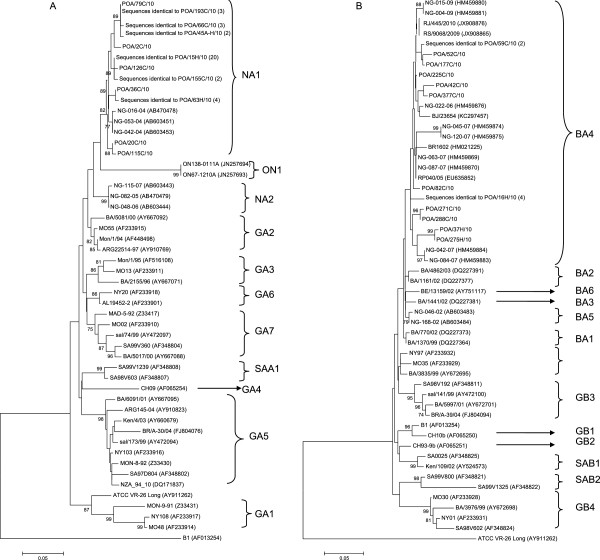
Results: We observed co-circulation of RSV-A and RSV-B, with RSV-A as the predominant group. All nosocomial and community-acquired RSV-A samples were from the same phylogenetic group, comprising the NA1 genotype, and all RSV-B samples (nosocomial and community-acquired) were of the BA4 genotype. Therefore, in both RSV groups (nosocomial and community-acquired), the isolates belonged to only one genotype in circulation.
Conclusions: This is the first study to describe circulation of the NA1 RSV genotype in Brazil. Furthermore, this study showed that the BA4 genotype remains in circulation. Deciphering worldwide RSV genetic variability will aid vaccine design and development.
Figures
References
-
- Peret TC, Hall CB, Schnabel KC, Golub JA, Anderson LJ. Circulation patterns of genetically distinct group A and B strains of human respiratory syncytial virus in a community. J Gen Virol. 1998;79:2221–2229. - PubMed
Publication types
MeSH terms
Substances
Associated data
- Actions
- Actions
- Actions
- Actions
- Actions
- Actions
- Actions
- Actions
- Actions
- Actions
- Actions
- Actions
- Actions
- Actions
- Actions
- Actions
- Actions
- Actions
- Actions
- Actions
- Actions
- Actions
- Actions
- Actions
- Actions
- Actions
- Actions
- Actions
- Actions
- Actions
- Actions
- Actions
- Actions
- Actions
- Actions
- Actions
- Actions
- Actions
- Actions
- Actions
- Actions
- Actions
- Actions
- Actions
- Actions
- Actions
- Actions
- Actions
- Actions
- Actions
- Actions
- Actions
- Actions
- Actions
- Actions
LinkOut - more resources
Full Text Sources
Other Literature Sources
Medical
