


Variability in the common genetic architecture of social-communication spectrum phenotypes during childhood and adolescence
- PMID: 24564958
- PMCID: PMC3940728
- DOI: 10.1186/2040-2392-5-18
Variability in the common genetic architecture of social-communication spectrum phenotypes during childhood and adolescence
Abstract
Background: Social-communication abilities are heritable traits, and their impairments overlap with the autism continuum. To characterise the genetic architecture of social-communication difficulties developmentally and identify genetic links with the autistic dimension, we conducted a genome-wide screen of social-communication problems at multiple time-points during childhood and adolescence.
Methods: Social-communication difficulties were ascertained at ages 8, 11, 14 and 17 years in a UK population-based birth cohort (Avon Longitudinal Study of Parents and Children; N ≤ 5,628) using mother-reported Social Communication Disorder Checklist scores. Genome-wide Complex Trait Analysis (GCTA) was conducted for all phenotypes. The time-points with the highest GCTA heritability were subsequently analysed for single SNP association genome-wide. Type I error in the presence of measurement relatedness and the likelihood of observing SNP signals near known autism susceptibility loci (co-location) were assessed via large-scale, genome-wide permutations. Association signals (P ≤ 10-5) were also followed up in Autism Genetic Resource Exchange pedigrees (N = 793) and the Autism Case Control cohort (Ncases/Ncontrols = 1,204/6,491).
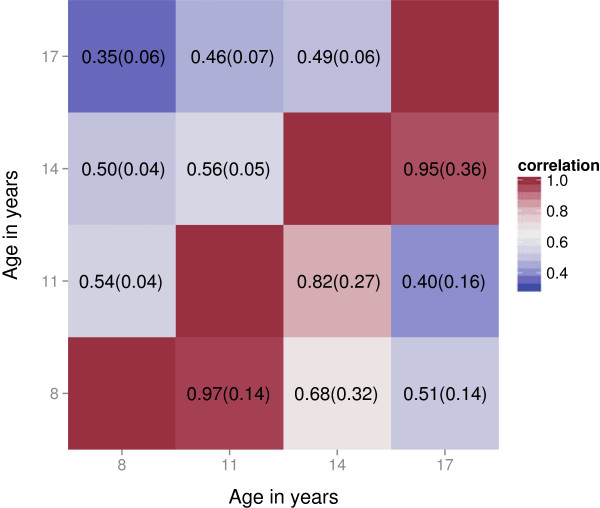
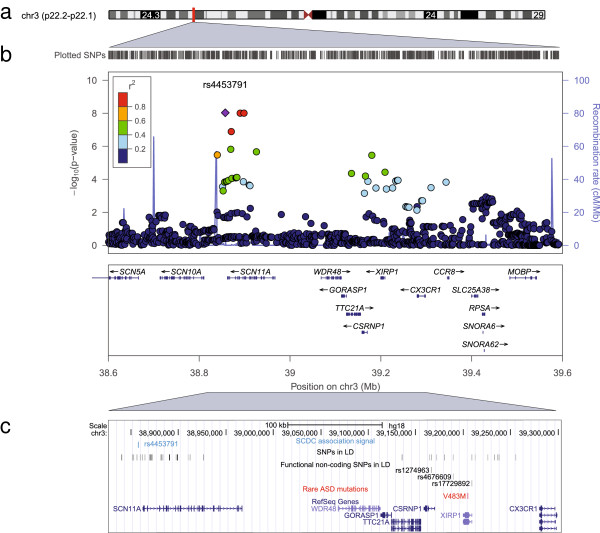
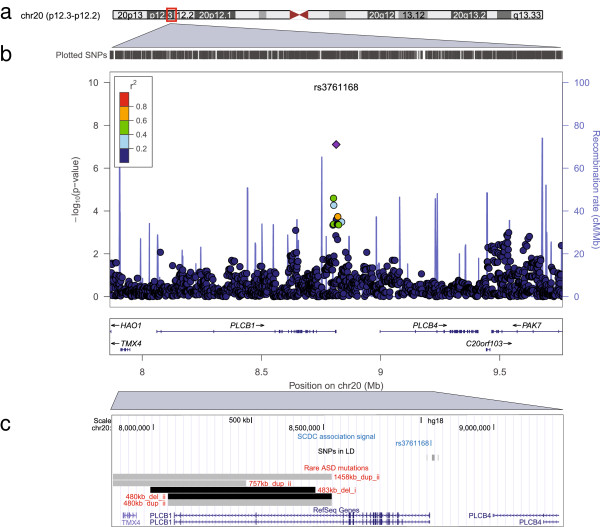
Results: GCTA heritability was strongest in childhood (h2(8 years) = 0.24) and especially in later adolescence (h2(17 years) = 0.45), with a marked drop during early to middle adolescence (h2(11 years) = 0.16 and h2(14 years) = 0.08). Genome-wide screens at ages 8 and 17 years identified for the latter time-point evidence for association at 3p22.2 near SCN11A (rs4453791, P = 9.3 × 10⁻⁹; genome-wide empirical P = 0.011) and suggestive evidence at 20p12.3 at PLCB1 (rs3761168, P = 7.9 × 10⁻⁸; genome-wide empirical P = 0.085). None of these signals contributed to risk for autism. However, the co-location of population-based signals and autism susceptibility loci harbouring rare mutations, such as PLCB1, is unlikely to be due to chance (genome-wide empirical Pco-location = 0.007).
Conclusions: Our findings suggest that measurable common genetic effects for social-communication difficulties vary developmentally and that these changes may affect detectable overlaps with the autism spectrum.
Figures
References
-
- Wing L. In: Diagnosis and Assessment in Autism. Schopler E, Mesibov G, editor. New York: Plenum; 1988. The continuum of autistic characteristics; pp. 91–110.
-
- American Psychiatric Association. Diagnostic and statistical manual of mental disorders. 5. Arlington, VA: American Psychiatric Publishing; 2013.
-
- Piven J, Palmer P, Jacobi D, Childress D, Arndt S. Broader autism phenotype: evidence from a family history study of multiple-incidence autism families. Am J Psychiatry. 1997;154:185–190. - PubMed
Grants and funding
LinkOut - more resources
Full Text Sources
Other Literature Sources
