


From strategy to action: how top managers' support increases middle managers' commitment to innovation implementation in health care organizations
- PMID: 24566252
- PMCID: PMC4141032
- DOI: 10.1097/HMR.0000000000000018
From strategy to action: how top managers' support increases middle managers' commitment to innovation implementation in health care organizations
Abstract
Background: Evidence suggests that top managers' support influences middle managers' commitment to innovation implementation. What remains unclear is how top managers' support influences middle managers' commitment. Results may be used to improve dismal rates of innovation implementation.
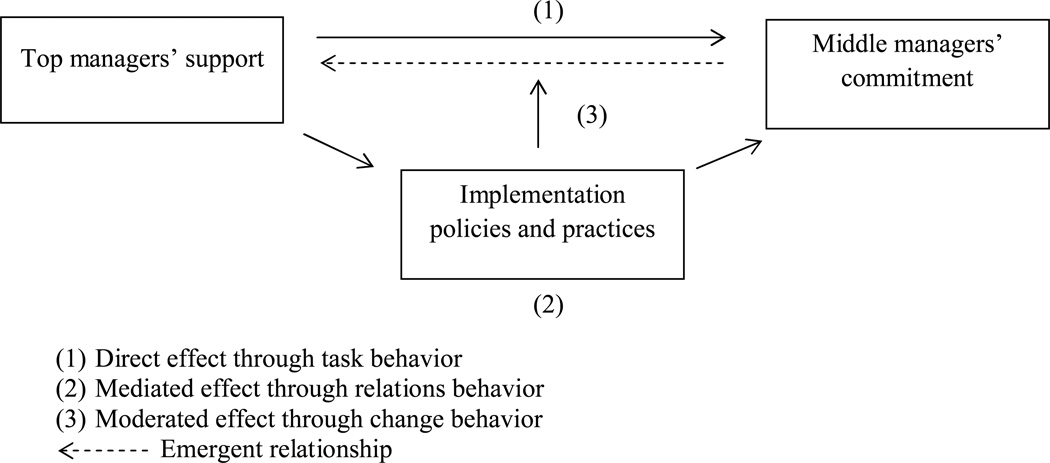
Methods: We used a mixed-method sequential design. We surveyed (n = 120) and interviewed (n = 16) middle managers implementing an innovation intended to reduce health disparities in 120 U.S. health centers to assess whether top managers' support directly influences middle managers' commitment; by allocating implementation policies and practices; or by moderating the influence of implementation policies and practices on middle managers' commitment. For quantitative analyses, multivariable regression assessed direct and moderated effects; a mediation model assessed mediating effects. We used template analysis to assess qualitative data.
Findings: We found support for each hypothesized relationship: Results suggest that top managers increase middle managers' commitment by directly conveying to middle managers that innovation implementation is an organizational priority (β = 0.37, p = .09); allocating implementation policies and practices including performance reviews, human resources, training, and funding (bootstrapped estimate for performance reviews = 0.09; 95% confidence interval [0.03, 0.17]); and encouraging middle managers to leverage performance reviews and human resources to achieve innovation implementation.
Practice implications: Top managers can demonstrate their support directly by conveying to middle managers that an initiative is an organizational priority, allocating implementation policies and practices such as human resources and funding to facilitate innovation implementation, and convincing middle managers that innovation implementation is possible using available implementation policies and practices. Middle managers may maximize the influence of top managers' support on their commitment by communicating with top managers about what kind of support would be most effective in increasing their commitment to innovation implementation.
Figures
References
-
- Adler PS, Riley P, Kwon S-W, Signer J, Lee B, Satrasala R. Performance Improvement Capability: Keys to accelerating performance improvement in hospitals. California Management Review. 2003;45:12–33.
-
- Alexander JA. Quality improvement in health care organizations: A review of research on QI implementation: Institute of Medicine. 2008.
-
- Birken SA. Doctoral dissertation. Chapel Hill, NC: University of North Carolina at Chapel Hill; 2011. Where the rubber meets the road: A mixed-method study of middle managers' role in innovation implementation in health care organizations.
Publication types
MeSH terms
Grants and funding
LinkOut - more resources
Full Text Sources
Medical
