


Post-intervention effects on screen behaviours and mediating effect of parental regulation: the HEalth In Adolescents study--a multi-component school-based randomized controlled trial
- PMID: 24568125
- PMCID: PMC3946033
- DOI: 10.1186/1471-2458-14-200
Post-intervention effects on screen behaviours and mediating effect of parental regulation: the HEalth In Adolescents study--a multi-component school-based randomized controlled trial
Abstract
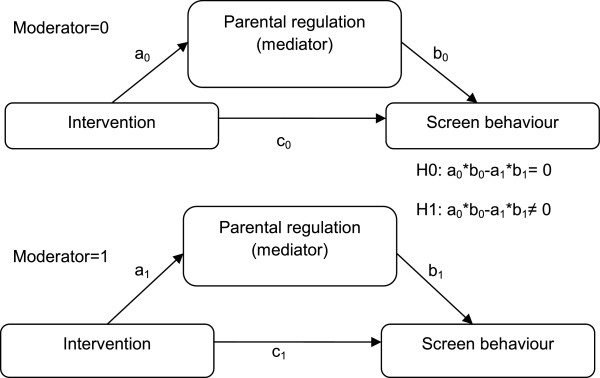
Background: To improve effectiveness of future screen behaviour interventions, one needs to know whether an intervention works via the proposed mediating mechanisms and whether the intervention is equally effective among subgroups. Parental regulation is identified as a consistent correlate of screen behaviours, but prospective evidence as well as the mediation role of parental regulation is largely lacking. This study investigated post-intervention main effects on screen behaviours in the HEIA-intervention--a Norwegian school-based multiple-behaviour study, as well as mediation effects of parental regulation by adolescents' and parents' report. In addition, moderating effects of gender and weight status on the intervention and mediating effects were explored.
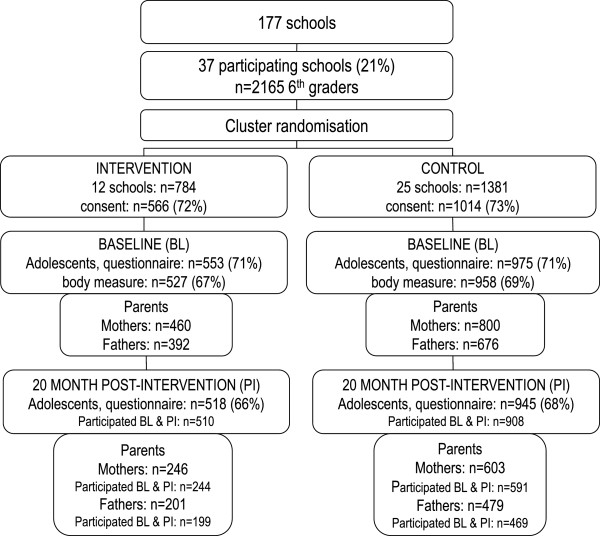
Methods: Participating schools were randomized to control (n=25) or intervention (n=12) condition. Adolescents (n=908 Control; 510 Intervention) self-reported their weekday and weekend TV-viewing and computer/game-use. Change in adolescents' behaviours was targeted through school and parents. Adolescents, mothers (n=591 Control; 244 Interventions) and fathers (n=469 Control; 199 Intervention) reported parental regulation of the screen behaviours post-intervention (at 20 month). The product-of-coefficient test using linear regression analysis was conducted to examine main and mediating effects.
Results: There was no intervention effect on the screen behaviours in the total sample. Gender moderated effect on weekend computer/game-use, while weight status moderated the effect on weekday TV-viewing and computer/game-use. Stratified analyses showed a small favourable intervention effect on weekday TV-viewing among the normal weight. Parental regulation did not mediate change in the screen behaviours. However, stronger parental regulation was associated with less TV-viewing and computer/game-use with effects being conditional on adolescents' versus parental reports. Parental regulation of the screen behaviours, primarily by the parental report, was associated with change in the respective behaviours.
Conclusion: Multiple behaviour intervention may not affect all equally well, and the effect may differ by weight status and gender. In future interventions parents should be encouraged to regulate their adolescents' TV-viewing and computer/game-use on both weekdays and weekends as parental regulation was identified as a determinant of these screen behaviours. However, future intervention studies may need to search for more effective intervention strategies targeting parental regulation.
Trial registration: Current Controlled Trials ISRCTN98552879.
Figures
References
-
- Lobstein T, Baur L, Uauy R. Obesity in children and young people: a crisis in public health. Obes Rev. 2004;5(Suppl 1):4–104. - PubMed
-
- Brug J, Van Stralen MM, Te Velde SJ, Chinapaw MJ, De BI, Lien N, Bere E, Maskini V, Singh AS, Maes L, Moreno L, Jan N, Kovacs E, Lobstein T, Manios Y. Differences in Weight Status and Energy-Balance Related Behaviors among Schoolchildren across Europe: The ENERGY-Project. PLoS One. 2012;7:e34742. doi: 10.1371/journal.pone.0034742. - DOI - PMC - PubMed
-
- Brown T, Summerbell C. Systematic review of school-based interventions that focus on changing dietary intake and physical activity levels to prevent childhood obesity: an update to the obesity guidance produced by the National Institute for Health and Clinical Excellence. Obes Rev. 2009;10:110–141. doi: 10.1111/j.1467-789X.2008.00515.x. - DOI - PubMed
-
- van Grieken A, Ezendam NP, Paulis WD, van der Wouden JC, Raat H. Primary prevention of overweight in children and adolescents: a meta-analysis of the effectiveness of interventions aiming to decrease sedentary behaviour. Int J Behav Nutr Phys Act. 2012;9:61. doi: 10.1186/1479-5868-9-61. - DOI - PMC - PubMed
Publication types
MeSH terms
Associated data
LinkOut - more resources
Full Text Sources
Other Literature Sources
Medical
