


Reduced handgrip strength as a marker of frailty predicts clinical outcomes in patients with heart failure undergoing ventricular assist device placement
- PMID: 24569037
- PMCID: PMC4284074
- DOI: 10.1016/j.cardfail.2014.02.008
Reduced handgrip strength as a marker of frailty predicts clinical outcomes in patients with heart failure undergoing ventricular assist device placement
Abstract
Background: Heart failure (HF) is associated with the derangement of muscle structure and metabolism, contributing to exercise intolerance, frailty, and mortality. Reduced handgrip strength is associated with increased patient frailty and higher morbidity and mortality. We evaluated handgrip strength as a marker of muscle function and frailty for prediction of clinical outcomes after ventricular assist device (VAD) implantation in patients with advanced HF.
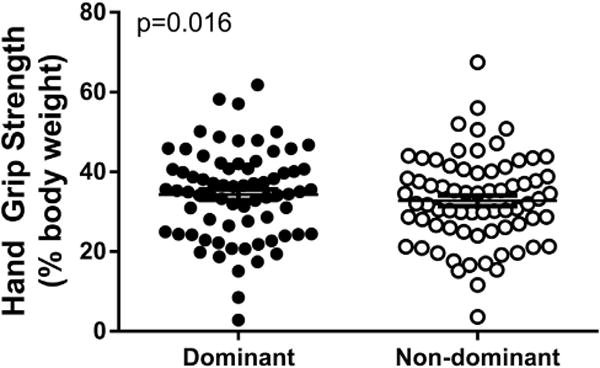
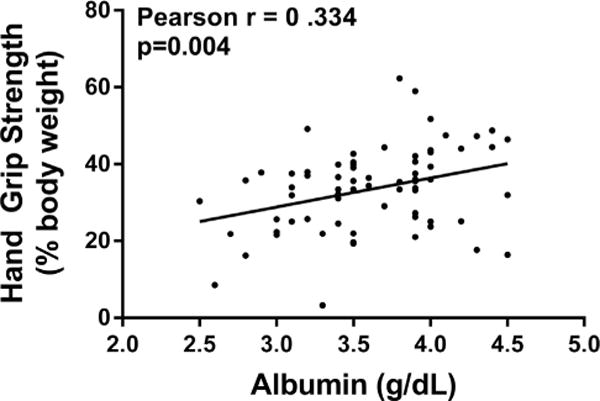
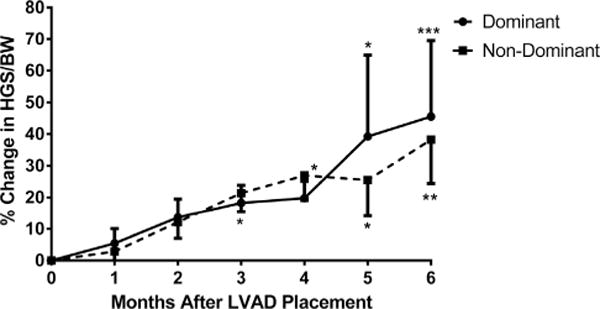
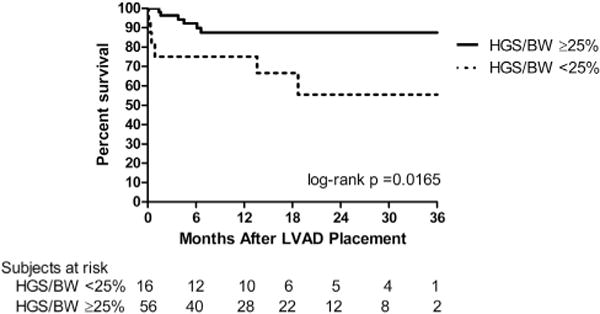
Methods and results: Handgrip strength was measured in 72 patients with advanced HF before VAD implantation (2.3 ± 4.9 days pre-VAD). We analyzed dynamics in handgrip strength, laboratory values, postoperative complications, and mortality. Handgrip strength correlated with serum albumin levels (r = 0.334, P = .004). Compared with baseline, handgrip strength increased post-VAD implantation by 18.2 ± 5.6% at 3 months (n = 29) and 45.5 ± 23.9% at 6 months (n = 27). Patients with a handgrip strength <25% of body weight had an increased risk of mortality, increased postoperative complications, and lower survival after VAD implantation.
Conclusion: Patients with advanced HF show impaired handgrip strength indicating a global myopathy. Handgrip strength <25% of body weight is associated with higher postoperative complication rates and increased mortality after VAD implantation. Thus, the addition of measures of skeletal muscle function underlying the frailty phenotype to traditional risk markers might have incremental prognostic value in patients undergoing evaluation for VAD placement.
Keywords: Heart failure; handgrip strength; skeletal muscle; ventricular assist device.
Copyright © 2014 Elsevier Inc. All rights reserved.
Figures
Comment in
-
Getting a grip on frailty: handgrip strength in patient selection for left ventricular assist device.J Card Fail. 2014 May;20(5):316-8. doi: 10.1016/j.cardfail.2014.03.002. Epub 2014 Mar 15. J Card Fail. 2014. PMID: 24642378 No abstract available.
References
-
- Anker SD, Coats AJ. Cardiac cachexia: a syndrome with impaired survival and immune and neuroendocrine activation. Chest. 1999;115:836–47. - PubMed
-
- Mancini DM, Coyle E, Coggan A, et al. Contribution of intrinsic skeletal muscle changes to 31P NMR skeletal muscle metabolic abnormalities in patients with chronic heart failure. Circulation. 1989;80:1338–46. - PubMed
-
- Duscha BD, Kraus WE, Keteyian SJ, et al. Capillary density of skeletal muscle: a contributing mechanism for exercise intolerance in class II–III chronic heart failure independent of other peripheral alterations. J Am Coll Cardiol. 1999;33:1956–63. - PubMed
-
- Anker SD, Chua TP, Ponikowski P, et al. Hormonal changes and catabolic/anabolic imbalance in chronic heart failure and their importance for cardiac cachexia. Circulation. 1997;96:526–34. - PubMed
Publication types
MeSH terms
Grants and funding
LinkOut - more resources
Full Text Sources
Other Literature Sources
Medical
Molecular Biology Databases
Research Materials
Miscellaneous
