Review
. 2014 Jul;24(7):426-34.
doi: 10.1016/j.tcb.2014.01.005. Epub 2014 Feb 23.

Crosstalk between ubiquitin and other post-translational modifications on chromatin during double-strand break repair

Affiliations
Review

Crosstalk between ubiquitin and other post-translational modifications on chromatin during double-strand break repair

Yu Zhao et al. Trends Cell Biol. 2014 Jul.

Abstract

The cellular response to DNA double-stranded breaks (DSBs) involves a conserved mechanism of recruitment and activation of numerous proteins involved in this pathway. The events that trigger this response in mammalian cells involve several post-translational modifications, but the role of non-proteasomal ubiquitin signaling is particularly central to this pathway. Recent work has demonstrated that ubiquitination does not act alone, but in concert with other post-translational modifications, including phosphorylation, methylation, acetylation, ADP-ribosylation, and other ubiquitin-like modifiers, particularly SUMOylation. We review novel and exciting crosstalk mechanisms between ubiquitination and other post-translational modifications, many of which work synergistically with each other to activate signaling events and help recruit important DNA damage effector proteins, particularly BRCA1 (breast cancer 1, early onset) and 53BP1 (tumor protein p53 binding protein 1), to sites of DNA damage.

Keywords: DNA damage; chromatin; signaling; ubiquitin.


Figures

Figure 1
Figure 1
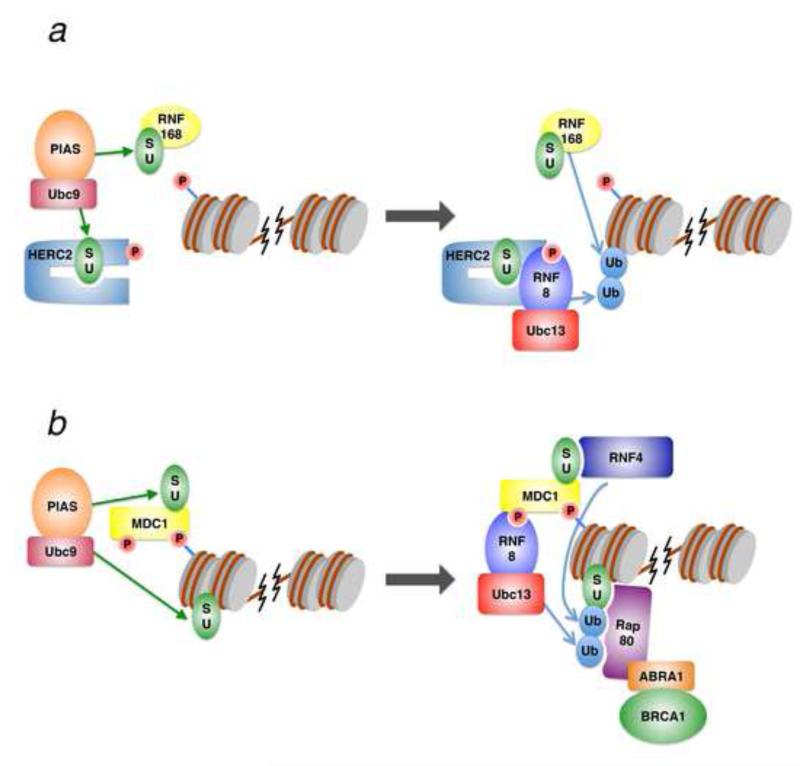
Two potential mechanisms of crosstalk between ubiquitination and SUMOylation. (a) The PIAS family of SUMO E3 ligases, in conjunction with the Ubc9 SUMO E2, SUMOylate RNF168 as well as HERC2. This SUMOylation promotes an intramolecular interaction within HERC2, causing association with RNF8 and the formation of an active Ubc13-RNF8 complex. In conjunction with RNF168, this active form of RNF8 promotes ubiquitin chain formation at the site of DNA damage. (b) PIAS-Ubc9 proteins SUMOylate MDC1 and other proteins near the site of DNA damage. SUMOylated MDC1 helps to recruit RNF4, which, along with Ubc13-RNF8, form mixed SUMO-ubiquitin conjugates. These conjugates are recognized by Rap80 via its SIM and tandem UIM motifs, which then recruits BRCA1 through ABRA1/CCDC98.
Figure 2
Figure 2
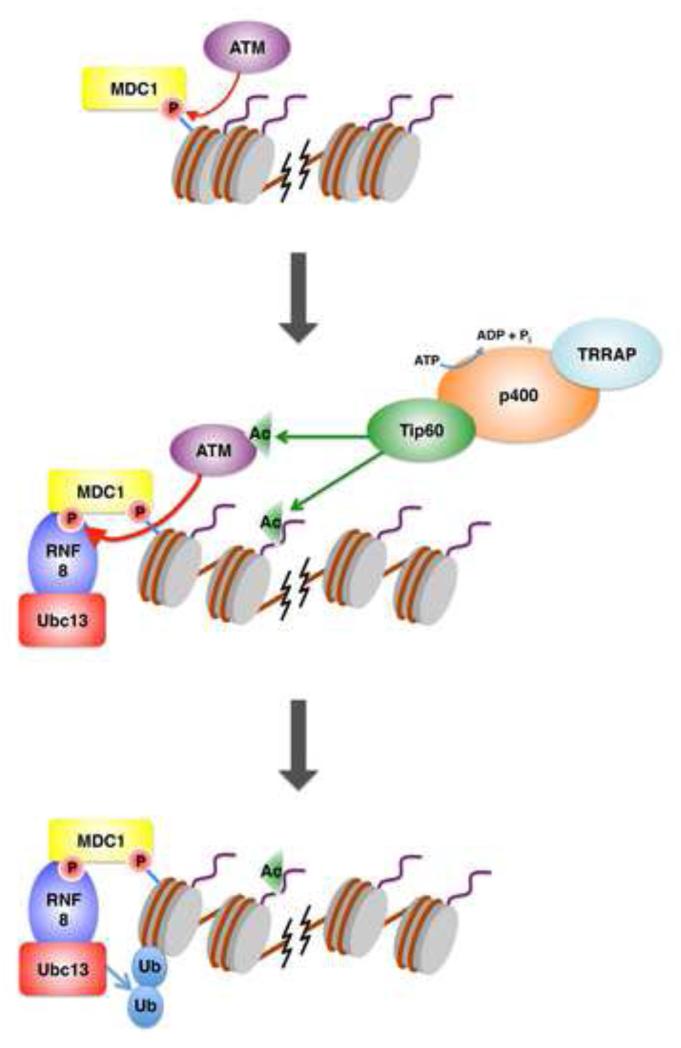
Crosstalk between the TRRAP-Tip60-p400 acetyltransferase complex and ubiquitination. Initially, ATM activation helps recruit MDC1 to sites of DNA damage (top). The Tip60 complex is subsequently recruited, which promotes chromatin remodeling via the p400 ATPase. Tip60 also acetylates multiple targets, including H4, H2A.X and ATM (middle). Acetylation of ATM further activates its kinase activity, and the hyperacetylated, more open chromatin configuration promotes RNF8-mediated ubiquitination (bottom).
Figure 3
Figure 3
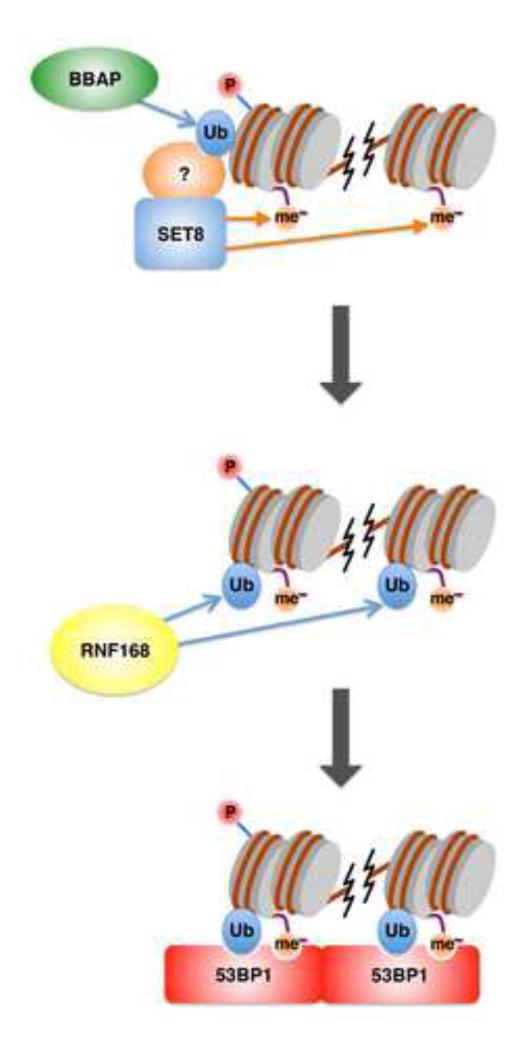
Synergistic function of histone methylation and ubiquitination in the recruitment of 53BP1. BBAP mediates monoubiquitination of H4 at lysine 91, which promotes SET8 recruitment, possibly through an associated partner that recognizes monoubiquitinated H4 (top). SET8 then promotes H4K20 methylation. RNF168 mediates monoubiquitination of H2A at lysine 15 near sites of DNA damage (middle). This monoubiquitination works in concert with H4K20 methylation to recruit 53BP1 via its respective tandem Tudor domains and the adjacent UDR motif (bottom).
Figure 4
Figure 4
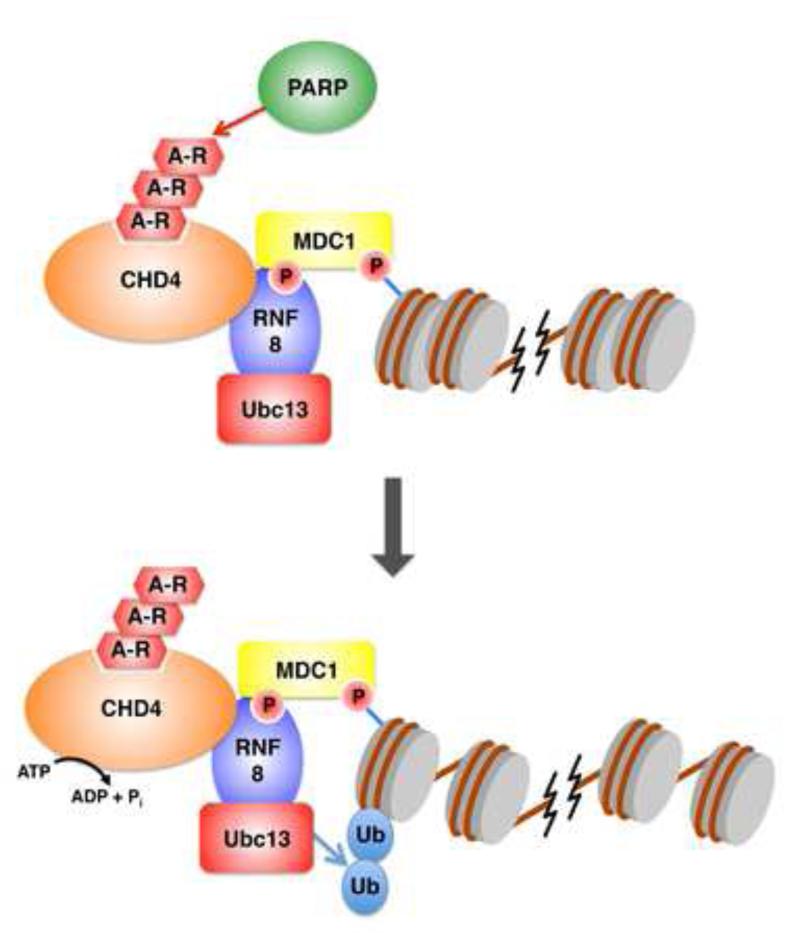
Mechanism of crosstalk between ADP-ribosylation and ubiquitination. Poly-ADP-ribose polymerase (PARP) enzymes act early during DNA damage signaling and help recruit the CHD4 chromatin remodeling complex (top). CHD4 recruitment is also promoted by its interaction with RNF8. Subsequently, CHD4 promotes chromatin remodeling, which promotes ubiquitination via Ubc13-RNF8 (bottom).

References

    1. Luger K, et al. Crystal structure of the nucleosome core particle at 2.8 A resolution. Nature. 1997;389:251–260. - PubMed
    1. Gardner KE, et al. Operating on chromatin, a colorful language where context matters. Journal of molecular biology. 2011;409:36–46. - PMC - PubMed
    1. Sirbu BM, Cortez D. DNA damage response: three levels of DNA repair regulation. Cold Spring Harbor perspectives in biology. 2013;5:a012724. - PMC - PubMed
    1. Matsuoka S, et al. ATM and ATR substrate analysis reveals extensive protein networks responsive to DNA damage. Science. 2007;316:1160–1166. - PubMed
    1. Celeste A, et al. Genomic instability in mice lacking histone H2AX. Science. 2002;296:922–927. - PMC - PubMed

Publication types