Comment
. 2014 Mar;124(3):976-8.
doi: 10.1172/JCI74434. Epub 2014 Feb 24.

Dynamin 2 the rescue for centronuclear myopathy

Comment

Dynamin 2 the rescue for centronuclear myopathy

Alexis R Demonbreun et al. J Clin Invest. 2014 Mar.

Abstract

Centronuclear myopathy is a lethal muscle disease. The most severe form of the disease, X-linked centronuclear myopathy, is due to mutations in the gene encoding myotubularin (MTM1), while mutations in dynamin 2 (DNM2) and amphiphysin 2/BIN1 (AMPH2) cause milder forms of myopathy. MTM1 is a lipid phosphatase, and mutations that disrupt this activity cause severe muscle wasting. In this issue of the JCI, Cowling and colleagues report on their finding of increased DNM2 levels in human and mouse muscle with MTM1 mutations. Partial reduction of Dnm2 in mice harboring Mtm1 mutations remarkably rescued muscle wasting and lethality, and this effect was muscle specific. DNM2 regulates membrane trafficking through vesicular scission, and it is presumed that reducing this activity accounts for improved outcome in X-linked centronuclear myopathy.


Figures
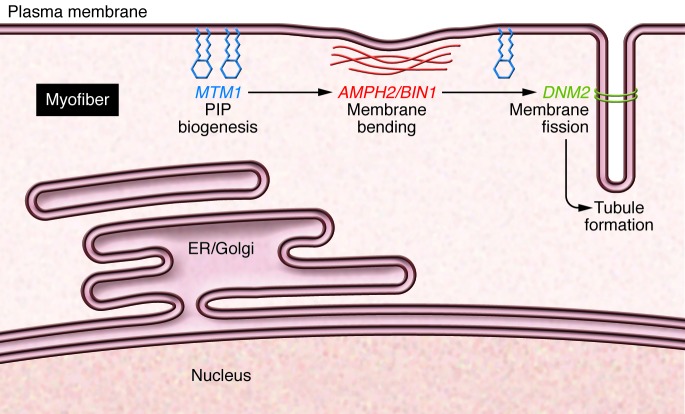
Figure 1
Figure 1. Genes implicated in CNM.
MTM1 encodes a membrane-bound lipid phosphatase (blue). Loss of function MTM1 mutations lead to severe, early onset myopathy characterized by myofibers with centrally placed nuclei. Dominant mutations in DNM2, encoding dynamin 2 (green), also lead to CNM. In this issue, Cowling and colleagues demonstrate that reducing DNM2 dramatically improves longevity in a mouse model of MTM1-mediated myopathy. Mutations in AMPH2/BIN1 (red) also cause CNM. These proteins are involved in phosphoinositide (PIP) biogenesis, membrane bending, and membrane fission. Mutations in these genes affect membranes throughout the muscle, including those that surround nuclei and those in the T-tubule.

Comment on

References

    1. Dowling JJ, Gibbs EM, Feldman EL. Membrane traffic and muscle: lessons from human disease. Traffic. 2008;9(7):1035–1043. doi: 10.1111/j.1600-0854.2008.00716.x. - DOI - PMC - PubMed
    1. De Matteis MA, Godi A. PI-loting membrane traffic. Nat Cell Biol. 2004;6(6):487–492. doi: 10.1038/ncb0604-487. - DOI - PubMed
    1. Buj-Bello A, et al. The lipid phosphatase myotubularin is essential for skeletal muscle maintenance but not for myogenesis in mice. Proc Natl Acad Sci U S A. 2002;99(23):15060–15065. doi: 10.1073/pnas.212498399. - DOI - PMC - PubMed
    1. Dowling JJ, et al. Loss of myotubularin function results in T-tubule disorganization in zebrafish and human myotubular myopathy. PLoS Genet. 2009;5(2):e1000372. doi: 10.1371/journal.pgen.1000372. - DOI - PMC - PubMed
    1. Macia E, Ehrlich M, Massol R, Boucrot E, Brunner C, Kirchhausen T. Dynasore, a cell-permeable inhibitor of dynamin. Dev Cell. 2006;10(6):839–850. doi: 10.1016/j.devcel.2006.04.002. - DOI - PubMed

Publication types
