Randomized Controlled Trial
. 2014 Apr;124(4):1587-97.
doi: 10.1172/JCI72829. Epub 2014 Feb 24.

Randomized trial of the anti-FGF23 antibody KRN23 in X-linked hypophosphatemia

Randomized Controlled Trial

Randomized trial of the anti-FGF23 antibody KRN23 in X-linked hypophosphatemia

Thomas O Carpenter et al. J Clin Invest. 2014 Apr.

Abstract

Background: X-linked hypophosphatemia (XLH) is the most common heritable form of rickets and osteomalacia. XLH-associated mutations in phosphate-regulating endopeptidase (PHEX) result in elevated serum FGF23, decreased renal phosphate reabsorption, and low serum concentrations of phosphate (inorganic phosphorus, Pi) and 1,25-dihydroxyvitamin D [1,25(OH)2D]. KRN23 is a human anti-FGF23 antibody developed as a potential treatment for XLH. Here, we have assessed the safety, tolerability, pharmacokinetics (PK), pharmacodynamics (PD), and immunogenicity of KRN23 following a single i.v. or s.c. dose of KRN23 in adults with XLH.

Methods: Thirty-eight XLH patients were randomized to receive a single dose of KRN23 (0.003-0.3 mg/kg i.v. or 0.1-1 mg/kg s.c.) or placebo. PK, PD, immunogenicity, safety, and tolerability were assessed for up to 50 days.

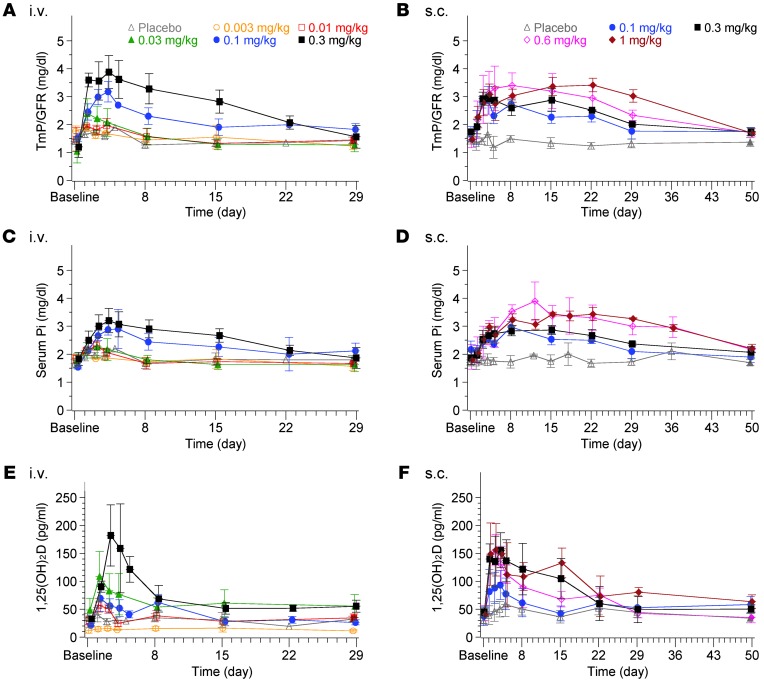
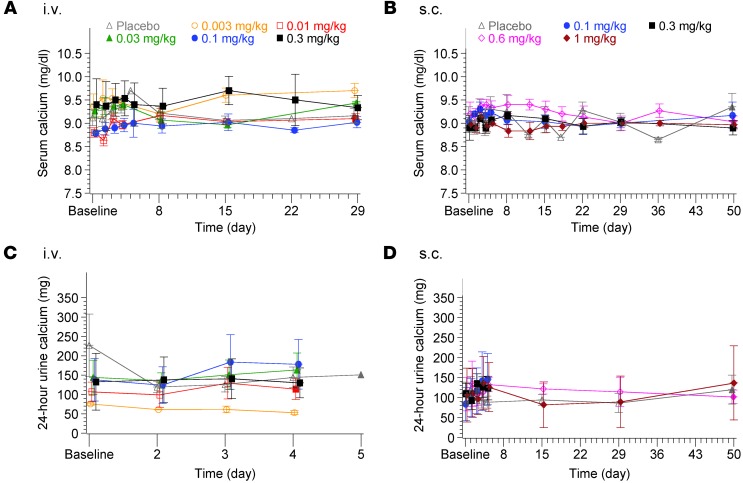
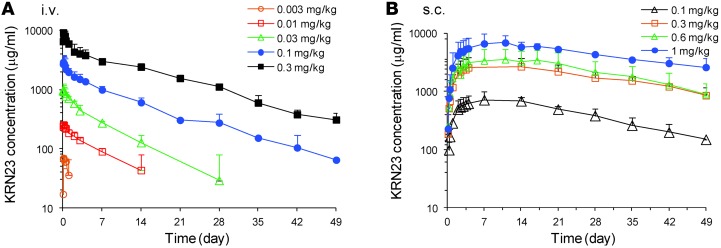
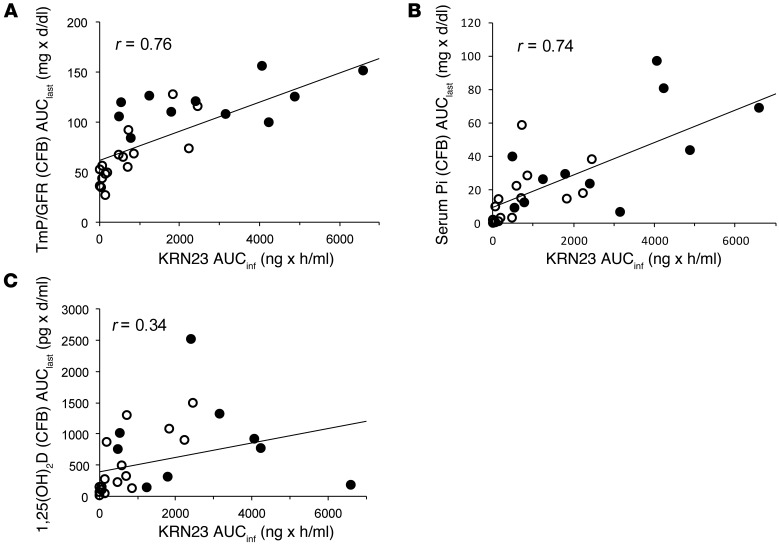
Results: KRN23 significantly increased the maximum renal tubular threshold for phosphate reabsorption (TmP/GFR), serum Pi, and 1,25(OH)2D compared with that of placebo (P<0.01). The maximum serum Pi concentration occurred later following s.c. dosing (8-15 days) compared with that seen with i.v. dosing (0.5-4 days). The effect duration was dose related and persisted longer in patients who received s.c. administration. Changes from baseline in TmP/GFR, serum Pi, and serum 1,25(OH)2D correlated with serum KRN23 concentrations. The mean t1/2 of KRN23 was 8-12 days after i.v. administration and 13-19 days after s.c. administration. Patients did not exhibit increased nephrocalcinosis or develop hypercalciuria, hypercalcemia, anti-KRN23 antibodies, or elevated serum parathyroid hormone (PTH) or creatinine.

Conclusion: KRN23 increased TmP/GFR, serum Pi, and serum 1,25(OH)2D. The positive effect of KR23 on serum Pi and its favorable safety profile suggest utility for KRN23 in XLH patients. Trial registration. Clinicaltrials.gov NCT00830674. Funding. Kyowa Hakko Kirin Pharma, Inc.


Figures
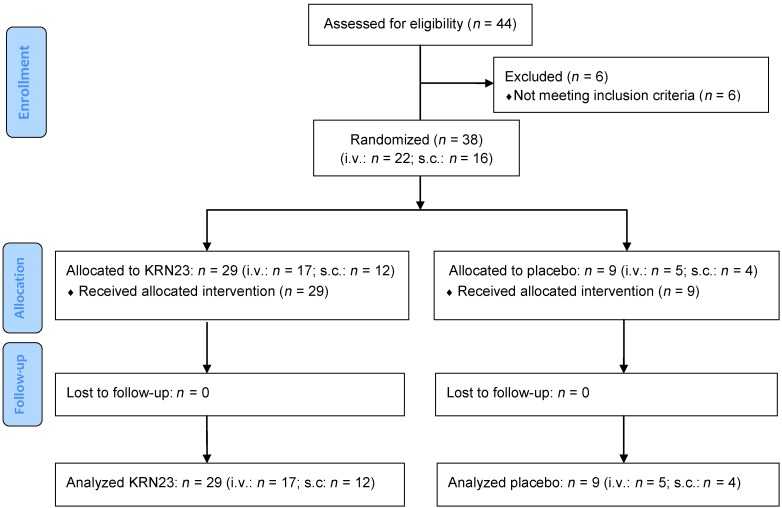
Figure 1
Figure 1. CONSORT diagram for this phase I randomized clinical trial.
Forty-four patients were screened, 38 eligible patients were randomized, and 6 were excluded. All 38 patients received single-dose treatment by i.v (n = 22) or s.c. (n = 16) administration of either KRN23 (n = 29) or KRN23 placebo (n = 9). All patients underwent complete follow-up and analysis.
Figure 2
Figure 2. Effect of i.v. and s.c administration of KRN23 on TmP/GFR, serum Pi, and 1,25(OH)2D compared with placebo.
(A and B) TmP/GFR; (C and D) serum Pi; and (E and F) 1,25(OH)2D. For the i.v. cohorts, six profiles are shown for panels A, C, and E: placebo (gray), 0.003 (yellow), 0.01 (red), 0.03 (green), 0.1 (blue), and 0.3 mg/kg (black). For s.c. cohorts, five profiles are shown for panels B, D, and F: placebo (gray), 0.1 (blue), 0.3 (black), 0.6 (pink), and 1 mg/kg (brown). Data are presented as the mean ± SEM.
Figure 3
Figure 3. Effect of i.v. and s.c administration of KRN23 on serum calcium and 24-hour urine calcium compared with placebo.
(A and B) Serum calcium; (C and D) 24-hour urine calcium. For i.v. cohorts, six profiles are shown for panels A and C: placebo (gray), 0.003 (yellow), 0.01 (red), 0.03 (green), 0.1 (blue), and 0.3 mg/kg (black). For s.c. cohorts, five profiles are shown in panels B and D: placebo (gray), 0.1 (blue), 0.3 (black), 0.6 (pink), and 1 mg/kg (brown). Data are presented as the mean ± SEM.
Figure 4
Figure 4. KRN23 PK profiles following single-dose administration.
(A) Single-dose i.v. administration of 0.003 (orange), 0.01 (red), 0.03 (green), 0.1 (blue), and 0.3 (black) mg/kg of KRN23; (B) Single-dose s.c. administration of 0.1 (black), 0.3 (orange), 0.6 (green), and 1 mg/kg (blue) of KRN23. Data are presented as the mean ± SD.
Figure 5
Figure 5. Relationship between PK and PD parameters.
(A) TmP/GFR change from baseline (CFB) AUClast; (B) serum Pi (CFB) AUClast; and (C) 1,25(OH)2D (CFB) AUClast. Open circles indicate i.v. dosing, and closed circles indicate s.c. dosing. The regression line is shown. Note: 2 patients (one at 0.1 mg/kg and one at 1 mg/kg) with a negative AUClast in panel C are not shown in the plot, but are included in the regression calculation.

References

    1. Imel EA, Econs MJ. Fibroblast growth factor 23: roles in health and disease. J Am Soc Nephrol. 2005;16(9):2565–2575. doi: 10.1681/ASN.2005050573. - DOI - PubMed
    1. Liu S, Quarles LD. How fibroblast growth factor 23 works. J Am Soc Nephrol. 2007;18(6):1637–1647. doi: 10.1681/ASN.2007010068. - DOI - PubMed
    1. Gattineni J, et al. FGF23 decreases renal NaPi-2a and NaPi-2c expression and induces hypophosphatemia in vivo predominantly via FGF receptor 1. Am J Physiol Renal Physiol. 2009;297:F282–F291. doi: 10.1152/ajprenal.90742.2008. - DOI - PMC - PubMed
    1. Larsson T, et al. Transgenic mice expressing fibroblast growth factor 23 under the control of the α1(I) collagen promoter exhibit growth retardation, osteomalacia, and disturbed phosphate homeostasis. Endocrinology. 2004;145(7):3087–3094. doi: 10.1210/en.2003-1768. - DOI - PubMed
    1. Shimada T, et al. FGF-23 transgenic mice demonstrate hypophosphatemic rickets with reduced expression of sodium phosphate cotransporter type IIa. Biochem Biophys Res Commun. 2004;314(2):409–414. doi: 10.1016/j.bbrc.2003.12.102. - DOI - PubMed

Publication types

MeSH terms

Associated data