


Effect of place of residence and treatment on survival outcomes in patients with diffuse large B-cell lymphoma in British Columbia
- PMID: 24569946
- PMCID: PMC3958457
- DOI: 10.1634/theoncologist.2013-0343
Effect of place of residence and treatment on survival outcomes in patients with diffuse large B-cell lymphoma in British Columbia
Abstract
Background: We examined the relationship between location of residence at the time of diagnosis of diffuse large B-cell lymphoma (DLBCL) and health outcomes in a geographically large Canadian province with publicly funded, universally available medical care.
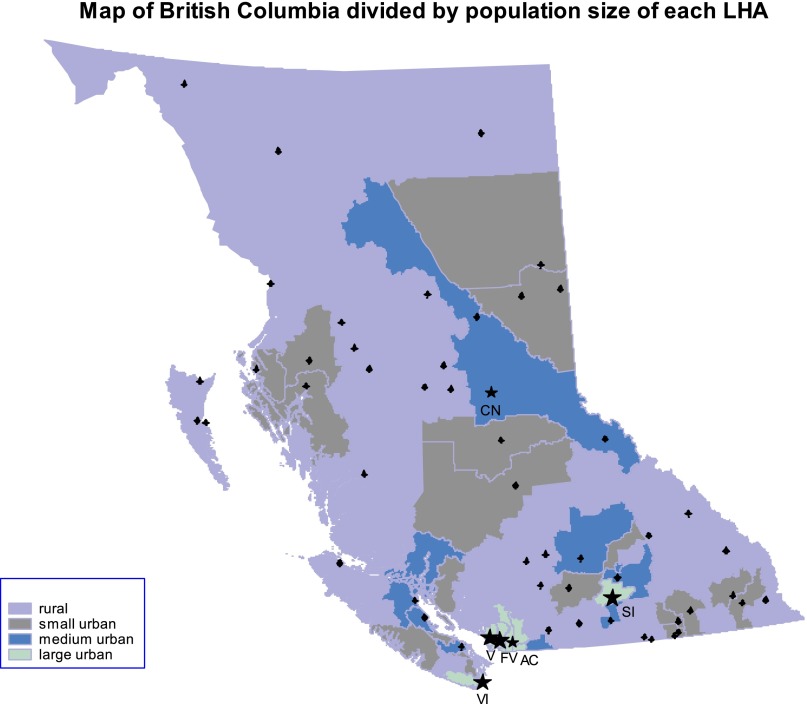
Patients and methods: The British Columbia Cancer Registry was used to identify all patients 18-80 years of age diagnosed with DLBCL between January 2003 and December 2008. Home and treatment center postal codes were used to determine urban versus rural status and driving distance to access treatment.
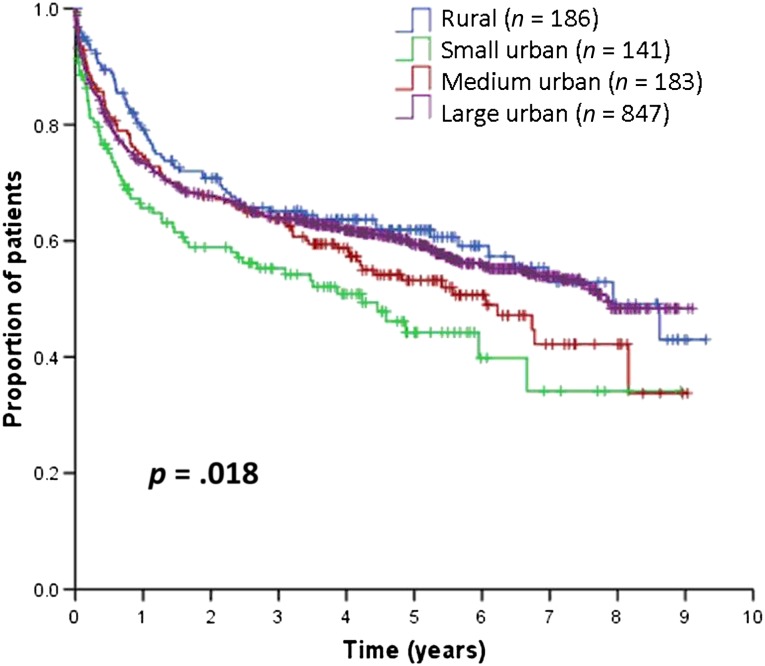
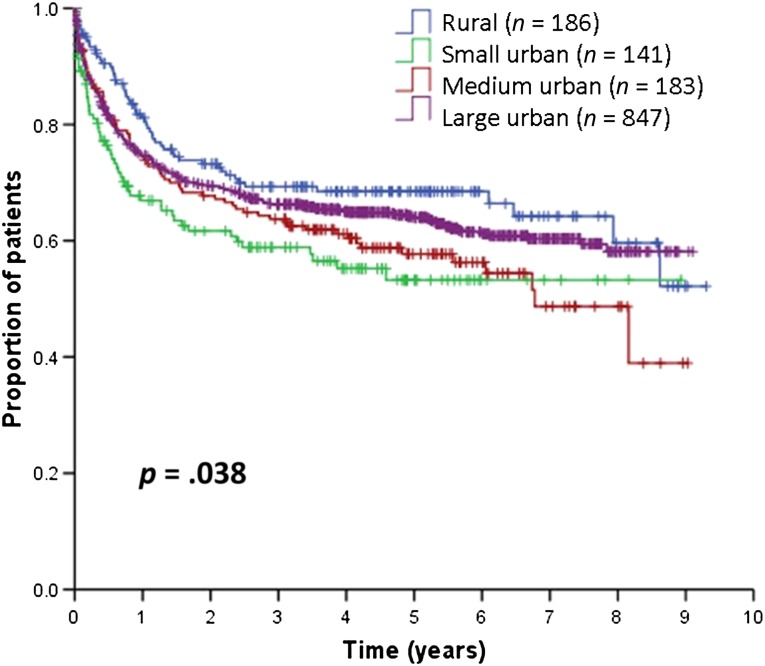
Results: We identified 1,357 patients. The median age was 64 years (range: 18-80 years), 59% were male, 50% were stage III/IV, 84% received chemotherapy with curative intent, and 32% received radiotherapy. There were 186 (14%) who resided in rural areas, 141 (10%) in small urban areas, 183 (14%) in medium urban areas, and 847 (62%) in large urban areas. Patient and treatment characteristics were similar regardless of location. Five-year overall survival (OS) was 62% for patients in rural areas, 44% in small urban areas, 53% in medium urban areas, and 60% in large urban areas (p = .018). In multivariate analysis, there was no difference in OS between rural and large urban area patients (hazard ratio [HR]: 1.0; 95% confidence interval [CI]: 0.7-1.4), although patients in small urban areas (HR: 1.4; 95% CI: 1.0-2.0) and medium urban areas (HR: 1.4; 95% CI: 1.0-1.9) had worse OS than those in large urban areas.
Conclusion: Place of residence at diagnosis is associated with survival of patients with DLBCL in British Columbia, Canada. Rural patients have similar survival to those in large urban areas, whereas patients living in small and medium urban areas experience worse outcomes.
Keywords: Access to care; Cancer care quality; Disparities; Lymphoma.
Conflict of interest statement
Disclosures of potential conflicts of interest may be found at the end of this article.
Figures
References
-
- Elliott TE, Elliott BA, Renier CM, et al. Rural-urban differences in cancer care: Results from the Lake Superior Rural Cancer Care Project. Minn Med. 2004;87:44–50. - PubMed
-
- Parikh-Patel A, Bates JH, Campleman S. Colorectal cancer stage at diagnosis by socioeconomic and urban/rural status in California, 1988-2000. Cancer. 2006;107(Suppl):1189–1195. - PubMed
-
- Baade PD, Youlden DR, Coory MD, et al. Urban-rural differences in prostate cancer outcomes in Australia: What has changed? Med J Aust. 2011;194:293–296. - PubMed
-
- Coory MD, Baade PD. Urban-rural differences in prostate cancer mortality, radical prostatectomy and prostate-specific antigen testing in Australia. Med J Aust. 2005;182:112–115. - PubMed
Publication types
MeSH terms
LinkOut - more resources
Full Text Sources
Other Literature Sources
Medical
