


Patterns and outcomes of red blood cell transfusion in patients undergoing percutaneous coronary intervention
- PMID: 24570247
- PMCID: PMC4276400
- DOI: 10.1001/jama.2014.980
Patterns and outcomes of red blood cell transfusion in patients undergoing percutaneous coronary intervention
Abstract
Importance: Studies have shown variation in the use of red blood cell transfusion among patients with acute coronary syndromes. There are no definitive data for the efficacy of transfusion in improving outcomes, and concerning data exist about possible association with harm. Current transfusion practices in patients undergoing percutaneous coronary intervention (PCI) are not well understood.
Objective: To determine the current patterns of blood transfusion among patients undergoing PCI and the association of transfusion with adverse cardiac outcomes across hospitals in the United States.
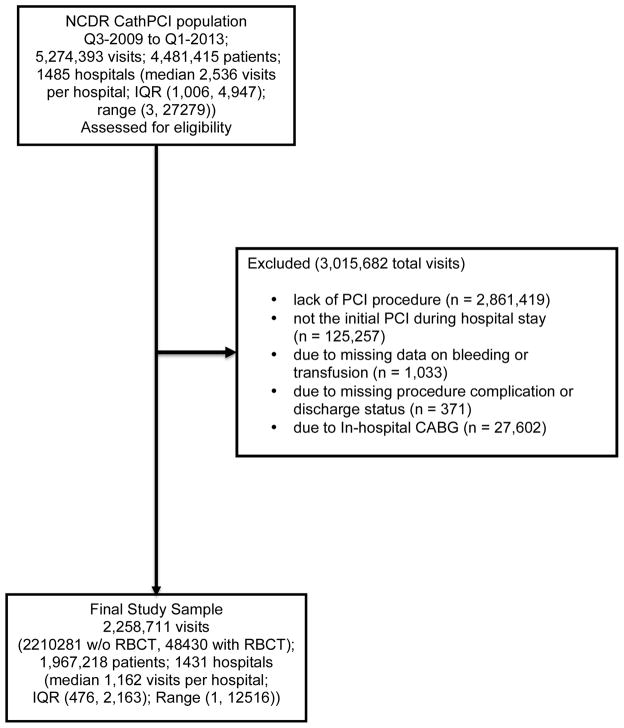
Design, setting, and participants: Retrospective cohort study of all patient visits from the CathPCI Registry from July 2009 to March 2013 that included PCI, excluding those with missing data on bleeding complications or who underwent in-hospital coronary artery bypass graft surgery (N = 2,258,711 visits).
Main outcomes and measures: Transfusion rates in the overall population and by hospital (N = 1431) were the primary outcomes. The association of transfusion with myocardial infarction, stroke, and death after accounting for a patient's propensity for transfusion was also measured.
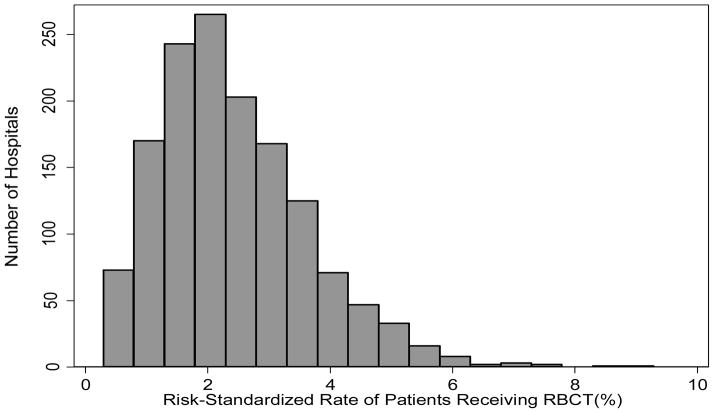
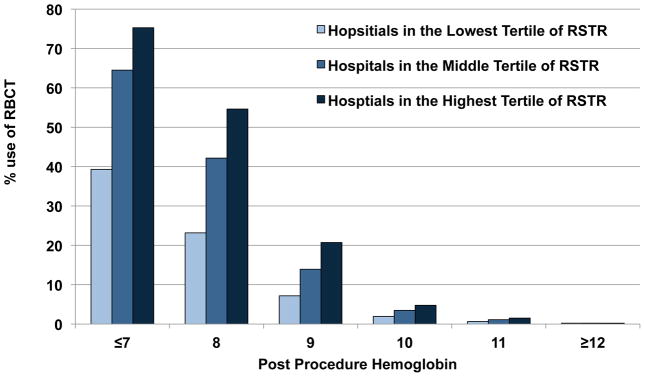
Results: The overall rate of transfusion was 2.14% (95% CI, 2.13%-2.16%) and quarterly transfusion rates slightly declined from July 2009 to March 2013 (from 2.11% [95% CI, 2.03%-2.19%] to 2.04% [95% CI, 1.97%-2.12%]; P < .001). Patients who were more likely to receive transfusion were older (mean, 70.5 vs 64.6 years), were women (56.3% vs 32.5%), and had hypertension (86.4% vs 82.0%), diabetes (44.8% vs 34.6%), advanced renal dysfunction (8.7% vs 2.3%), prior myocardial infarction (33.0% vs 30.2%), or prior heart failure (27.0% vs 11.8%). Overall, 96.3% of sites gave a transfusion to less than 5% of patients and 3.7% of sites gave a transfusion to 5% of patients or more. Variation in hospital risk-standardized rates of transfusion persisted after adjustment, and hospitals showed variability in their transfusion thresholds. Receipt of transfusion was associated with myocardial infarction (42,803 events; 4.5% vs 1.8%; odds ratio [OR], 2.60; 95% CI, 2.57-2.63), stroke (5011 events; 2.0% vs 0.2%; OR, 7.72; 95% CI, 7.47-7.98), and in-hospital death (31,885 events; 12.5% vs 1.2%; OR, 4.63; 95% CI, 4.57-4.69), irrespective of bleeding complications.
Conclusions and relevance: Among patients undergoing PCI at US hospitals, there was considerable variation in blood transfusion practices, and receipt of transfusion was associated with increased risk of in-hospital adverse cardiac events. These observational findings may warrant a randomized trial of transfusion strategies for patients undergoing PCI.
Figures
Comment in
-
ACP Journal Club. Red blood cell transfusion after PCI was associated with increased mortality, MI, and stroke.Ann Intern Med. 2014 Jun 17;160(12):JC12. doi: 10.7326/0003-4819-160-12-201406170-02012. Ann Intern Med. 2014. PMID: 24935506 No abstract available.
References
-
- Chatterjee S, Wetterslev J, Sharma A, Lichstein E, Mukherjee D. Association of blood transfusion with increased mortality in myocardial infarction: A meta-analysis and diversity-adjusted study sequential analysis. Archives of internal medicine. 2012:1–8. - PubMed
-
- Jolicoeur EM, O’Neill WW, Hellkamp A, Hamm CW, Holmes DR, Jr, Al-Khalidi HR, Patel MR, Van de Werf FJ, Pieper K, Armstrong PW, Granger CB, Investigators A-A. Transfusion and mortality in patients with st-segment elevation myocardial infarction treated with primary percutaneous coronary intervention. European heart journal. 2009;30:2575–2583. - PubMed
-
- Nikolsky E, Mehran R, Sadeghi HM, Grines CL, Cox DA, Garcia E, Tcheng JE, Griffin JJ, Guagliumi G, Stuckey T, Turco M, Fahy M, Lansky AJ, Stone GW. Prognostic impact of blood transfusion after primary angioplasty for acute myocardial infarction: Analysis from the cadillac (controlled abciximab and device investigation to lower late angioplasty complications) trial. JACC. Cardiovascular interventions. 2009;2:624–632. - PubMed
-
- Shishehbor MH, Madhwal S, Rajagopal V, Hsu A, Kelly P, Gurm HS, Kapadia SR, Lauer MS, Topol EJ. Impact of blood transfusion on short- and long-term mortality in patients with st-segment elevation myocardial infarction. JACC. Cardiovascular interventions. 2009;2:46–53. - PubMed
-
- Aronson D, Dann EJ, Bonstein L, Blich M, Kapeliovich M, Beyar R, Markiewicz W, Hammerman H. Impact of red blood cell transfusion on clinical outcomes in patients with acute myocardial infarction. The American journal of cardiology. 2008;102:115–119. - PubMed
Publication types
MeSH terms
Grants and funding
LinkOut - more resources
Full Text Sources
Other Literature Sources
Medical
Miscellaneous
