


Cardiopulmonary resuscitation among mechanically ventilated patients
- PMID: 24570267
- PMCID: PMC4005593
- DOI: 10.1007/s00134-014-3247-2
Cardiopulmonary resuscitation among mechanically ventilated patients
Abstract
Purpose: To evaluate the outcomes, including long-term survival, after cardiopulmonary resuscitation (CPR) in mechanically ventilated patients.
Methods: We analyzed Medicare data from 1994 to 2005 to identify beneficiaries who underwent in-hospital CPR. We then identified a subgroup receiving CPR one or more days after mechanical ventilation was initiated [defined by ICD-9 procedure code for intubation (96.04) or mechanical ventilation (96.7x) one or more days prior to procedure code for CPR (99.60 or 99.63)].
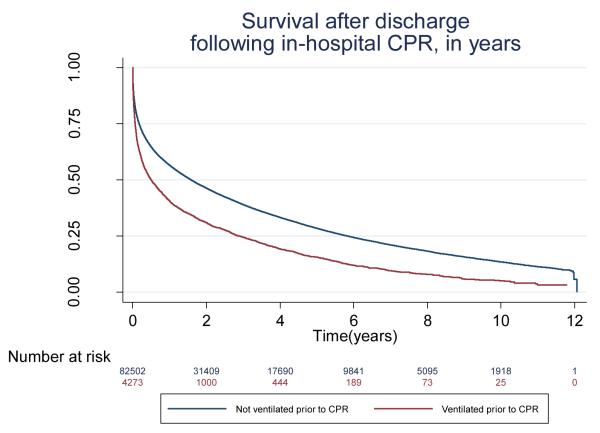
Results: We identified 471,962 patients who received in-hospital CPR with an overall survival to hospital discharge of 18.4 % [95 % confidence interval (CI) 18.3-18.5 %]. Of those, 42,163 received CPR one or more days after mechanical ventilation initiation. Survival to hospital discharge after CPR in ventilated patients was 10.1 % (95 % CI 9.8-10.4 %), compared to 19.2 % (95 % CI 19.1-19.3 %) in non-ventilated patients (p < 0.001). Among this group, older age, race other than white, higher burden of chronic illness, and admission from a nursing facility were associated with decreased survival in multivariable analyses. Among all CPR recipients, those who were ventilated had 52 % lower odds of survival (OR 0.48, 95 % CI 0.46-0.49, p < 0.001). Median long-term survival in ventilated patients receiving CPR who survived to hospital discharge was 6.0 months (95 % CI 5.3-6.8 months), compared to 19.0 months (95 % CI 18.6-19.5 months) among the non-ventilated survivors (p < 0.001 by logrank test). Of all patients receiving CPR while ventilated, only 4.1 % were alive at 1 year.
Conclusions: Survival after in-hospital CPR is decreased among ventilated patients compared to those who are not ventilated. This information is important for clinicians, patients, and family members when discussing CPR in critically ill patients.
Figures
References
-
- American Heart association . Highlights of the History of Cardiopulmonary Resuscitation (CPR) American Heart association; [Accessed August 19th, 2013]. 2013. About Cardiopulmonary Resuscitation (CPR) Available via DIALOG. http://www.heart.org/HEARTORG/CPRAndECC/WhatisCPR/CPRFactsandStats/Histo....
-
- Kouwenhoven WB, Ing, Jude JR, Knickerbocker GG. Closed-chest cardiac massage. JAMA. 1960;173:94–97. - PubMed
-
- Lemiale V, Dumas F, Mongardon N, Giovanetti O, Charpentier J, Chiche JD, Carli P, Mira JP, Nolan J, Cariou A. Intensive care unit mortality after cardiac arrest: the relative contribution of shock and brain injury in a large cohort. Intensive Care Med. 2013;39:1972–80. doi: 10.1007/s00134-013-3043-4. Epub 2013 Aug 14. - PubMed
-
- Begg CB, Riedel ER, Bach PB, et al. Variations in morbidity after radical prostatectomy. N Engl J Med. 2002;346:1138–44. - PubMed
-
- Schermerhorn ML, O’Malley AJ, Jhaveri A, Cotterill P, Pomposelli F, Landon BE. Endovascular vs. open repair of abdominal aortic aneurysms in the Medicare population. N Engl J Med. 2008;358:464–74. - PubMed
Publication types
MeSH terms
Grants and funding
LinkOut - more resources
Full Text Sources
Other Literature Sources
Medical
