Review
. 2014 Feb 7:5:29.
doi: 10.3389/fpls.2014.00029. eCollection 2014.

GIP/MZT1 proteins orchestrate nuclear shaping

Affiliations
Review

GIP/MZT1 proteins orchestrate nuclear shaping

Morgane Batzenschlager et al. Front Plant Sci. .

Abstract

The functional organization of the nuclear envelope (NE) is only just emerging in plants with the recent characterization of NE protein complexes and their molecular links to the actin cytoskeleton. The NE also plays a role in microtubule nucleation by recruiting γ-Tubulin Complexes (γ-TuCs) which contribute to the establishment of a robust mitotic spindle. γ-tubulin Complex Protein 3 (GCP3)-interacting proteins (GIPs) have been identified recently as integral components of γ-TuCs. GIPs have been conserved throughout evolution and are also named MZT1 (mitotic-spindle organizing protein 1). This review focuses on recent data investigating the role of GIP/MZT1 at the NE, including insights from the study of GIP partners. It also uncovers new functions for GIP/MZT1 during interphase and highlights a current view of NE-associated components which are critical for nuclear shaping during both cell division and differentiation.

Keywords: Arabidopsis thaliana; gamma-tubulin complex; nuclear envelope proteins; nucleocytoplasmic continuum; spindle assembly.


Figures
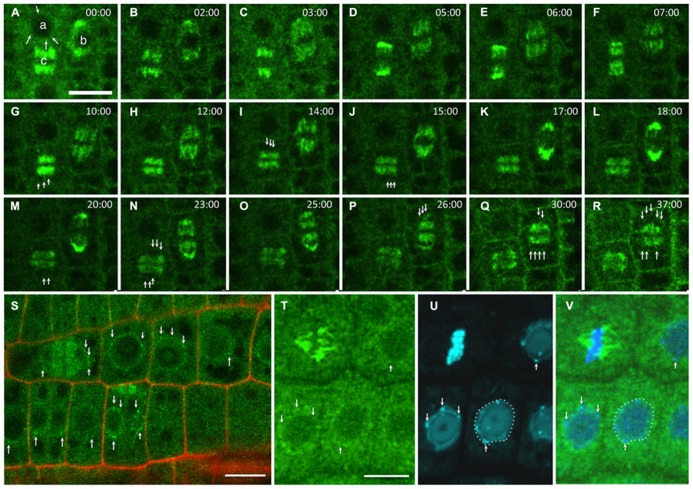
FIGURE 1
FIGURE 1
GIP dynamics throughout the cell cycle. Time-lapse images of the expression of pGIP1::AtGIP1-GFP in an Arabidopsis root tip. Three cells were followed for 37 min, using confocal microscopy (A–R). (A) GIP1 localizes in a dotted pattern (arrows) at the nuclear periphery of an interphase cell (a), on a prophase spindle (b) and on a metaphase spindle (c). In end-anaphase-telophase transition, GIP1 remains associated with remnant kinetochore fibers and redistributes in a dotted pattern to the newly built NE (arrows in G, I, J, M and N of the (c) cell and in P–R of the (b) cell). (S) Larger view of a GIP1-GFP expressing root tip in which the nuclear periphery is labeled in interphase and telophase cells (arrows). (T–V) DAPI staining of GIP1–GFP cells confirming that GIP is located at the nuclear periphery. The arrows indicate that some GIP1–GFP signals are located close to chromocentres which are under the inner nuclear membrane. Bar = 10 μm.
FIGURE 2
FIGURE 2
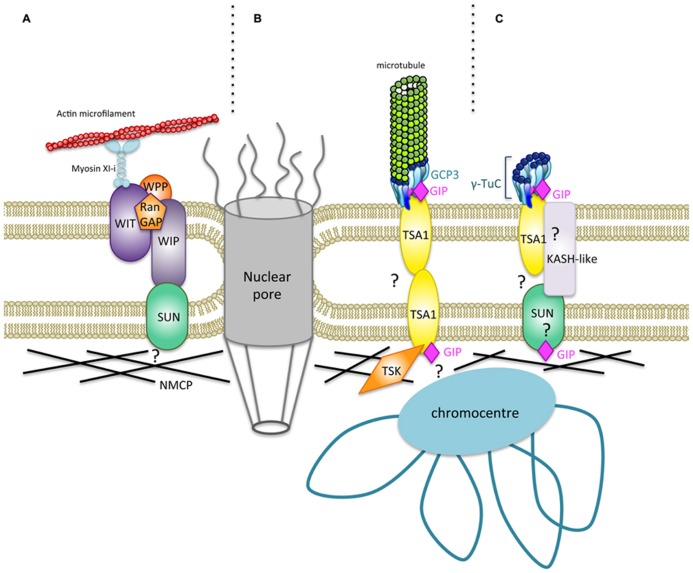
Hypothetical model for a new type of nucleocytoplasmic bridges regulating the shape of Arabidopsis thaliana nuclei. (A) A specific plant LINC complex has been characterized, and it plays a role in nuclear movement and shaping (Meier and Brkljacic, 2009; Graumann and Evans, 2010; Zhou et al., 2012; Tamura et al., 2013). Trimeric organization of SUN domain proteins (Sosa et al., 2012) has been omitted for more clarity. A WIT–WIP complex interacts with WWP proteins and RanGAP. WIT also interacts with Myosin XI-i which links the actin cytoskeleton to the ONM. The WIP–SUN complex constitutes the first core LINC identified in plants. NMCPs/LINCs are plamina components (Ciska and Moreno Diaz de la Espina, 2013) which may interact with SUN (Graumann et al., 2013). (B) A new nucleocytoplasmic continuum may consist of GIPs which bind both GCP3, a component of the γ-TuC involved in MT nucleation at the NE, and TSA1, a putative transmembrane protein. TSK localizes in the nucleoplasm (Suzuki et al., 2004; Takeda et al., 2004; Ohno et al., 2011) and may associate with TSA1 at the INM. Both TSK and GIP binding domains of TSA1 are overlapping at its C-terminus. TSA1 possesses coiled-coil domains which may allow multimerization of the protein. Multimerization propensity of GIP/MZT1 proteins have also been reported and could reinforce the interaction with their partners (Batzenschlager et al., 2013; Dhani et al., 2013). Such a model may at least exist in cycling cells. (C) The continuum may also involve a subpopulation of γ-TuCs which does not nucleate MTs in differentiated cells. The GIP–TSA1 complex may interact with a still unknown KASH-like protein associated to SUN in the perinuclear space. The molecular interplay at the INM, plamina and chromatin interface needs to be further characterized.

References

    1. Batzenschlager M., Masoud K., Janski N., Houlné G., Herzog E., Evrard J.-L., et al. (2013). The GIP gamma-tubulin complex-associated proteins are involved in nuclear architecture in Arabidopsis thaliana. Front. Plant Sci. 4:480 10.3389/fpls.2013.00480 - DOI - PMC - PubMed
    1. Bonne G., Quijano-Roy S. (2013). Emery-dreifuss muscular dystrophy, laminopathies, and other nuclear envelopathies. Handb. Clin. Neurol. 113 1367–137610.1016/B978-0-444-59565-2.00007-1 - DOI - PubMed
    1. Canaday J., Brochot A. L., Seltzer V., Herzog E., Evrard J. L., Schmit A. C. (2005) “Microtubule assembly in higher plants,” in Recent Research Developments in Molecular Biology Vol. 2 ed. Pandalai S. G. (Trivandrum, India: Research Signpost) 103–119
    1. Ciska M, Moreno Diaz de la Espina S. (2013). NMCP/LINC proteins: putative lamin analogs in plants? Plant Signal. Behav. 8, pii: e26669. 10.4161/psb.26669 - DOI - PMC - PubMed
    1. Dechat T., Pfleghaar K., Sengupta K., Shimi T., Shumaker D., Solimando L., et al. (2008). Nuclear lamins: major factors in the structural organization and function of the nucleus and chromatin. Genes Dev. 22 832–85310.1101/gad.1652708 - DOI - PMC - PubMed