


Invasive and non-invasive fractional flow reserve index in validation of hemodynamic severity of intracoronary lesions
- PMID: 24570710
- PMCID: PMC3915971
- DOI: 10.5114/pwki.2013.35452
Invasive and non-invasive fractional flow reserve index in validation of hemodynamic severity of intracoronary lesions
Abstract
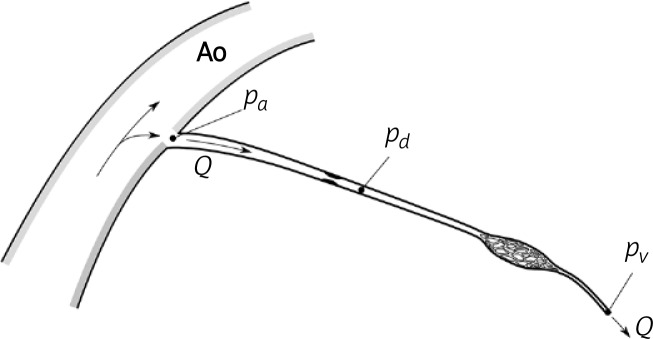
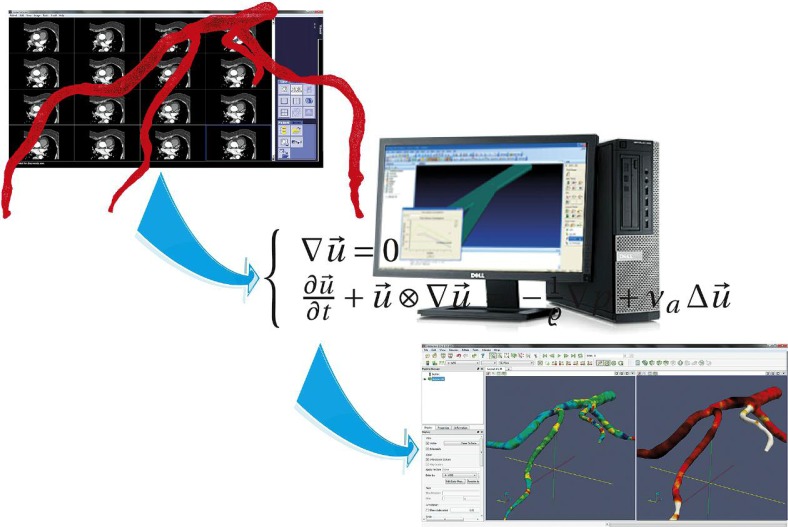
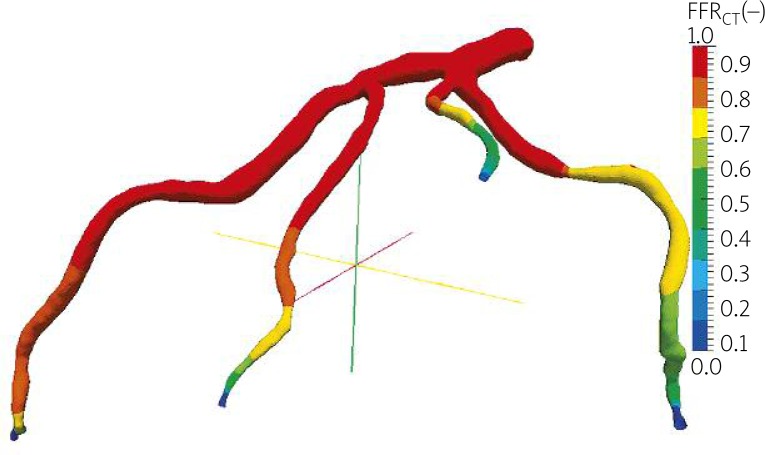
This review discusses visual and functional evaluation of the hemodynamic significance of the degree of stenosis in coronary angiography, with respect to the indications for revascularization. The concept of the coronary flow reserve is defined, and the theoretical assumptions of the invasive measurement of the fractional flow reserve (FFR) are presented. In the following part, the publication describes the basic steps of numerical stimulations in terms of computational fluid dynamics (CFD) in calculating the fractional flow reserve based on computed tomography (CT) coronary angiography (FFRCT). The numerical FFRCT estimation in correlation with invasive measurements, as well as benefits deriving from FFRCT in the diagnosis of coronary artery disease, is presented in the example of the multicentre prospective DISCOVER-FLOW trial and the DeFACTO project. The CDF method enables to obtain hemodynamic significance of stenosis solely from the coronary anatomy vizualized by CT angiography. The calculation of FFRCT increases the diagnostic reliability of coronary flow reserve estimations. It contributes to the improvement in patients' qualification for contrast coronarography. If the accuracy of FFRCT is confirmed in clinical practice, and the time required for computational processing is shortened, it may turn out that the algorithms of coronary heart disease diagnosis will be verified and it will be to a greater extent based on the CT results.
Keywords: computational fluid dynamics; fractional flow reserve.
Figures

References
-
- Lindstaedt M, Spiecker M, Perings C, et al. How good are experienced interventional cardiologists at predicting the functional significance of intermediate or equivocal left main coronary artery stenoses? Int J Cardiol. 2007;120:254–261. - PubMed
-
- Botman KJ, Pijls NH, Bech JW, et al. Percutaneous coronary intervention or bypass surgery in multivessel disease? A tailored approach based on coronary pressure measurement. Catheter Cardiovasc Interv. 2004;63:184–191. - PubMed
-
- Tonino PA, De Bruyne B, Pijls NH, et al. Fractional flow reserve versus angiography for guiding percutaneous coronary intervention. N Engl J Med. 2009;360:213–224. - PubMed
-
- Lopez-Palop R, Pinar E, Lozano I, et al. Utility of the fractional flow reserve in the evaluation of angiographically moderate in-stent restenosis. Eur Heart J. 2004;25:2040–2047. - PubMed
-
- Fearon WF, Bornschein B, Tonino PA, et al. Fractional Flow Reserve Versus Angiography for Multivessel Evaluation (FAME) Study Investigators. Economic evaluation of fractional flow reserve-guided percutaneous coronary intervention in patients with multivessel disease. Circulation. 2010;122:2545–2550. - PubMed
LinkOut - more resources
Full Text Sources
Other Literature Sources
Miscellaneous