Genome-wide association analyses of child genotype effects and parent-of-origin effects in specific language impairment
- PMID: 24571439
- PMCID: PMC4114547
- DOI: 10.1111/gbb.12127
Genome-wide association analyses of child genotype effects and parent-of-origin effects in specific language impairment
Abstract
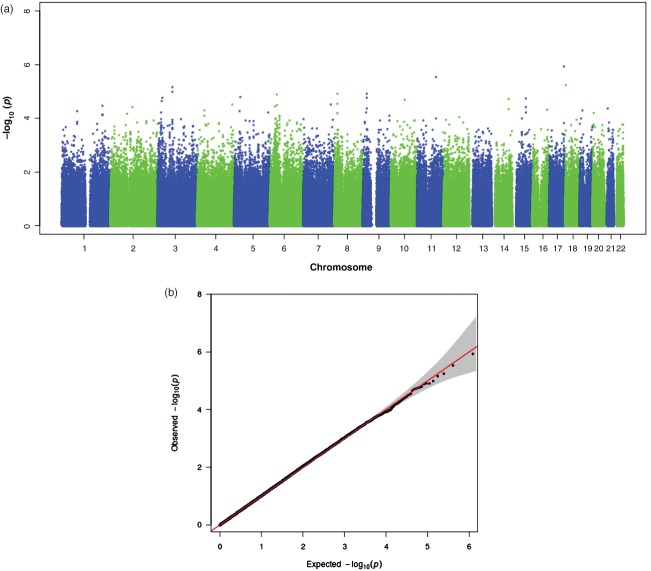
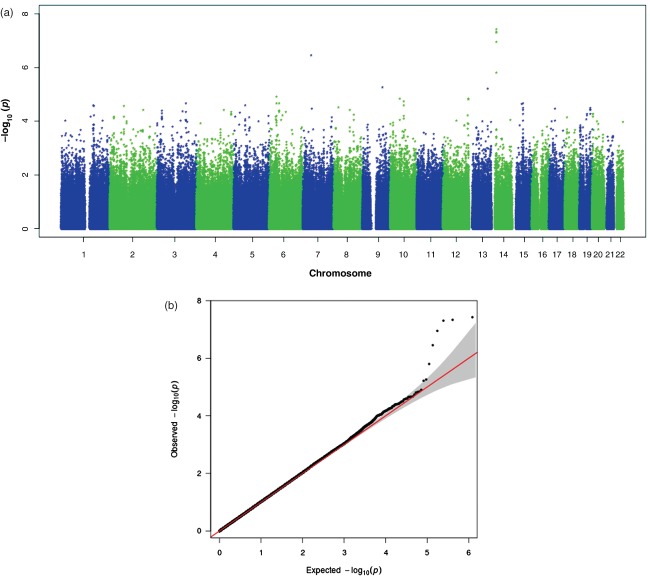
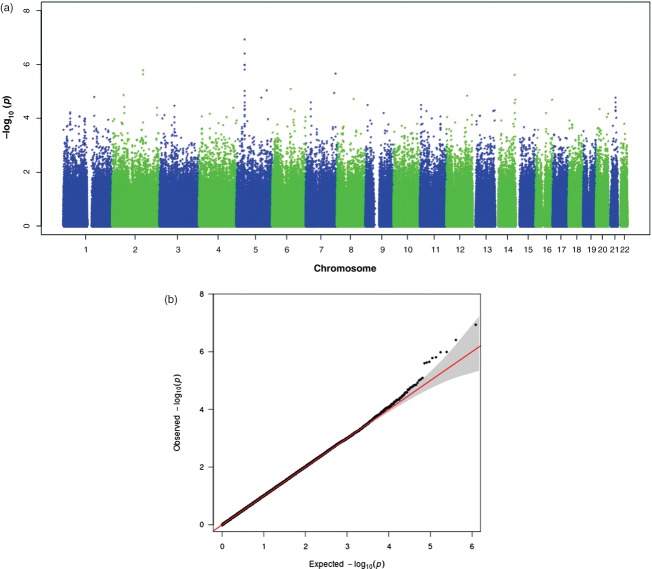
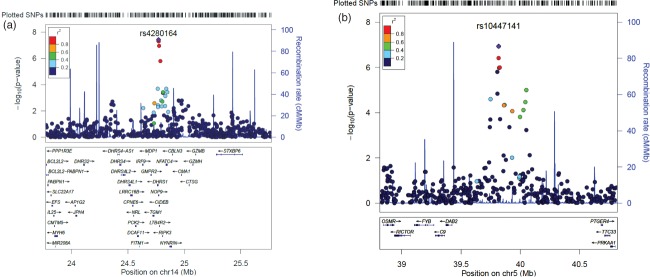
Specific language impairment (SLI) is a neurodevelopmental disorder that affects linguistic abilities when development is otherwise normal. We report the results of a genome-wide association study of SLI which included parent-of-origin effects and child genotype effects and used 278 families of language-impaired children. The child genotype effects analysis did not identify significant associations. We found genome-wide significant paternal parent-of-origin effects on chromosome 14q12 (P = 3.74 × 10(-8)) and suggestive maternal parent-of-origin effects on chromosome 5p13 (P = 1.16 × 10(-7)). A subsequent targeted association of six single-nucleotide-polymorphisms (SNPs) on chromosome 5 in 313 language-impaired individuals and their mothers from the ALSPAC cohort replicated the maternal effects, albeit in the opposite direction (P = 0.001); as fathers' genotypes were not available in the ALSPAC study, the replication analysis did not include paternal parent-of-origin effects. The paternally-associated SNP on chromosome 14 yields a non-synonymous coding change within the NOP9 gene. This gene encodes an RNA-binding protein that has been reported to be significantly dysregulated in individuals with schizophrenia. The region of maternal association on chromosome 5 falls between the PTGER4 and DAB2 genes, in a region previously implicated in autism and ADHD. The top SNP in this association locus is a potential expression QTL of ARHGEF19 (also called WGEF) on chromosome 1. Members of this protein family have been implicated in intellectual disability. In summary, this study implicates parent-of-origin effects in language impairment, and adds an interesting new dimension to the emerging picture of shared genetic etiology across various neurodevelopmental disorders.
Keywords: ALSPAC; GWAS; imprinting; neurodevelopmental disorder; specific language impairment.
© 2014 The Authors. Genes, Brain and Behavior published by International Behavioural and Neural Genetics Society and John Wiley & Sons Ltd.
Figures
References
-
- Abou Jamra R, Wohlfart S, Zweier M, Uebe S, Priebe L, Ekici A, Giesebrecht S, Abboud A, Al Khateeb MA, Fakher M, Hamdan S, Ismael A, Muhammad S, Nothen MM, Schumacher J. Reis A. Homozygosity mapping in 64 Syrian consanguineous families with non-specific intellectual disability reveals 11 novel loci and high heterogeneity. Eur J Hum Genet. 2011;19:1161–1166. - PMC - PubMed
Publication types
MeSH terms
Substances
Grants and funding
- MR/J003719/1/MRC_/Medical Research Council/United Kingdom
- G1000569/MRC_/Medical Research Council/United Kingdom
- 102215/WT_/Wellcome Trust/United Kingdom
- MC_PC_15018/MRC_/Medical Research Council/United Kingdom
- 090532/WT_/Wellcome Trust/United Kingdom
- G0800523/MRC_/Medical Research Council/United Kingdom
- 090532/Z/09/Z/WT_/Wellcome Trust/United Kingdom
- G0800523/86473/MRC_/Medical Research Council/United Kingdom
- 076566/WT_/Wellcome Trust/United Kingdom
- 060774/WT_/Wellcome Trust/United Kingdom
- 092731/WT_/Wellcome Trust/United Kingdom
- MC_UU_12013/1/MRC_/Medical Research Council/United Kingdom
- G1000569/1/MRC_/Medical Research Council/United Kingdom
LinkOut - more resources
Full Text Sources
Other Literature Sources