


Two-dose varicella vaccination coverage among children aged 7 years--six sentinel sites, United States, 2006-2012
- PMID: 24572613
- PMCID: PMC4584524
Two-dose varicella vaccination coverage among children aged 7 years--six sentinel sites, United States, 2006-2012
Abstract
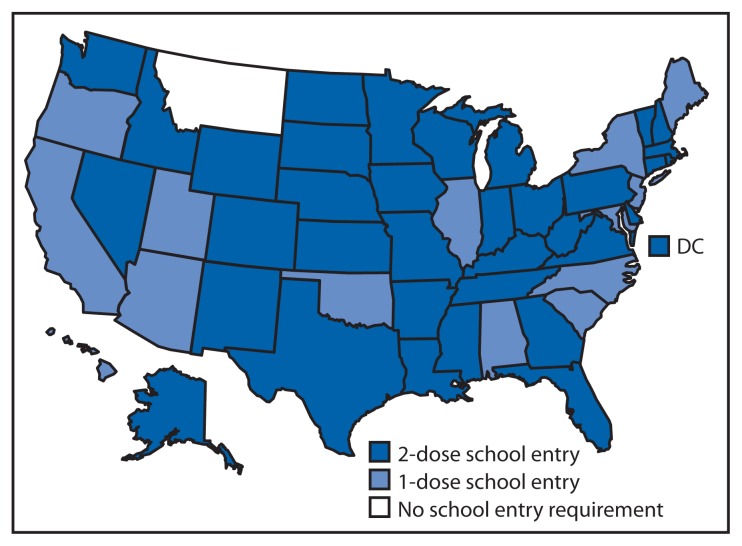
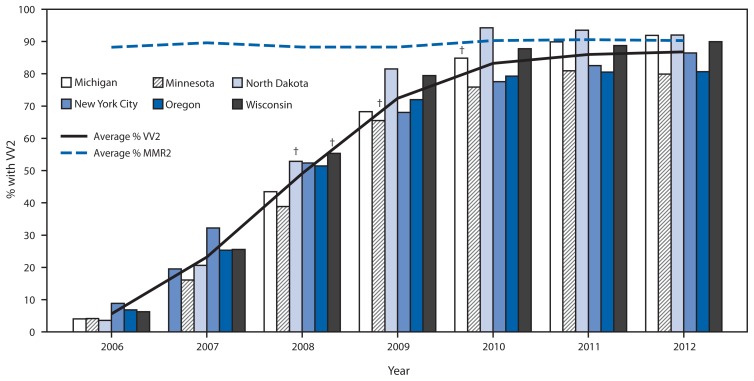
In 2007, the Advisory Committee on Immunization Practices (ACIP) recommended a routine second dose of varicella vaccine for children at age 4-6 years, in addition to the first dose given at age 12-15 months. One strategy recommended for increasing varicella vaccination coverage is a school entry requirement of proof of varicella immunity. To determine the extent of implementation of the routine 2-dose varicella vaccination program, the number of states with a 2-dose varicella vaccination elementary school entry requirement in 2012 was compared with the number in 2007, and 2-dose varicella vaccination coverage during 2006 was compared with coverage in 2012 among children aged 7 years, using data from six Immunization Information System (IIS) sentinel sites. The number of states (including the District of Columbia) with a 2-dose varicella vaccination elementary school entry requirement increased from four in 2007 to 36 in 2012. Two-dose varicella vaccination coverage levels among children aged 7 years in the six IIS sentinel sites increased from a range of 3.6%-8.9% in 2006 to a range of 79.9%-92.0% in 2012 and were approaching the levels of 2-dose measles, mumps, and rubella (MMR) coverage, which had a range of 81.9%-94.0% in 2012. These increases suggest substantial progress in implementing the routine 2-dose varicella vaccination program in the first 6 years since its recommendation by ACIP. Wider adoption of 2-dose varicella vaccination school entry requirements might help progress toward the Healthy People 2020 target of 95% of kindergarten students having received 2 doses of varicella vaccine.
Figures
References
-
- CDC. Prevention of varicella: recommendations of the Advisory Committee on Immunization Practices (ACIP) MMWR. 2007;56(RR-4) - PubMed
-
- CDC. Advisory Committee on Immunization Practices (ACIP) General recommendations on immunization: recommendations of the Advisory Committee on Immunization Practices (ACIP) MMWR. 2006;55(RR-15) - PubMed
-
- Community Preventive Services Task Force. Guide to community preventive services. Atlanta, GA: Community Preventive Services Task Force; 2010. Universally recommended vaccinations: immunization information systems. Available at http://www.thecommunityguide.org/vaccines/imminfosystems.html.
-
- Williams W, Lowery NE, Lyalin D, et al. Development and utilization of best practice operational guidelines for immunization information systems. J Public Health Manag Pract. 2011;17:449–56. - PubMed
-
- US Census Bureau. State single year of age and sex population estimates: April 1, 2010 to July 1, 2012—resident. Washington, DC: US Census Bureau; 2012. Available at http://www.census.gov/popest/data/state/asrh/2012/index.html.
MeSH terms
Substances
LinkOut - more resources
Full Text Sources
Medical
