


Behavioural flexibility allows an invasive vertebrate to survive in a semi-arid environment
- PMID: 24573152
- PMCID: PMC3949372
- DOI: 10.1098/rsbl.2013.1014
Behavioural flexibility allows an invasive vertebrate to survive in a semi-arid environment
Abstract
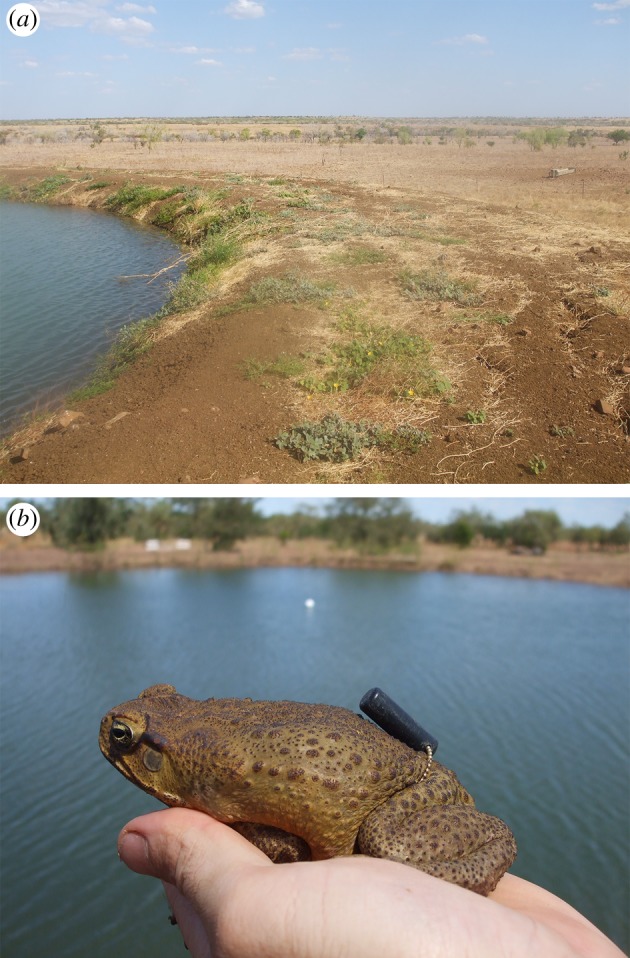
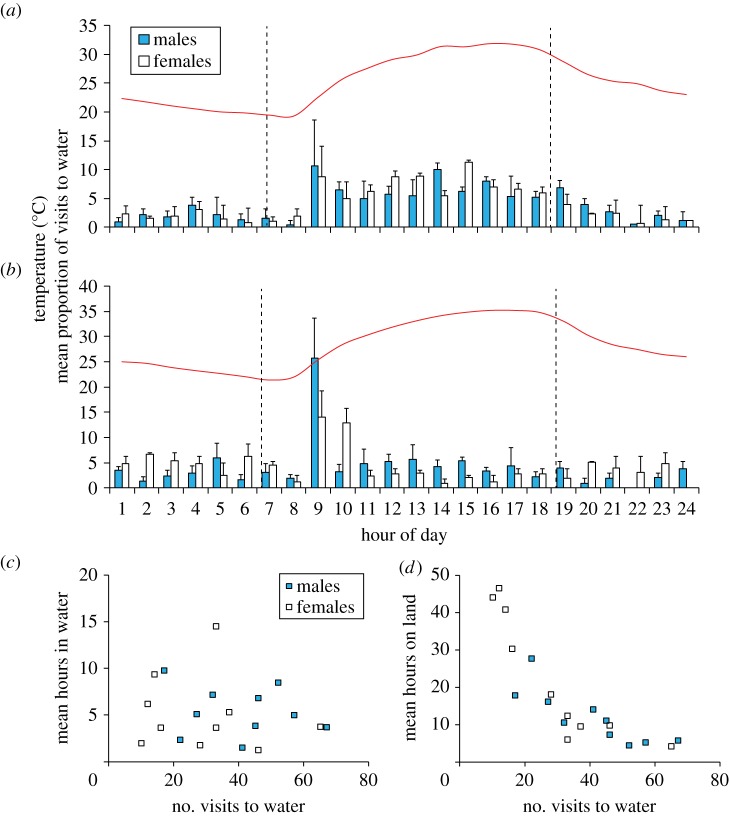
Plasticity or evolution in behavioural responses are key attributes of successful animal invasions. In northern Australia, the invasive cane toad (Rhinella marina) recently invaded semi-arid regions. Here, cane toads endure repeated daily bouts of severe desiccation and thermal stress during the long dry season (April-October). We investigated whether cane toads have shifted their ancestral nocturnal rehydration behaviour to one that exploits water resources during the day. Such a shift in hydration behaviour could increase the fitness of individual toads by reducing exposure to desiccation and thermal stress suffered during the day even within terrestrial shelters. We used a novel method (acoustic tags) to monitor the daily hydration behaviour of 20 toads at two artificial reservoirs on Camfield station, Northern Territory. Remarkably, cane toads visited reservoirs to rehydrate during daylight hours, with peaks in activity between 9.00 and 17.00. This diurnal pattern of rehydration activity contrasts with nocturnal rehydration behaviour exhibited by adult toads in their native geographical range and more mesic parts of Australia. Our results demonstrate that cane toads phase shift a key behaviour to survive in a harsh semi-arid landscape. Behavioural phase shifts have rarely been reported in invasive species but could facilitate ongoing invasion success.
Keywords: Rhinella marina; cane toad; invasive species; plasticity; temporal niche shift.
Figures
References
-
- Blackburn TM, Pysek P, Bacher S, Carlton JT, Duncan RP, Jarosik V, Wilson JRU, Richardson DM. 2011. A proposed unified framework for biological invasions. Trends Ecol. Evol. 26, 333–339 (doi:10.1016/j.tree.2011.03.023) - DOI - PubMed
-
- Chapple DG, Simmonds SM, Wong BBM. 2012. Can behavioral and personality traits influence the success of unintentional species introductions? Trends Ecol. Evol. 27, 57–64 (doi:10.1016/j.tree.2011.09.010) - DOI - PubMed
-
- Sih A, Cote J, Evans M, Fogarty S, Pruitt J. 2012. Ecological implications of behavioural syndromes. Ecol. Lett. 15, 278–289 (doi:10.1111/j.1461-0248.2011.01731.x) - DOI - PubMed
-
- Harrington LA, Harrington AL, Yamaguchi N, Thom MD, Ferreras P, Windham TR, MacDonald DW. 2009. The impact of native competitors on an alien invasive: temporal niche shifts to avoid interspecific aggression? Ecology 90, 1207–1216 (doi:10.1890/08-0302.1) - DOI - PubMed
-
- Kronfeld-Schor N, Dayan T. 2003. Partitioning of time as an ecological resource. Annu. Rev. Ecol. Evol. Syst. 34, 153–181 (doi:10.1146/annurev.ecolsys.34.011802.132435) - DOI
Publication types
MeSH terms
LinkOut - more resources
Full Text Sources
Other Literature Sources
Miscellaneous
