


Light therapy for improving cognition, activities of daily living, sleep, challenging behaviour, and psychiatric disturbances in dementia
- PMID: 24574061
- PMCID: PMC10837684
- DOI: 10.1002/14651858.CD003946.pub4
Light therapy for improving cognition, activities of daily living, sleep, challenging behaviour, and psychiatric disturbances in dementia
Abstract
Background: Rest-activity and sleep-wake cycles are controlled by the endogenous circadian rhythm generated by the suprachiasmatic nuclei (SCN) of the hypothalamus. Degenerative changes in the SCN appear to be a biological basis for circadian disturbances in people with dementia, and might be reversed by stimulation of the SCN by light.
Objectives: The review examines the effectiveness of light therapy in improving cognition, activities of daily living (ADLs), sleep, challenging behaviour, and psychiatric symptoms associated with dementia.
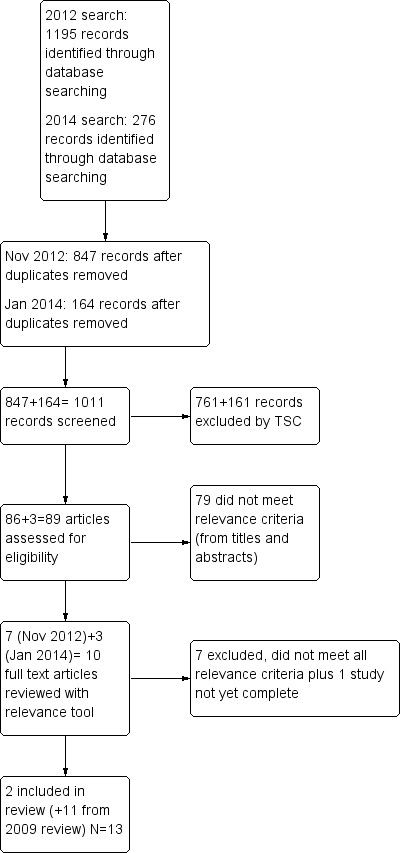
Search methods: ALOIS, the Specialized Register of the Cochrane Dementia and Cognitive Improvement Group (CDCIG), The Cochrane Library, MEDLINE, EMBASE, PsycINFO, CINAHL and LILACS were searched on 20 January 2014 using the terms: "bright light*", "light box*", "light visor*", "dawn-dusk*", phototherapy, "photo therapy", "light therapy" "light treatment", light* . The CDCIG Specialized Register contains records from all major healthcare databases (The Cochrane Library, MEDLINE, EMBASE, PsycINFO, CINAHL, LILACS) as well as from many trials databases and grey literature sources.
Selection criteria: All relevant, randomized controlled trials were included in which light therapy, at any intensity and duration, was compared with a control group for the effect of improving cognition, ADLs, sleep, challenging behaviour, and psychiatric symptoms associated with dementia (as well as institutionalization rates or cost of care). Included were people with dementia of any type and degree of severity.
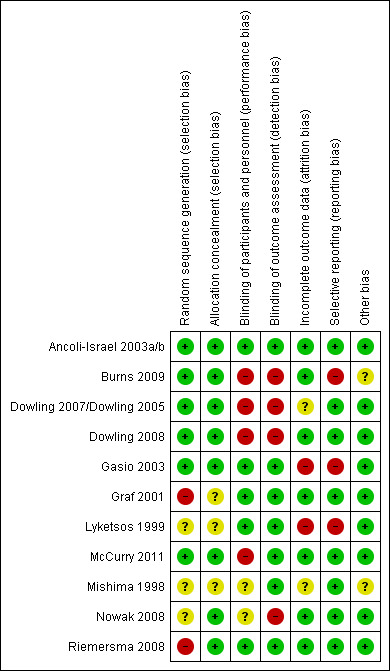
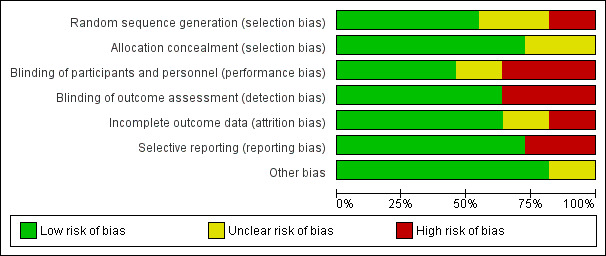
Data collection and analysis: Two review authors independently assessed the retrieved articles for relevance, and four review authors independently assessed the selected studies for risk of bias and extracted the data. Statistically significant differences in outcomes between the treatment and control groups at the end of treatment and follow-up were examined. Each study was summarized using a measure of effect (for example mean difference).
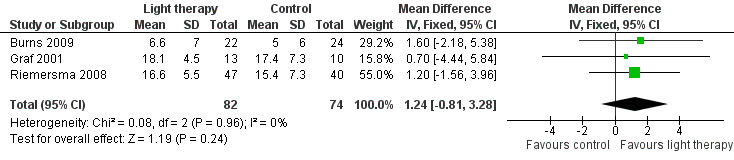
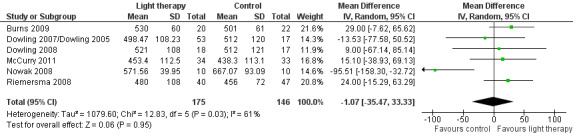
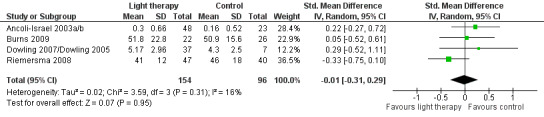
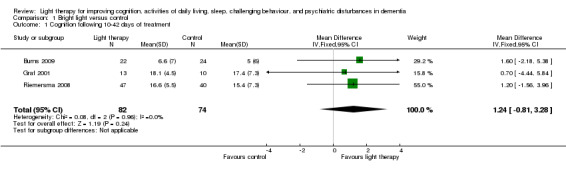
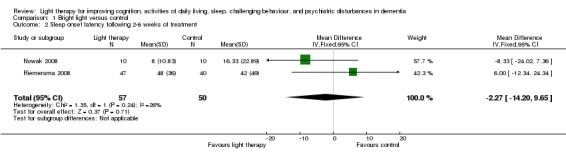
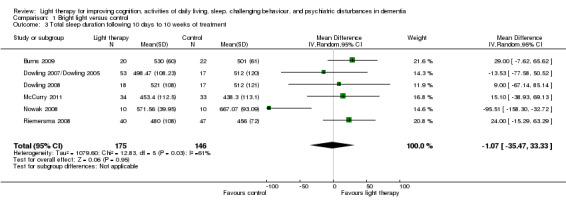
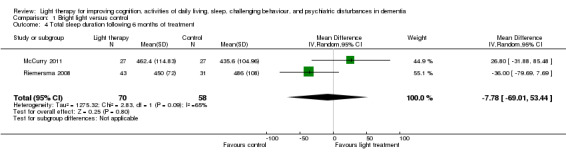
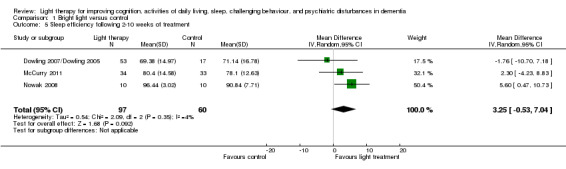
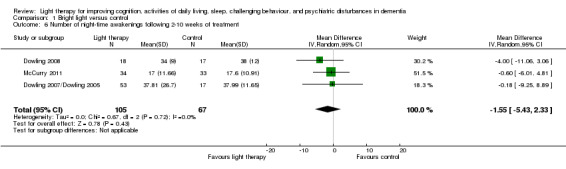
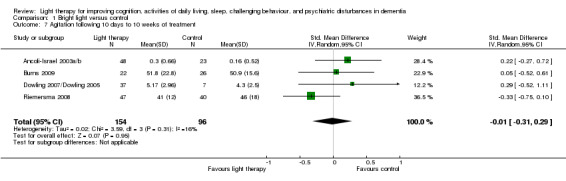
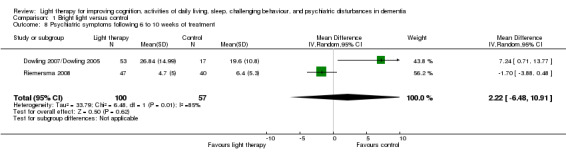
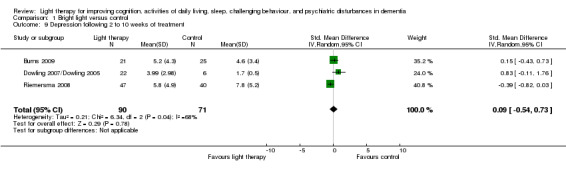
Main results: Eleven trials (13 articles) met the inclusion criteria. However, three of the studies could not be included in the analyses either because the reported data could not be used in the meta-analysis or we were unable to retrieve the required data from the authors.This updated review found no effect of light therapy on cognitive function, sleep, challenging behaviour (for example agitation), or psychiatric symptoms associated with dementia. Reduction in the development of ADL limitations was reported in one study, at three of five time points, and light therapy was found to have an effect after six weeks and two years but not after one year.
Authors' conclusions: There is insufficient evidence to justify the use of bright light therapy in dementia. Further research should concentrate on replicating the suggested effect on ADLs, and establishing the biological mechanism for how light therapy improves these important outcomes.
Conflict of interest statement
None known
Figures






Update of
-
Light therapy for managing cognitive, sleep, functional, behavioural, or psychiatric disturbances in dementia.Cochrane Database Syst Rev. 2009 Oct 7;(4):CD003946. doi: 10.1002/14651858.CD003946.pub3. Cochrane Database Syst Rev. 2009. Update in: Cochrane Database Syst Rev. 2014 Feb 26;(2):CD003946. doi: 10.1002/14651858.CD003946.pub4. PMID: 19821317 Updated.
References
References to studies included in this review
Ancoli‐Israel 2003a/b {published data only (unpublished sought but not used)}
-
- Ancoli‐Israel S, Gehrman P, Martin JL, Shochat T, Marler M, Corey‐Bloom J, et al. Increased light exposure consolidates sleep and strengthens circadian rhythms in severe Alzheimer's Disease patients. Behavioural Sleep Medicine 2003;1(1):22‐36. - PubMed
-
- Ancoli‐Israel S, Martin J, Gehrman P, Shochat T, Corey‐Bloom J, Marler M, et al. Effect of light on agitation in institutionalized patients with severe Alzheimer Disease. American Journal of Geriatric Psychiatry 2003;11(2):194‐203. - PubMed
Burns 2009 {published and unpublished data}
-
- Burns A, Allen H, Tomenson B, Duignan D, Byrne J. Bright light therapy for agitation in dementia: A randomized controlled trial. International Psychogeriatrics 2009;21(4):711‐21. - PubMed
Dowling 2007/Dowling 2005 {published data only}
Dowling 2008 {published data only}
Gasio 2003 {published and unpublished data}
-
- Gasio PF, Krauchi K, Cajochen C, Someren E, Amrhein I, Pache M, et al. Dawn‐dusk simulation light therapy of disturbed circadian rest‐activity cycles in demented elderly. Experimental Gerontology 2003;38(1‐2):207‐16. - PubMed
Graf 2001 {published data only}
-
- Graf A, Wallner C, Schubert V, Willeit M, Wlk W, Fischer P, et al. The effects of light therapy on Mini‐Mental State Examination scores in demented patients. Biological Psychiatry 2001;50(9):725‐7. - PubMed
Lyketsos 1999 {published data only}
-
- Lyketsos CG, Veiel LL, Baker A, Steele C. A randomized, controlled trial of bright light therapy for agitated behaviors in dementia patients residing in long‐term care. International Journal of Geriatric Psychiatry 1999;14(7):520‐5. - PubMed
McCurry 2011 {published data only}
-
- McCurry SM, Pike KC, Vitiello MV, Logsdon RG, Larson EB, Teri L. Increasing walking and bright light exposure to improve sleep in community‐dwelling persons with Alzheimer's disease: Results of a randomized, controlled trial. Journal of the American Geriatrics Society 2011;59(8):1393‐402. - PMC - PubMed
Mishima 1998 {published data only}
-
- Mishima K, Hishikawa Y, Okawa M. Randomized, dim light controlled, crossover test of morning bright light therapy for rest‐activity rhythm disorders in patients with vascular dementia and dementia of Alzheimer's type. Chronobiology International 1998;15(6):647‐54. - PubMed
Nowak 2008 {published data only}
-
- Nowak L. The effect of timed blue‐green light on sleep‐wake patterns in women with Alzheimer's disease. Dissertation Abstracts International: Section B: The Sciences and Engineering 2008;69(6‐B):1‐154.
Riemersma 2008 {published data only}
-
- Riemersma‐van der Lek RF, Swaab DF, Twisk J, Hol EM, Hoogendijk WJG, Someren EJW. Effect of bright light and melatonin on cognitive and noncognitive function in elderly residents of group care facilities: A randomized controlled trial. JAMA 2008;299(22):2642‐55. - PubMed
References to studies excluded from this review
Abegg 1993 {published data only}
-
- Abegg A, Wettstein A. Phototherapy of behavioral disorders as a sequela of disordered circadian rhythm in dementia in the elderly: Difficulties in practical applications [Lichttherapie von verhaltensstorungen als folge gestorter zirkadianer rhythmen bei dementiellen alterspatienten: Schwierigkeiten der praktisch‐klinischen anwendbarkeit]. Schweizer Archiv fur Neorologie und Psychiatrie Band 1993;144(1):63‐80. - PubMed
Ancoli‐Israel 1997 {published data only}
-
- Ancoli‐Israel S, Klauber MR, Williams Jones D, Kripke DF, Martin J, Mason W, et al. Variations in circadian rhythms of activity, sleep, and light exposure related to dementia in nursing‐home patients. Sleep 1997;20(1):18‐23. - PubMed
Ancoli‐Israel 2002 {published data only}
Barrick 2010 {published data only}
Chong 2013 {published data only}
Colenda 1997 {published data only}
-
- Colenda CC, Cohen W, McCall WV, Rosenquist PB. Phototherapy for patients with Alzheimer disease with disturbed sleep patterns: Results of a community‐based pilot study. Alzheimer Disease and Associated Disorders 1997;11:175‐8. - PubMed
Connell 2007 {published data only}
-
- Connell BR, Sanford JA, Lewis D. Therapeutic effects of an outdoor activity program on nursing home residents with dementia. Journal of Housing for the Elderly 2007;21(3‐4):195‐209.
Dawson 1999 {published data only}
-
- Dawson P. Bright light treatment for people with Alzheimer's disease. Perspectives 1999;23(1):25‐6. - PubMed
Dowling 2005a {published data only}
Fetveit 2003 {published data only}
-
- Fetveit A, Skjerve A, Bjorvatn B. Bright light treatment improves sleep in institutionalised elderly ‐ an open trial. International Journal of Geriatric Psychiatry 2003;18:520‐6. - PubMed
Haffmans 2001 {published data only}
-
- Haffmans PMJ, Sival RC, Lucius SAP, Cats Q, Gelder L. Bright light therapy and melatonin in motor restless behaviour in dementia: A placebo‐controlled study. International Journal of Geriatric Psychiatry 2001;16:106‐10. - PubMed
Hickman 2007 {published data only}
-
- Hickman SE, Barrick AL, Williams CS, Zimmerman S, Connell BR, Preisser JS, et al. The effect of ambient bright light therapy on depressive symptoms in persons with dementia. Journal of the American Geriatrics Society 2007;55:1817‐24. - PubMed
Hozumi 1990 {published data only}
-
- Hozumi S, Okawa M, Mishima K, Hishikawa Y, Hori H, Takahashi K. Phototherapy for elderly patients with dementia and sleep‐wake rhythm disorders‐A comparison between morning and evening exposure. The Japanese Journal of Psychiatry and Neurology 1990;44(4):813‐4.
Ito 1999 {published data only}
-
- Ito T, Yamadera H, Ito R, Endo S. Effects of bright light on cognitive disturbances in Alzheimer‐type dementia. Nippon‐Ika_Daigaku‐Zusshi 1999;66(4):229‐38. - PubMed
Ito 2001 {published data only}
-
- Ito T, Yamadera H, Ito R, Suzuki H, Asayama K, Endo S. Effects of vitamin B12 on bright light on cognition and sleep‐wake rhythm in Alzheimer‐type dementia. Psychiatry Clinical Neuroscience 2001;55:281‐2. - PubMed
Kobayashi 2001 {published data only}
-
- Kobayashi R, Fukuda N, Kohsaka M, et al. Effects of bright light at lunchtime on sleep in a geriatric hospital. Psychiatry and Clinical Neurosciences 2001;55:287‐9. - PubMed
Koyama 1999 {published data only}
-
- Koyama E, Matsubara H, Nakano T. Bright light treatment for sleep‐wake disturbances in aged individuals with dementia. Psychiatry and Clinical Neuroscience 1999;53(2):227‐9. - PubMed
Laborie 2010 {published data only}
-
- Laborie S. Effect of bright light and melatonin on cognitive and non‐cognitive function. Cahiers de l'Annee Gerontologique 2010;2(3):194‐8.
Lovell 1995 {published data only}
-
- Lovell BB, Ancoli‐Israel S, Gevirtz R. Effect of bright light treatment on agitated behavior in institutionalized elderly subjects. Psychiatry Research 1995;57:7‐12. - PubMed
McCurry 2005 {published data only}
-
- McCurry SM, Gibbons LE, Logsdon RG, Vitiello MV, Teri L. Nighttime insomnia treatment and education for Alzheimer’s Disease: A randomized controlled trial. Journal of the American Geriatics Society 2005;53(5):793‐802. - PubMed
McCurry 2006 {published data only}
-
- McCurry SM, Logsdon RG, Gibbon LE, Vitiello MV, Teri L. Behavioral treatment for sleep disturbances in Alzheimer's Disease: The Nite‐AD study. Research and Practice in Alzheimer's Disease 2006;11:341‐6.
Mishima 1994 {published data only}
-
- Mishima K, Okawa M, Hishikawa Y, Hozumi S, Hori H, Takahashi K. Morning bright light therapy for sleep and behavior disorders in elderly patients with dementia. Acta Psychiatrica Scandinavica 1994;89:1‐7. - PubMed
Mishima 2000 {published data only}
-
- Mishima K, Okawa M, Hozumi S, Hishikawa Y. Supplementary administration of artificial bright light and melatonin as potent treatment for disorganized circadian rest‐activity and dysfunctional autonomic and neuroendocrine systems in institutionalized demented elderly persons. Chronobiology International 2000;17(3):419‐32. - PubMed
NCT01816152 {published data only}
-
- NCT01816152. Methodology Issues in a Tailored Light Treatment for Persons With Dementia. ClinicalTrials.gov NCT01816152.
Okawa 1989 {published data only}
-
- Okawa M, Mishima K, Shimizu T, Iijima S, Hishikawa Y, Hozumi S, Hori H. Sleep‐waking rhythm disorders and their phototherapy in elderly patients with dementia. The Japanese Journal of Psychiatry and Neurology 1989;43(2):293‐5.
Okawa 1999a {published data only}
-
- Okawa M, Mishima K, Hishikawa Y, Hozumi S, Hori H. Sleep disorder in elderly patients with dementia and trials of new treatments‐Enforcement of social interaction and bright light therapy. Unknown 1999;Unknown:128‐32.
Okawa 1999b {published data only}
-
- Okawa M, Mishima K, Hozumi S. Effects of environmental stimulation with bright light and transcranial electrostimulation on sleep and behavior disorders in elderly patients with dementia. Alzheimer's Disease and Related Disorders 1999;87:757‐62.
Okumoto 1998 {published data only}
-
- Okumoto Y, Koyama E, Matsubara H, Nakano T, Nakamura R. Aging and sleep: Sleep improvement by light in a demented aged individual. Psychiatry and Clinical Neurosciences 1998;52(2):194‐6. - PubMed
Porter 2012 {published data only}
Rheaume 1998 {published data only}
-
- Rheame Y, Manning B, Harper D, Volcier L. Effect of light therapy upon disturbed behaviors in Alzheimer patients. American Journal of Alzheimer's Disease 1998;13(6):291‐5.
Riemersma 2001 {published data only}
-
- Riemersma R, Hutten R, Kalis A, Hoekstra R, Hoogendijk W, Scherder E, Swaab D, Someren E. Indirect bright light therapy decreases sleep fragmentation in institutionalized demented elderly. Sleep‐Wake Research in the Netherlands 2001;12:96‐8.
Satlin 1992 {published data only}
-
- Satlin A, Volicer L, Ross V, Herz L, Campbell S. Bright light treatment of behavioral and sleep disturbances in patients with Alzheimer's disease. American Journal of Psychiatry 1992;149:1028‐32. - PubMed
Skjerve 2004 {published data only}
-
- Skjerve A, Holsten F, Aarsland D, Bjorvatn B, Nygaard HA, Johansen IM. Improvement in behavioral symptoms and advance of activity acrophase after short‐term bright light treatment in severe dementia. Psychiatry and Clinical Neurosciences 2004;58:343‐7. - PubMed
Sloane 2007 {published data only}
-
- Sloane PD. High‐intensity environmental light in dementia: Effect on sleep and activity. Journal of the American Geriatrics Society 2007;55:1524‐33. - PubMed
Thorpe 2000 {published data only}
-
- Thorpe L, Middleton J, Russell G, Stewart N. Bright light therapy for demented nursing home patients with behavioral disturbance. American Journal of Alzheimer's Disease 2000;15(1):18‐26.
Van Hoof 2009 {published data only}
-
- Hoof J, Aarts MPJ, Rense CG, Schoutens AMC. Ambient bright light in dementia: effects on behaviour and circadian rhythmicity. Building and Environment 2009;44(1):146‐55.
van Someren 1997 {published data only}
-
- Someren EJW, Kessler A, Mirmiran M, Swaab DF. Indirect bright light improves circadian rest‐activity rhythm disturbances in demented patients. Biological Psychiatry 1997;41:955‐63. - PubMed
Yamadera 2000 {published data only}
-
- Yamadera H, Ito T, Suzuki H, Asyama K, Ito R, Endo S. Effects of bright light on cognitive and sleep‐wake (circadian) rhythm disturbances in Alzheimer‐type dementia. Psychiatry and Clinical Neurosciences 2000;54:352‐3. - PubMed
References to ongoing studies
Additional references
APA 1995
-
- American Psychiatric Association. Diagnostic and statistical manual of mental disorders. 4th Edition. Washington, DC: American Psychiatric Association, 1995.
ASC 2013
-
- Alzheimer Society of Canada. What is dementia?. http://www.alzheimer.ca/en/About‐dementia/Dementias/What‐is‐dementia accessed March 28 2013.
Balk 2002
-
- Balk EM, Bonis PAL, Moskowitz H, Schmid CH, Ioannidis JPA, Wang C, et al. Correlation of quality measures with estimates of treatment effect in meta‐analyses of randomized controlled trials. JAMA 2002;287:2973‐82. - PubMed
Campbell 1995
-
- Campbell SS, Terman M, Lewy AJ, et al. Light treatment for sleep disorders: Consensus report. V. Age‐related disturbances. Journal of Biological Rhythms 1995;10:151‐4. - PubMed
David 2010
-
- David R, Zeitzer J, Friedman L, Noda A, O'Hara R, Robert P, Yesavage JA. Non pharmacologic management of sleep disturbance in Alzheimer's disease. The Journal of Nutrition, Health & Aging 2010;14(3):203‐6. - PubMed
Davis 2001
-
- Davis FA. Taber's Cyclopedic Medical Dictionary. 19th Edition. Philadelphia: FA Davis, 2001.
Feldman 2005
-
- Feldman HH, Woodward M. The staging and assessment of moderate to severe Alzheimer disease. Neurology 2005;65 Suppl 3:S10‐7.
Folstein 1975
-
- Folstein MF, Folstein SE, McHugh PR. "Mini‐mental state". A practical method for grading the cognitive state of patients for the clinician. Journal of Psychiatric Research 1975;12:189‐98. - PubMed
Harper 2001
-
- Harper DG, Stopa EG, McKee AC, Satlin A, Harlan PC, Goldstein R, Volicer L. Differential circadian rhythm disturbances in men with Alzheimer disease and frontotemporal degeneration. Archives of General Psychiatry 2001;58:353‐60. - PubMed
Harper 2008
Higgins 2002
-
- Higgins JPT, Thompson SG. Quantifying heterogeneity in a meta‐analysis. Statistics in Medicine 2002;21:1539‐58. - PubMed
Higgins 2003
Higgins 2011
-
- Higgins JPT, Green S (editors). Cochrane Handbook for Systematic Reviews of Interventions 5.1.0 (updated March 2011). The Cochrane Collaboration. Available from www.cochrane‐handbook.org 2011.
Hogan 2007
-
- Hogan DB, Bailey P, Carswell A, Clarke C, Forbes D, et al. Management of mild to moderate Alzheimer's disease and dementia. Alzheimer's & Dementia 2007;3(4):355‐84. - PubMed
Kjaergard 2001
-
- Kjaergard LL, Villumsen J, Gluud C. Reported methodologic quality and discrepancies between large and small randomized trials in meta‐analyses. Annals of Internal Medicine 2001;135:982‐9. - PubMed
Kong 2009
-
- Kong EH, Evans LK, Guevara JP. Nonpharmacological intervention for agitation in dementia: A systematic review and meta‐analysis. Aging and Mental Health 2009;13(4):512‐20. - PubMed
Liu 2000
-
- Liu RY, Zhou JN, Hoogendijk WJG, Heerikhuize J, Kamphorst W, Unmehopa UA, et al. Decreased vasopressin gene expression in the biological clock of Alzheimer disease patients with and without depression. Journal of Neuropathology and Experimental Neurology 2000;59(4):314‐22. - PubMed
Martin 2007
-
- Martin JL, Marler MR, Harker JO, Josephson KR, Alessi CA. A multicomponent nonpharmacological intervention improves activity rhythms among nursing home residnets with disrupted sleep/wake patterns. The Journals of Gerontology: Series A: Biological Sciences and Medical Sciences 2007;62A(1):67‐72. - PubMed
McCurry 2000
-
- McCurry SM, Reynolds III CF, Ancoli‐Israel S, Teri L, Vitiello MV. Treatment of sleep disturbances in Alzheimer's disease. Sleep Medicine Reviews 2000;4(6):603‐28. - PubMed
McKhann 1984
-
- McKhann G, Drachman D, Folstein M, Katzman R, Price D, Stadlan EM. Clinical diagnosis of Alzheimer's disease: report of the NINCDS‐ADRDA Work Group under the auspices of Department of Health and Human Services Task Force on Alzheimer's disease. Neurology 1984;34:939‐44. - PubMed
Mishima 1997
-
- Mishima K, Okawa M, Satoh K, Shimizu T, Hozumi S, Hishikawa Y. Different manifestations of circadian rhythms in seniledementia of Alzheimer’s type and multi‐infarct dementia. Neurobiology of Aging 1997;18:105‐9. - PubMed
Nowak 2011
-
- Nowak L, Davis J. Qualitative analysis of therapeutic light effects on global function in Alzheimer’s Disease. Western Journal of Nursing Research 2011;33(7):933‐52 DOI: 10.1177/0193945910386248. - PubMed
Padilla 2011
-
- Padilla R. Effectiveness of environment‐based interventions for people with Alzheimer's disease and related dementias. American Journal of Occupational Therapy 2011;65(5):514‐22. - PubMed
Paniagua 2008
-
- Paniagua MA, Paniagua EW. The demented elder with insomnia. Clinics in Geriatric Medicine 2008;24:69‐81. - PubMed
Pildal 2007
-
- Pildal J, Hrobjartsson A, Jørgensen KJ, Hilden J, Altman DG, Gotzsche PC. Impact of allocation concealment on conclusions drawn from meta‐analyses of randomized trials. International Journal of Epidemiology 2007;36:847‐57. - PubMed
Porta 2007
-
- Porta N, Bonet C, Cobo E. Discordance between reported intention‐to‐treat and per protocol analyses. Journal of Clinical Epidemiology 2007;60:663‐9. - PubMed
Salami 2011
Schulz 1995
-
- Schulz KF, Chalmers I, Hayes RJ, Altman DG. Empirical evidence of bias: Dimensions of methodological quality associated with estimates of treatment effects in controlled trials. JAMA 1995;273:408‐12. - PubMed
Shirani 2009
Siersma 2007
-
- Siersma V, Als‐Nielsen B, Chen W, Hilden J, Gluud LL, Gluud C. Multivariable modelling for meta‐epidemiological assessment of the association between trial quality and treatment effects estimated in randomized clinical trials. Statistics in Medicine 2007;26(14):2745‐58. - PubMed
Tierney 2005
-
- Tierney JF, Stewart LA. Investigating patient exclusion bias in meta‐analysis. International Journal of Epidemiology 2005;34:79‐87. - PubMed
van Someren 1996
-
- Someren EJW, Hagebeuk EEO, Lijzenga C, Scheltens P, Rooij SEJA, Jonker C, et al. Circadian rest‐activity rhythm disturbances in Alzheimer's Disease. Biological Psychiatry 1996;40:259‐70. - PubMed
Weldemichael 2010
WHO 1992
-
- World Health Organization. The ICD‐10 Classification of Mental and Behavioural Disorders: Clinical Descriptions and Diagnostic Guidelines. Geneva: World Health Organization, Division of Mental Health, 1992.
WHO 2012
-
- World Health Organization (WHO) and Alzheimer Disease International. Dementia: A Public Health Priority. http://whqlibdoc.who.int/publications/2012/9789241564458_eng.pdf 2012.
Wild 2003
Wood 2004
-
- Wood AM, White IR, Thompson SG. Are missing outcome data adequately handled? A review of published randomized controlled trials in major medical journals. Clinical Trials 2004;1:368‐76. - PubMed
Wood 2008
World Alzheimer Report 2012
-
- Alzheimer Disease International. World Alzheimer Report 2012. Overcoming the stigma of dementia. http://www.alz.co.uk/research/WorldAlzheimerReport2012.pdf September 2012.
References to other published versions of this review
Forbes 2004
-
- Forbes D, Morgan DG, Bangma J, Peacock S, Adamson J. Light therapy for managing sleep, behaviour, and mood disturbances in dementia. Cochrane Database of Systematic Reviews 2004, Issue 2. - PubMed
Publication types
MeSH terms
LinkOut - more resources
Full Text Sources
Other Literature Sources
Medical
Miscellaneous
