


Probiotics for preventing gestational diabetes
- PMID: 24574258
- PMCID: PMC6885033
- DOI: 10.1002/14651858.CD009951.pub2
Probiotics for preventing gestational diabetes
Update in
-
Probiotics for preventing gestational diabetes.Cochrane Database Syst Rev. 2021 Apr 19;4(4):CD009951. doi: 10.1002/14651858.CD009951.pub3. Cochrane Database Syst Rev. 2021. PMID: 33870484 Free PMC article.
Abstract
Background: Gestational diabetes mellitus (GDM) is associated with a range of adverse pregnancy outcomes for mother and infant. The prevention of GDM using lifestyle interventions has proven difficult. The gut microbiome (the composite of bacteria present in the intestines) influences host inflammatory pathways, glucose and lipid metabolism and, in other settings, alteration of the gut microbiome has been shown to impact on these host responses. Probiotics are one way of altering the gut microbiome but little is known about their use in influencing the metabolic environment of pregnancy.
Objectives: To assess the effects of probiotic supplementation when compared with other methods for the prevention of GDM.
Search methods: We searched the Cochrane Pregnancy and childbirth Group's Trials Register (31 August 2013) and reference lists of the articles of retrieved studies.
Selection criteria: Randomised and cluster-randomised trials comparing the use of probiotic supplementation with other methods for the prevention of the development of GDM. Cluster-randomised trials were eligible for inclusion but none were identified. Quasi-randomised and cross-over design studies are not eligible for inclusion in this review. Studies presented only as abstracts with no subsequent full report of study results would also have been excluded.
Data collection and analysis: Two review authors independently assessed study eligibility, extracted data and assessed risk of bias of included study. Data were checked for accuracy.
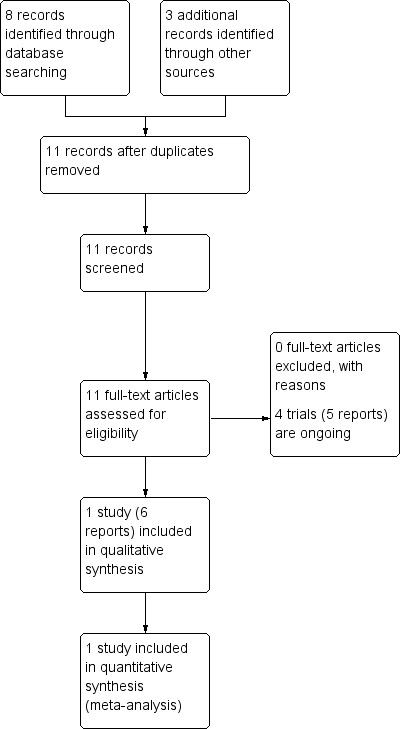
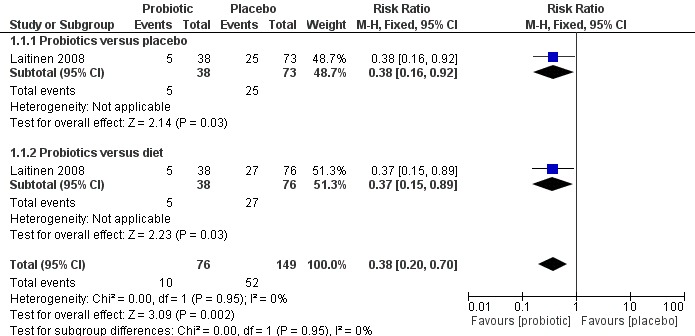
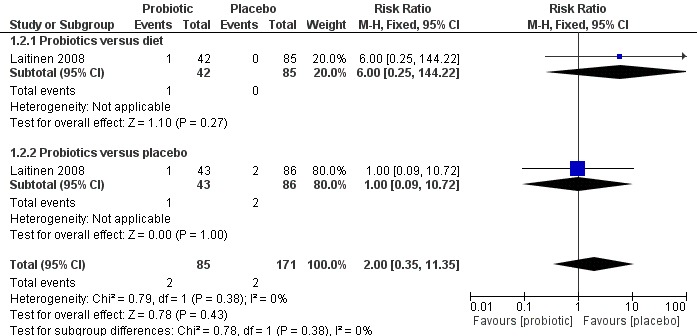
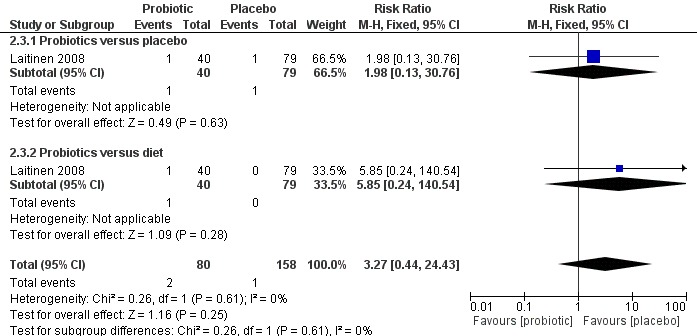
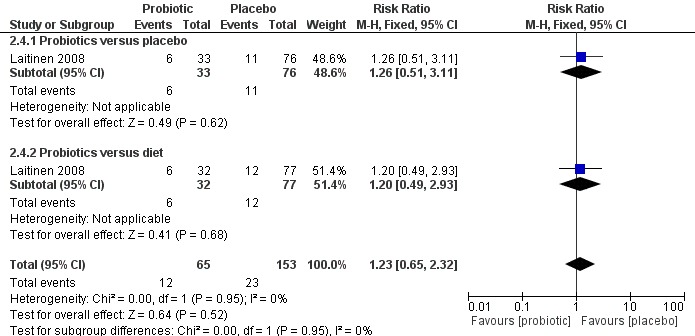
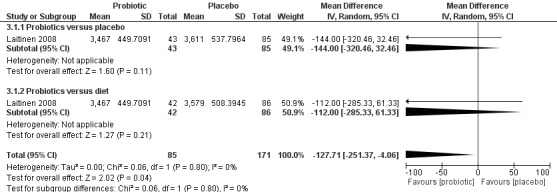
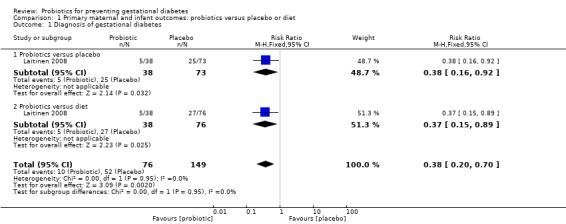
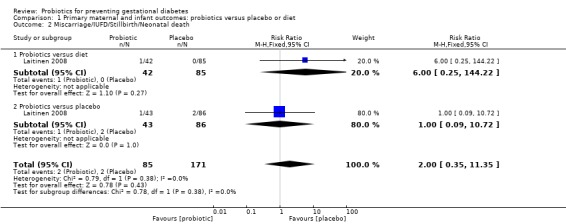
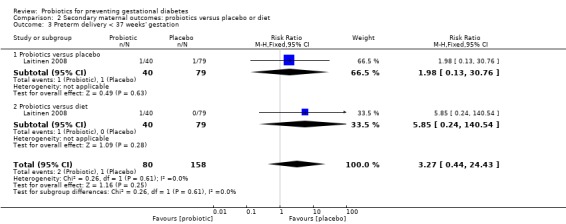
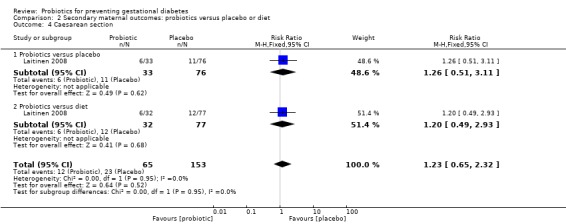
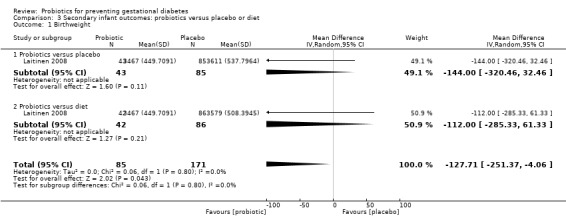
Main results: Eleven reports (relating to five possible trials) were found. We included one study (six trial reports) involving 256 women. Four other studies are ongoing.The included trial consisted of three treatment arms: probiotic with dietary intervention, placebo and dietary intervention, and dietary intervention alone; it was at a low risk of bias. The study reported primary outcomes of a reduction in the rate of gestational diabetes mellitus (risk ratio (RR) 0.38, 95% confidence interval (CI) 0.20 to 0.70), with no statistical difference in the rates of miscarriage/intrauterine fetal death (IUFD)/stillbirth/neonatal death (RR 2.00, 95% CI 0.35 to 11.35). Secondary outcomes reported were a reduction in infant birthweight (mean difference (MD) -127.71 g, 95% CI -251.37 to -4.06) in the probiotic group and no clear evidence of increased risk of preterm delivery (RR 3.27, 95% CI 0.44 to 24.43), or caesarean section rate (RR 1.23, 95% CI 0.65 to 2.32). The primary infant outcomes of rates of macrosomia and large-for-gestational age infants were not reported. The following secondary outcomes were not reported: maternal gestational weight gain, pre-eclampsia, and the long-term diagnosis of diabetes mellitus; infant body composition, shoulder dystocia, admission to neonatal intensive care, jaundice, hypoglycaemia and long-term rates of obesity and diabetes mellitus.
Authors' conclusions: One trial has shown a reduction in the rate of GDM when women are randomised to probiotics early in pregnancy but more uncertain evidence of any effect on miscarriage/IUFD/stillbirth/neonatal death. There are no data on macrosomia. At this time, there are insufficient studies to perform a quantitative meta-analysis. Further results are awaited from four ongoing studies.
Conflict of interest statement
Louise Conwell ‐ none known.
Leonie Callaway, Marloes Dekker Nitert and Helen Barrett are investigators in a trial examining the use of probiotics for preventing gestational diabetes mellitus (Callaway 2012) ‐ Leonie Callaway is the primary investigator of this trial. In future updates of this review, these investigators will not be involved in any decisions relating to their trial: assessment of the trial for inclusion, assessment of risk of bias and data extraction will be carried out by individuals who are not directly involved in the trial. Louise Conwell (review author) and a third party will carry out these tasks.
Figures
Comment in
-
What do Cochrane systematic reviews say about probiotics as preventive interventions?Sao Paulo Med J. 2017 Nov-Dec;135(6):578-586. doi: 10.1590/1516-3180.2017.0310241017. Sao Paulo Med J. 2017. PMID: 29267517 Free PMC article.
References
References to studies included in this review
-
- Aaltonen J, Ojala T, Laitinen K, Piirainen TJ, Poussa TA, Isolauri E. Evidence of infant blood pressure programming by maternal nutrition during pregnancy: a prospective randomized controlled intervention study. Journal of Pediatrics 2008;152:79‐84. - PubMed
- Aaltonen J, Ojala T, Laitinen K, Poussa T, Ozanne S, Isolauri E. Impact of maternal diet during pregnancy and breastfeeding on infant metabolic programming: a prospective randomized controlled study. European Journal of Clinical Nutrition 2011;65(1):10‐9. - PubMed
- Laitinen K, Poussa T, Isolauri E. Probiotics and dietary counselling contribute to glucose regulation during and after pregnancy: a randomised controlled trial. British Journal of Nutrition 2008;101(11):1679‐87. - PubMed
- Luoto R, Laitinen K, Nermes M, Isolauri E. Impact of maternal probiotic‐supplemented dietary counseling during pregnancy on colostrum adiponectin concentration: A prospective, randomized, placebo‐controlled study. Early Human Development 2012;88(6):339‐44. - PubMed
- Luoto R, Laitinen K, Nermes M, Isolauri E. Impact of maternal probiotic‐supplemented dietary counselling on pregnancy outcome and prenatal and postnatal growth: a double‐blind, placebo‐controlled study. British Journal of Nutrition 2010;103(12):1792‐9. - PubMed
- Piirainen T, Isolauri E, Lagstrom H, Laitinen K. Impact of dietary counselling on nutrient intake during pregnancy: a prospective cohort study. British Journal of Nutrition 2006;96(6):1095‐104. - PubMed
References to ongoing studies
-
- Ahmed B, Jabbar A, Nanji K, Khowaja A, Saleem S, Sikandar R. Effects of probiotics (lactobacillus rhamnosus) in reducing glucose intolerance during and after pregnancy: a double blind randomized controlled trial in antenatal clinic of Karachi‐Pakistan (GRIP). http://clinicaltrials.gov/show/NCT01436448 (accessed 6 July 2012).
-
- Callaway L. Randomized placebo controlled trial of probiotics in overweight and obese women to assess the prevention of gestational diabetes. http://www.anzctr.org.au/trial_view.aspx?ID=347738 (accessed 6 July 2012).
- Dekker Nitert M, Barrett HL, Foxcroft K, Tremellen A, Wilkinson S, Lingwood B, et al. SPRING: an RCT study of probiotics in the prevention of gestational diabetes mellitus in overweight and obese women. BMC Pregnancy and Childbirth 2013;13:50. - PMC - PubMed
-
- McAuliffe F. A randomised control trial of probiotics in pregnancy to reduce maternal glucose in obese and gestational diabetic women. http://www.controlled‐trials.com/ISRCTN97241163 (accessed 6 July 2012).
-
- Wickens K. A randomized placebo controlled trial of the effects of the probiotic Lactobacillus rhamnosus HN001 taken from the 1st trimester of pregnancy till 6 months post partum, if breastfeeding, on the development of eczema and atopic sensitization in infants by age 12 months. http://www.anzctr.org.au/trial_view.aspx?ID=362049 (accessed 6 July 2012).
Additional references
-
- ACOG Committee. ACOG Committee Opinion number 315, September 2005. Obesity in pregnancy. Obstetrics & Gynecology 2005;106(3):671‐5. - PubMed
-
- Andreasen AS, Larsen N, Pedersen‐Skovsgaard T, Berg RM, Moller K, Svendsen KD, et al. Effects of Lactobacillus acidophilus NCFM on insulin sensitivity and the systemic inflammatory response in human subjects. British Journal of Nutrition 2010;104(12):1831‐8. - PubMed
-
- Backhed F. Changes in intestinal microflora in obesity: cause or consequence?. Journal of Pediatric Gastroenterology and Nutrition 2009;48(Suppl 2):S56‐S57. - PubMed
Publication types
MeSH terms
LinkOut - more resources
Full Text Sources
Other Literature Sources
Medical
