Comparative effectiveness of radical prostatectomy and radiotherapy in prostate cancer: observational study of mortality outcomes
- PMID: 24574496
- PMCID: PMC3936107
- DOI: 10.1136/bmj.g1502
Comparative effectiveness of radical prostatectomy and radiotherapy in prostate cancer: observational study of mortality outcomes
Abstract
Objective: To compare the survival outcomes of patients treated with surgery or radiotherapy for prostate cancer.
Design: Observational study.
Setting: Sweden, 1996-2010.
Participants: 34,515 men primarily treated for prostate cancer with surgery (n=21,533) or radiotherapy (n=12,982). Patients were categorised by risk group (low, intermediate, high, and metastatic), age, and Charlson comorbidity score.
Main outcome measures: Cumulative incidence of mortality from prostate cancer and other causes. Competing risks regression hazard ratios for radiotherapy versus surgery were computed without adjustment and after propensity score and traditional (multivariable) adjustments, as well as after propensity score matching. Several sensitivity analyses were performed.
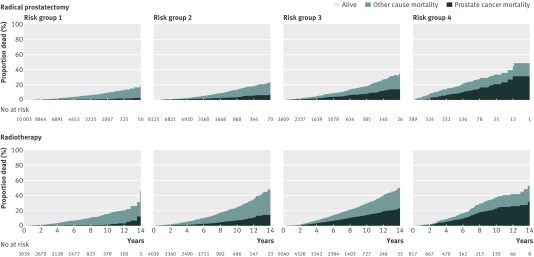
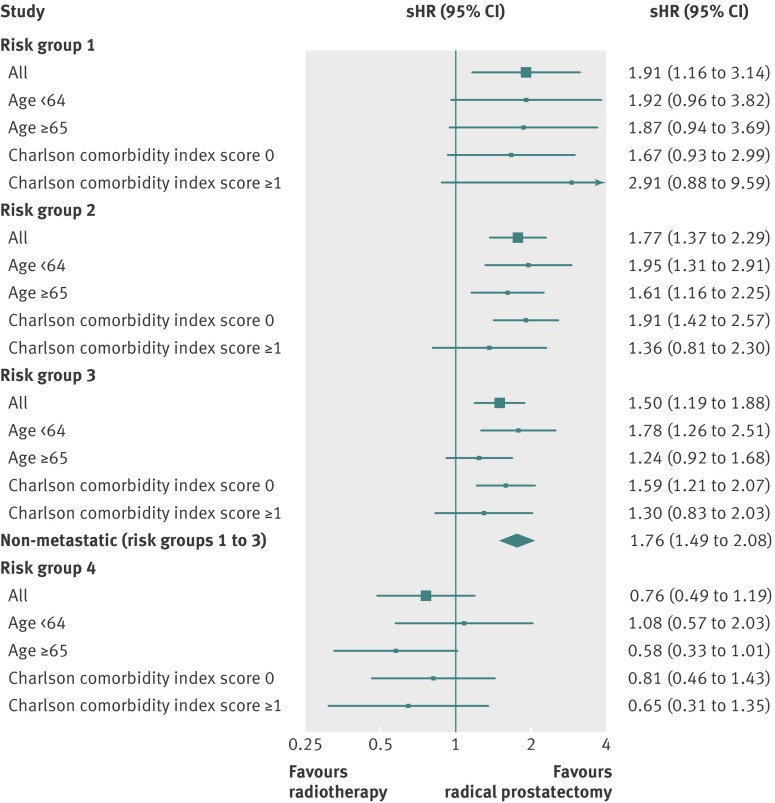
Results: Prostate cancer mortality became a larger proportion of overall mortality as risk group increased for both the surgery and the radiotherapy cohorts. Among patients with non-metastatic prostate cancer the adjusted subdistribution hazard ratio for prostate cancer mortality favoured surgery (1.76, 95% confidence interval 1.49 to 2.08, for radiotherapy v prostatectomy), whereas there was no discernible difference in treatment effect among men with metastatic disease. Subgroup analyses indicated more clear benefits of surgery among younger and fitter men with intermediate and high risk disease. Sensitivity analyses confirmed the main findings.
Conclusions: This large observational study with follow-up to 15 years suggests that for most men with non-metastatic prostate cancer, surgery leads to better survival than does radiotherapy. Younger men and those with less comorbidity who have intermediate or high risk localised prostate cancer might have a greater benefit from surgery.
Conflict of interest statement
Competing interests: All authors have completed the ICMJE uniform disclosure form at
Figures
Comment in
-
Surgery or radiotherapy for prostate cancer?BMJ. 2014 Feb 26;348:g1580. doi: 10.1136/bmj.g1580. BMJ. 2014. PMID: 24574475 No abstract available.
-
Prostatectomy v radiotherapy: possible detrimental effect of hormonal manipulation in patients receiving radiotherapy.BMJ. 2014 Mar 25;348:g2273. doi: 10.1136/bmj.g2273. BMJ. 2014. PMID: 24668697 No abstract available.
-
Sitting during consultations encourages higher order thinking.BMJ. 2014 Mar 25;348:g2305. doi: 10.1136/bmj.g2305. BMJ. 2014. PMID: 24668764 No abstract available.
-
Authors' reply to Roach.BMJ. 2014 Mar 25;348:g2271. doi: 10.1136/bmj.g2271. BMJ. 2014. PMID: 24668778 No abstract available.
-
Radical prostatectomy v radiation: only a randomised trial can provide the answer.BMJ. 2014 Mar 25;348:g2266. doi: 10.1136/bmj.g2266. BMJ. 2014. PMID: 24668796 No abstract available.
References
-
- Jemal A, Bray F, Center MM, Ferlay J, Ward E, Forman D. Global cancer statistics. CA Cancer J Clin 2011;61:69-90. - PubMed
-
- Makarov DV, Trock BJ, Humphreys EB, Mangold LA, Walsh PC, Epstein JI, et al. Updated nomogram to predict pathologic stage of prostate cancer given prostate-specific antigen level, clinical stage, and biopsy Gleason score (Partin tables) based on cases from 2000 to 2005. Urology 2007;69:1095-101. - PMC - PubMed
-
- Bill-Axelson A, Holmberg L, Ruutu M, Garmo H, Stark JR, Busch C, et al. Radical prostatectomy versus watchful waiting in early prostate cancer. N Engl J Med 2011;364:1708-17. - PubMed
-
- Lane JA, Hamdy FC, Martin RM, Turner EL, Neal DE, Donovan JL. Latest results from the UK trials evaluating prostate cancer screening and treatment: the CAP and ProtecT studies. Eur J Cancer 2010;46:3095-101. - PubMed
Publication types
MeSH terms
LinkOut - more resources
Full Text Sources
Other Literature Sources
Medical