Review
. 2013 Dec 1;2(12):e26961.
doi: 10.4161/onci.26961. Epub 2013 Nov 6.

Immunosuppressants in cancer prevention and therapy

Affiliations
Review

Immunosuppressants in cancer prevention and therapy

Mikhail V Blagosklonny. Oncoimmunology. .

Abstract

Rapalogs such as rapamycin (sirolimus), everolimus, temserolimus, and deforolimus are indicated for the treatment of some malignancies. Rapamycin is the most effective cancer-preventive agent currently known, at least in mice, dramatically delaying carcinogenesis in both normal and cancer-prone murine strains. In addition, rapamycin and everolimus decrease the risk of cancer in patients receiving these drugs in the context of immunosuppressive regimens. In general, the main concern about the use of immunosuppressants in humans is an increased risk of cancer. Given that rapalogs are useful in cancer prevention and therapy, should they be viewed as immunosuppressants or immunostimulators? Or should we reconsider the role of immunity in cancer altogether? In addition to its anti-viral, anti-inflammatory, anti-angiogenic and anti-proliferative effects, rapamycin operates as a gerosuppressant, meaning that it inhibits the cellular conversion to a senescent state (the so-called geroconversion), a fundamental process involved in aging and age-related pathologies including cancer.

Keywords: cancer; geroconversion; immunosuppression; inflammation; mTOR; rapalog; rapamycin; senescence.


Figures
None
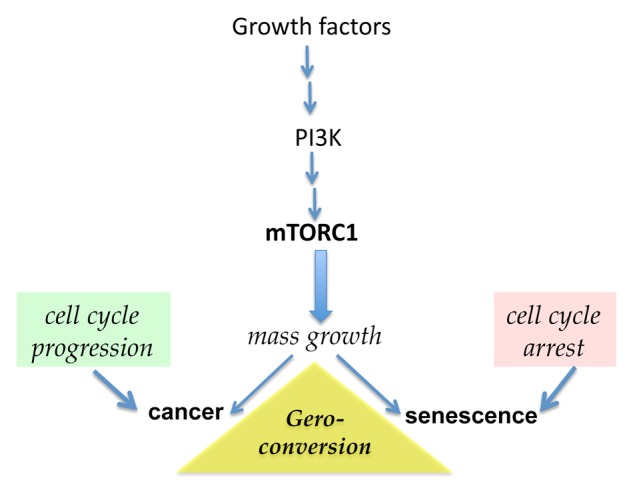
Figure 1. The mTOR pathway is involved in both cancer and senescence. Growth factors, cytokines, insulin, nutrients, and oncoproteins activate the phosphoinositide-3-kinase/mammalian target of rapamycin (PI3K/mTOR) signaling pathway, which promotes cellular growth and cell cycle progression. Mutations that results in constitutive activation of the mTOR pathway are involved in oncogenic transformation when intrinsic controls on cell cycle progression are disabled. Conversely, when mTOR is activated and the cell cycle is arrested, cells enter a senescent state. Rapamycin and other rapalogs (e.g., everolimus) inhibit the mTOR complex 1 (mTORC1) and suppress such a geroconversion.

References

    1. Hall MN. Talks about TORCs: recent advancesin target of rapamycin signalling. On mTOR nomenclature. Biochem Soc Trans. 2013;41:887–8. doi: 10.1042/BST20130092. - DOI - PubMed
    1. Loewith R, Jacinto E, Wullschleger S, Lorberg A, Crespo JL, Bonenfant D, Oppliger W, Jenoe P, Hall MN. Two TOR complexes, only one of which is rapamycin sensitive, have distinct roles in cell growth control. Mol Cell. 2002;10:457–68. doi: 10.1016/S1097-2765(02)00636-6. - DOI - PubMed
    1. Benjamin D, Colombi M, Moroni C, Hall MN. Rapamycin passes the torch: a new generation of mTOR inhibitors. Nat Rev Drug Discov. 2011;10:868–80. doi: 10.1038/nrd3531. - DOI - PubMed
    1. Kang SA, Pacold ME, Cervantes CL, Lim D, Lou HJ, Ottina K, Gray NS, Turk BE, Yaffe MB, Sabatini DM. mTORC1 phosphorylation sites encode their sensitivity to starvation and rapamycin. Science. 2013;341:1236566. doi: 10.1126/science.1236566. - DOI - PMC - PubMed
    1. Gibbons JJ, Abraham RT, Yu K. Mammalian target of rapamycin: discovery of rapamycin reveals a signaling pathway important for normal and cancer cell growth. Semin Oncol. 2009;36(Suppl 3):S3–17. doi: 10.1053/j.seminoncol.2009.10.011. - DOI - PubMed

LinkOut - more resources
