


The Possible Effects on Socio-Economic Inequalities of Introducing HPV Testing as Primary Test in Cervical Cancer Screening Programs
- PMID: 24575388
- PMCID: PMC3919018
- DOI: 10.3389/fonc.2014.00020
The Possible Effects on Socio-Economic Inequalities of Introducing HPV Testing as Primary Test in Cervical Cancer Screening Programs
Abstract
Background: Screening with HPV is more effective than Pap test in preventing cervical cancer. HPV as primary test will imply longer intervals and a triage test for HPV positive women. It will also permit the development of self-sampling devices. These innovations may affect population coverage, participation, and compliance to protocols, and likely in a different way for less educated, poorer, and disadvantaged women.
Aim: To describe the impact on inequalities, actual or presumed, of the introduction of HPV-based screening.
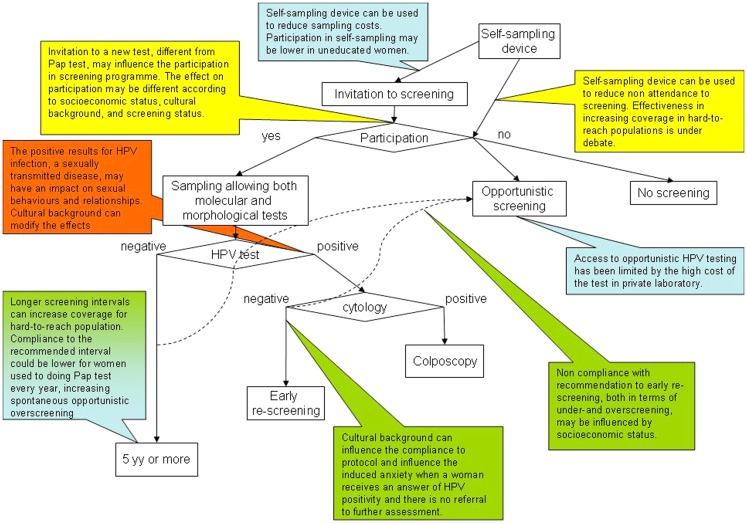
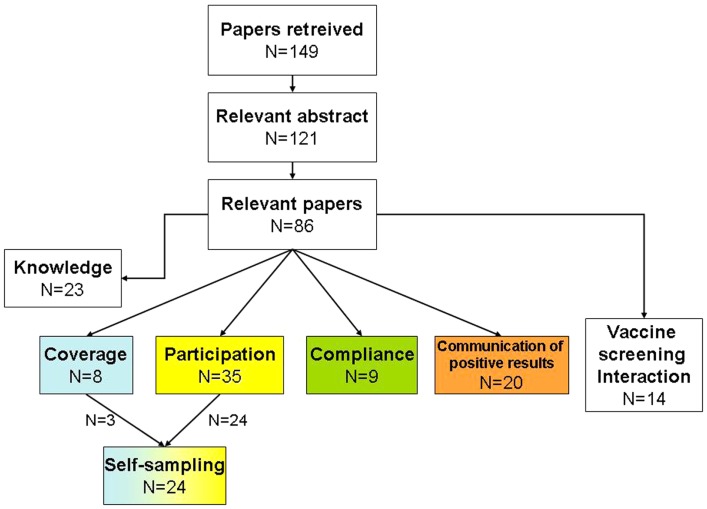
Methods: The putative HPV-based screening algorithm has been analyzed to identify critical points for inequalities. A systematic review of the literature has been conducted searching PubMed on HPV screening coverage, participation, and compliance. RESULTS were summarized in a narrative synthesis.
Results: Knowledge about HPV and cervical cancer was lower in women with low socio-economic status and in disadvantaged groups. A correct communication can reduce differences. Longer intervals will make it easier to achieve high-population coverage, but higher cost of the test in private providers could reduce the use of opportunistic screening by disadvantaged women. There are some evidences that inviting for HPV test instead of Pap increases participation, but there are no data on social differences. Self-sampling devices are effective in increasing participation and coverage. Some studies showed that the acceptability of self-sampling is higher in more educated women, but there is also an effect on hard-to-reach women. Communication of HPV positivity may increase anxiety and impact on sexual behaviors, the effect is stronger in low educated and disadvantaged women. Finally, many studies found indirect evidence that unvaccinated women are or will be more probably under-screened.
Conclusion: The introduction of HPV test may increase population coverage, but non-compliance to protocols and interaction with opportunistic screening can increase the existing inequalities.
Keywords: compliance; coverage; human papillomavirus; mass screening; participation; social inequalities.
Figures
References
-
- IARC Globocan. Cancer Fact Sheet: Cervical Cancer Estimated Incidence, Mortality and Prevalence Worldwide in 2012. (2012). Available from: http://globocan.iarc.fr/Pages/fact_sheets_cancer.aspx descriptive epidemiology
-
- Arbyn M, Anttila A, Jordan J, Schenck U, Ronco G, Segnan N, et al., editors. European Commission. European Guidelines for Quality Assurance in Cervical Cancer Screening. 2nd ed Luxembourg: Office for Official Publications of the European Communities; (2008). p. 1–291
-
- IARC Working Group on the Evaluation of Cancer Preventive Strategies Handbooks of cancer prevention. Cervix Cancer Screening. (Vol. 10), Lyon: IARC; (2005). p. 1–302.
Publication types
LinkOut - more resources
Full Text Sources
Other Literature Sources
Research Materials
