


Catalytic enantioselective cyclization/cross-coupling with alkyl electrophiles
- PMID: 24575754
- PMCID: PMC3985453
- DOI: 10.1021/ja500706v
Catalytic enantioselective cyclization/cross-coupling with alkyl electrophiles
Abstract
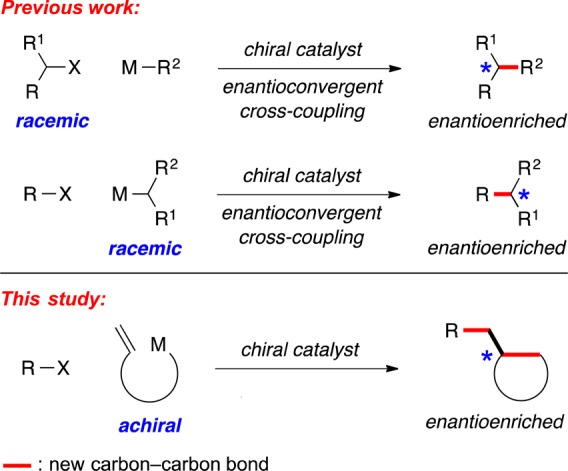
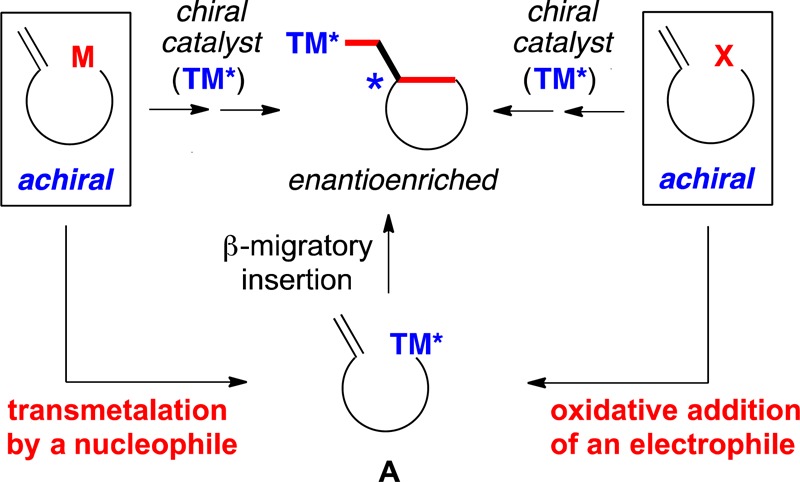
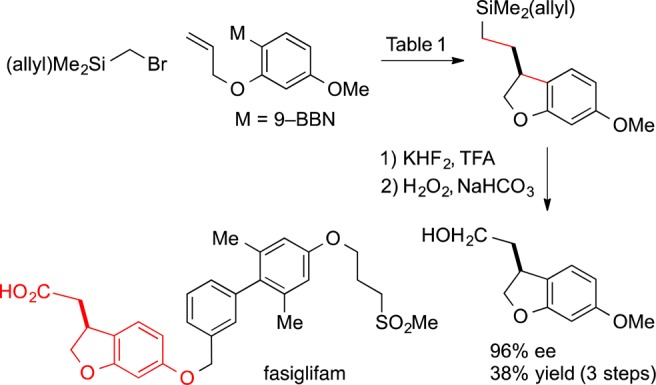
As part of our ongoing effort to expand the scope of cross-coupling reactions of alkyl electrophiles, we have pursued a strategy wherein the nucleophilic coupling partner includes a pendant olefin; after transmetalation by such a substrate, if β-migratory insertion proceeds faster than direct cross-coupling, an additional carbon-carbon bond and stereocenter can be formed. With the aid of a nickel/diamine catalyst (both components are commercially available), we have established the viability of this approach for the catalytic asymmetric synthesis of 2,3-dihydrobenzofurans and indanes. Furthermore, we have applied this new method to the construction of the dihydrobenzofuran core of fasiglifam, as well as to a cross-coupling with a racemic alkyl electrophile; in the latter process, the chiral catalyst controls two stereocenters, one that is newly generated in a β-migratory insertion and one that begins as a mixture of enantiomers.
Figures
References
-
-
For reviews and leading references, see:
- Glasspoole B. W.; Crudden C. M. Nat. Chem. 2011, 3, 912–913. - PubMed
- Rudolph A.; Lautens M. Angew. Chem., Int. Ed. 2009, 48, 2656–2670. - PubMed
- Glorius F. Angew. Chem., Int. Ed. 2008, 47, 8347–8349. - PubMed
- Swift E. C.; Jarvo E. R. Tetrahedron 2013, 69, 5799–5817. - PMC - PubMed
-
-
-
For a few examples and leading references, see:
- Do H.-Q.; Chandrashekar E. R. R.; Fu G. C. J. Am. Chem. Soc. 2013, 135, 16288–16291. - PMC - PubMed
- Schmidt T.; Kirschning A. Angew. Chem., Int. Ed. 2012, 51, 1063–1066. - PubMed
- Tsuji T.; Yorimitsu H.; Oshima K. Angew. Chem., Int. Ed. 2002, 41, 4137–4139. - PubMed
- Shields J. D.; Ahneman D. T.; Graham T. J. A.; Doyle A. G. Org. Lett. 2014, 16, 142–145. - PMC - PubMed
- Caeiro J.; Sestelo J. P.; Sarandeses L. A. Chem.—Eur. J. 2008, 14, 741–746. - PubMed
-
-
-
For reviews on asymmetric carbometalation, see:
- Ojima I.; Kaloko J. J.; Chaterpaul S. J.; Teng Y.-H. G.; Lin C.-F. In Catalytic Asymmetric Synthesis; Ojima I., Ed.; Wiley: Hoboken, NJ, 2010; pp 643–681.
- Negishi E.-i.; Tan Z. Top. Organomet. Chem. 2005, 8, 139–176.
- Hoveyda A. H.; Heron N. M. In Comprehensive Asymmetric Catalysis; Jacobsen E. N., Pfaltz A., Yamamoto H., Eds.; Springer–Verlag: Berlin, 1999; pp 431–454.
-
Publication types
MeSH terms
Substances
Grants and funding
LinkOut - more resources
Full Text Sources
Other Literature Sources
Research Materials
