


Noncalcified coronary plaque volumes in healthy people with a family history of early onset coronary artery disease
- PMID: 24577355
- PMCID: PMC4419782
- DOI: 10.1161/CIRCIMAGING.113.000980
Noncalcified coronary plaque volumes in healthy people with a family history of early onset coronary artery disease
Abstract
Background: Although age and sex distributions of calcified coronary plaque have been well described in the general population, noncalcified plaque (NCP) distributions remain unknown. This is important because NCP is a putative precursor for clinical coronary artery disease and could serve as a sentinel for aggressive primary prevention, especially in high-risk populations. We examined the distributions of NCP and calcified coronary plaque in healthy 30- to 74-year-old individuals from families with early onset coronary artery disease.
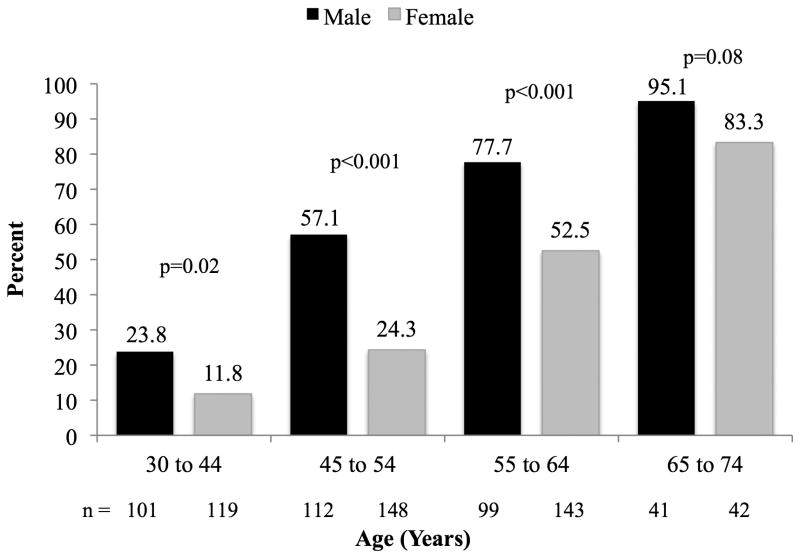
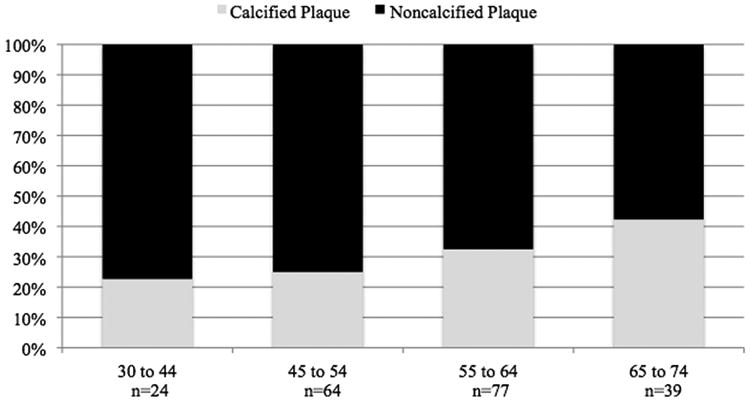
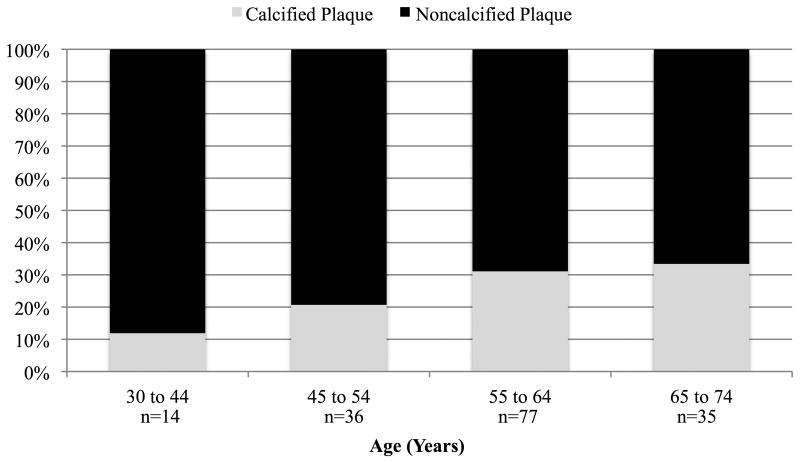
Methods and results: Participants in the GeneSTAR family study (N=805), mean age 51.1±10.8 years, 56% women, were screened for coronary artery disease risk factors and coronary plaque using dual-source computed tomographic angiography. Plaque volumes (mm(3)) were quantified using a validated automated method. The prevalence of coronary plaque was 57.8% in men and 35.8% in women (P<0.0001). NCP volume increased with age (P<0.001) and was higher in men than women (P<0.001). Although NCP, as a percentage of total plaque, was inversely related to age (P<0.01), NCP accounted for most of the total plaque volume at all ages, especially in men and women <55 years (>70% and >80%, respectively). Higher Framingham risk was associated with the number of affected vessels (P<0.01), but 44% of men and 20.8% of women considered intermediate risk had left main and 3-vessel disease involvement.
Conclusions: The majority of coronary plaque was noncalcified, particularly in younger individuals. These findings support the importance of assessing family history and suggest that early primary prevention interventions may be warranted at younger ages in families with early onset coronary artery disease.
Keywords: asymptomatic diseases; atherosclerosis; multidetector computed tomography.
© 2014 American Heart Association, Inc.
Figures
Comment in
-
Screening for coronary artery disease in patients with family history… how, when, and in whom?Circ Cardiovasc Imaging. 2014 May;7(3):417-9. doi: 10.1161/CIRCIMAGING.114.001985. Circ Cardiovasc Imaging. 2014. PMID: 24847006 No abstract available.
References
-
- Wong ND, Kouwabunpat D, Vo AN, Detrano RC, Eisenberg H, Goel M, Tobis JM. Coronary calcium and atherosclerosis by ultrafast computed tomography in asymptomatic men and women: Relation to age and risk factors. Am Heart J. 1994;127:422–430. - PubMed
-
- Fallavollita JA, Brody AS, Bunnell IL, Kumar K, Canty JM., Jr Fast computed tomography detection of coronary calcification in the diagnosis of coronary artery disease. Comparison with angiography in patients < 50 years old. Circulation. 1994;89:285–290. - PubMed
-
- Stary HC, Chandler AB, Dinsmore RE, Fuster V, Glagov S, Insull W, Jr, Rosenfeld ME, Schwartz CJ, Wagner WD, Wissler RW. A definition of advanced types of atherosclerotic lesions and a histological classification of atherosclerosis. A report from the committee on vascular lesions of the council on arteriosclerosis, american heart association. Arterioscler Thromb Vasc Biol. 1995;15:1512–1531. - PubMed
-
- Virmani R, Kolodgie FD, Burke AP, Farb A, Schwartz SM. Lessons from sudden coronary death: A comprehensive morphological classification scheme for atherosclerotic lesions. Arterioscler Thromb Vasc Biol. 2000;20:1262–1275. - PubMed
-
- Burke AP, Kolodgie FD, Farb A, Weber DK, Malcom GT, Smialek J, Virmani R. Healed plaque ruptures and sudden coronary death: Evidence that subclinical rupture has a role in plaque progression. Circulation. 2001;103:934–940. - PubMed
Publication types
MeSH terms
Grants and funding
- R01 HL071025/HL/NHLBI NIH HHS/United States
- R01 NR008153/NR/NINR NIH HHS/United States
- R01HL071025/HL/NHLBI NIH HHS/United States
- M01-RR000052/RR/NCRR NIH HHS/United States
- K23 HL094747/HL/NHLBI NIH HHS/United States
- R01HL59684,/HL/NHLBI NIH HHS/United States
- R01NR08153/NR/NINR NIH HHS/United States
- K23HL094747/HL/NHLBI NIH HHS/United States
- M01 RR000052/RR/NCRR NIH HHS/United States
- RC1 HL099747/HL/NHLBI NIH HHS/United States
- R01 HL059684/HL/NHLBI NIH HHS/United States
- RC1HL099747/HL/NHLBI NIH HHS/United States
LinkOut - more resources
Full Text Sources
Other Literature Sources
Medical
