. 2014 Mar 1:7:119.
doi: 10.1186/1756-0500-7-119.

Ontogeny of adrenal-like glucocorticoid synthesis pathway and of 20α-hydroxysteroid dehydrogenase in the mouse lung

Affiliations

Ontogeny of adrenal-like glucocorticoid synthesis pathway and of 20α-hydroxysteroid dehydrogenase in the mouse lung

Eric Boucher et al. BMC Res Notes. .

Abstract

Background: Glucocorticoids exert recognized positive effects on lung development. The genes involved in the classical pathway of glucocorticoid synthesis normally occurring in adrenals were found to be expressed on gestation day (GD) 15.5 in the developing mouse lung. Recently, expression of two of these genes was also detected on GD 17.5 suggesting a more complex temporal regulation than previously expected. Here, we deepen the knowledge on expression of "adrenal" glucocorticoid synthesis genes in the mouse lung during the perinatal period and we also study expression of the gene encoding for the steroid inactivating enzyme 20α-hydroxysteroid dehydrogenase (20α-HSD).

Results: We performed an ontogenic study of P450scc, 3β-hydroxysteroid dehydrogenase/Δ5-Δ4 isomerase 1 (3β-HSD1), 21-hydroxylase, 11β-hydroxylase, 11β-HSD1, and 11β-HSD2 expression up to post natal day (PN) 15. The substrate (progesterone) and the product (deoxycorticosterone) of 21-hydroxylase are substrates of 20α-HSD, thus 20α-HSD (Akr1c18) gene expression was investigated. In lung samples collected between GD 15.5 and PN 15, 11β-hydroxylase was only detected on GD 15.5. In contrast, all the other tested genes were expressed throughout the analyzed period with different temporal expression patterns. P450scc, 21-hydroxylase, 20α-HSD and 11β-HSD2 mRNA levels increased after birth with different patterns including an increase from PN 3 with a possible sex difference for 21-hydroxylase mRNA. Also, the 21-hydroxylase protein was observed by Western blot in perinatal lungs with higher levels after birth.

Conclusion: Progesterone is present at high levels during gestation and the product of 21-hydroxylase, deoxycorticosterone, can bind the glucocorticoid receptor with an affinity close to that of corticosterone. Detection of 21-hydroxylase at the protein level during antenatal lung development is the first evidence that the adrenal-like glucocorticoid synthesis pathway detected during lung development has the machinery to produce glucocorticoids in the fetal lung. Glucocorticoids from lung 21-hydroxylase appear to modulate lung ontogenesis through paracrine/intracrine actions.


Figures
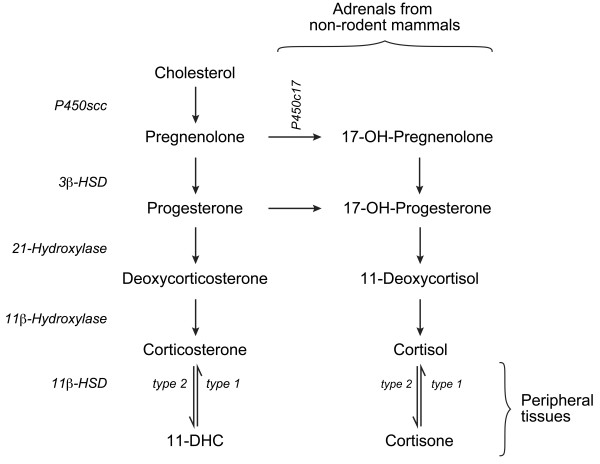
Figure 1
Figure 1
Glucocorticoid synthesis pathway in rodent and non-rodent mammals. Corticosterone (rodent) and cortisol (non-rodent mammals) are the most potent circulating GCs. Their production from cholesterol in adrenals correspond to the classical pathway of GC synthesis. There is no P450c17 enzyme in the rodent adrenal. Cell-specific 11β-HSD-catalyzed reactions occur in peripheral tissues. During the last decade, expression of some or all the enzymes catalyzing GC production from cholesterol has been observed in some non-adrenal tissues including the developing lung.
Figure 2
Figure 2
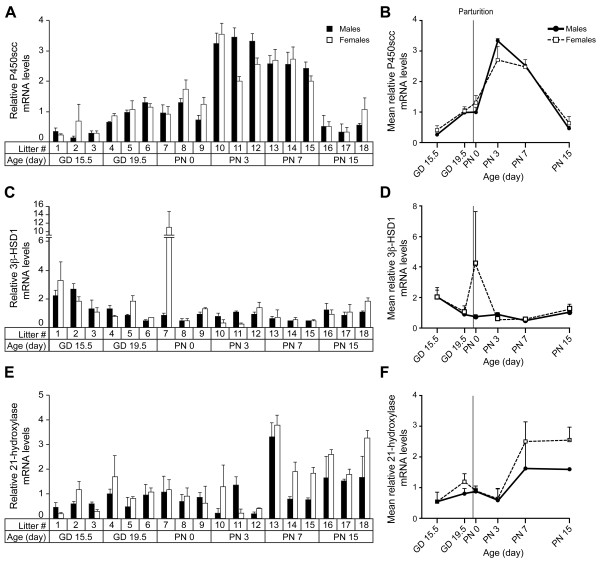
Relative expression of P450scc, 3β-HSD1, and 21-hydroxylase genes according to sex and age in the mouse developing lung. Relative expression values were determined by qPCR for P450scc (A), 3β-HSD1 (C), and 21-hydroxylase (E) in male and female pools of 3 litters for each age. The results are the mean of 2 PCR reactions (±SD). Then, the mean of expression (± SEM) for each sex and each age was calculated from the values presented in the histograms and the resulting curves are presented for P450scc (B), 3β-HSD1 (D), and 21-hydroxylase (F).
Figure 3
Figure 3
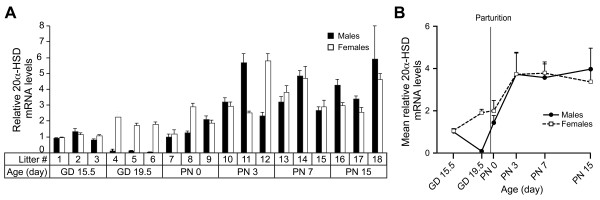
Relative expression of 20α-HSD according to sex and age in the mouse developing lung. Relative expression values were determined by qPCR for 20α-HSD (A) in male and female pools of 3 litters for each age. The results are the mean of 2 PCR reactions (±SD). Then, the mean of expression (± SEM) for each sex and each age was calculated from the values presented in the histograms (B).
Figure 4
Figure 4
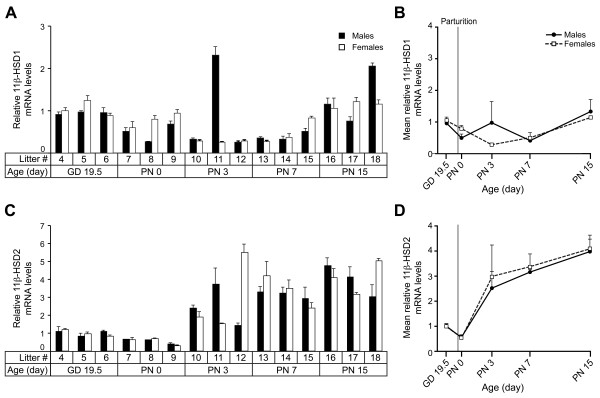
Relative expression of 11β-HSD1 and 11β-HSD2 according to sex and time in the mouse developing lung. Relative expression values were determined by qPCR for 11β-HSD1 (A) and 11β-HSD2 (C) in male and female pools of 3 litters for each age. The results are the mean of 2 PCR reactions (±SD). Then, the mean of expression (± SEM) for each sex and each age was calculated from the values presented in the histograms for 11β-HSD1 (B) and 11β-HSD2 (D).
Figure 5
Figure 5
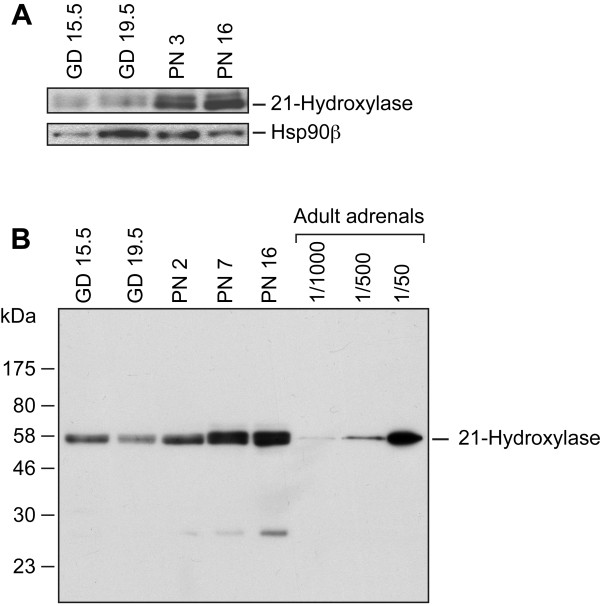
21-hydroxylase protein in the mouse developing lung. A Western blot analysis of the 21-hydroxylase protein is presented for whole lung protein extracts (50 μg) (panel A) and microsomal fractions (50 μg of microsomal proteins) (panel B) for the indicated developmental times. For the study of total protein extracts, levels of Hsp90β are shown as a loading control. Total protein extracts were prepared with the lungs from one individual for each time point, whereas microsomal fractions were prepared using a pool of lungs from all the fetuses/neonates of one litter for each time point. Microsomes from adult adrenals were used as control. The proportion of adrenal microsomal proteins loaded on the gel compared to the amount loaded for the lungs is indicated (1/1000 = 50 ng microsomal proteins, 1/500 = 100 ng, and 1/50 = 1 μg). Each pannel corresponds to a different gel.
Figure 6
Figure 6
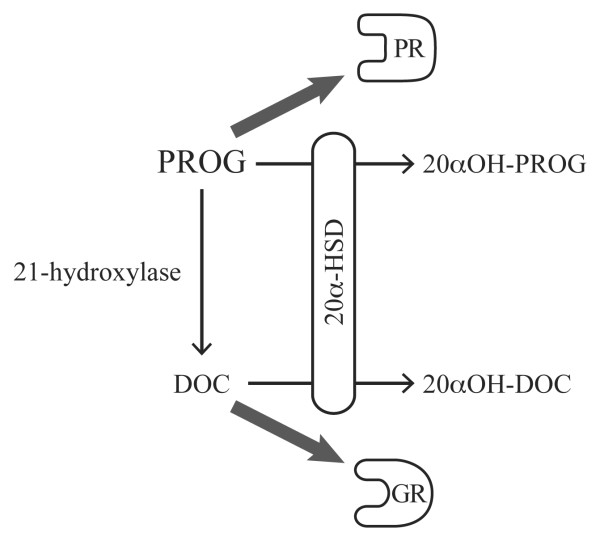
Effects of 21-hydroxylase and 20α-HSD on progesterone receptor and glucocorticoid receptor occupancy. PROG, progesterone; PR progesterone receptor; GR, glucocorticoid receptor.

References

    1. Bolt RJ, Van Weissenbruch MM, Lafeber HN, de Wall HA D-v. Glucocorticoids and lung development in the fetus and preterm infant. Pediatr Pulmonol. 2001;32:76–91. doi: 10.1002/ppul.1092. - DOI - PubMed
    1. Venihaki M, Majzoub J. Animal models of CRH deficiency. Front Neuroendocrinol. 1999;20:122–145. doi: 10.1006/frne.1999.0179. - DOI - PubMed
    1. Wang J, Kuliszewski M, Yee W, Sedlackova L, Xu J, Tseu I, Post M. Cloning and expression of glucocorticoid-induced genes in fetal rat lung fibroblasts. J Biol Chem. 1995;270:2722–2728. doi: 10.1074/jbc.270.6.2722. - DOI - PubMed
    1. Cole TJ, Blendy JA, Monaghan AP, Krieglstein K, Schmid W, Aguzzi A, Fantuzzi G, Hummler E, Unsicker K, Schütz G. Targeted disruption of the glucocorticoid receptor gene blocks adrenergic chromaffin cell development and severely retards lung maturation. Genes Dev. 1995;9:1608–1621. doi: 10.1101/gad.9.13.1608. - DOI - PubMed
    1. Muglia L, Jacobson L, Dikkes P, Majzoub JA. Corticotropin-releasing hormone deficiency reveals major fetal but not adult glucocorticoid need. Nature. 1995;373:427–432. doi: 10.1038/373427a0. - DOI - PubMed

Publication types

MeSH terms

Substances

LinkOut - more resources