. 2014 Mar 6;94(3):405-14.
doi: 10.1016/j.ajhg.2014.01.020. Epub 2014 Feb 27.

XYLT1 mutations in Desbuquois dysplasia type 2

Affiliations

XYLT1 mutations in Desbuquois dysplasia type 2

Catherine Bui et al. Am J Hum Genet. .

Abstract

Desbuquois dysplasia (DBQD) is a severe condition characterized by short stature, joint laxity, and advanced carpal ossification. Based on the presence of additional hand anomalies, we have previously distinguished DBQD type 1 and identified CANT1 (calcium activated nucleotidase 1) mutations as responsible for DBQD type 1. We report here the identification of five distinct homozygous xylosyltransferase 1 (XYLT1) mutations in seven DBQD type 2 subjects from six consanguineous families. Among the five mutations, four were expected to result in loss of function and a drastic reduction of XYLT1 cDNA level was demonstrated in two cultured individual fibroblasts. Because xylosyltransferase 1 (XT-I) catalyzes the very first step in proteoglycan (PG) biosynthesis, we further demonstrated in the two individual fibroblasts a significant reduction of cellular PG content. Our findings of XYLT1 mutations in DBQD type 2 further support a common physiological basis involving PG synthesis in the multiple dislocation group of disorders. This observation sheds light on the key role of the XT-I during the ossification process.


Figures

Figure 1
Figure 1
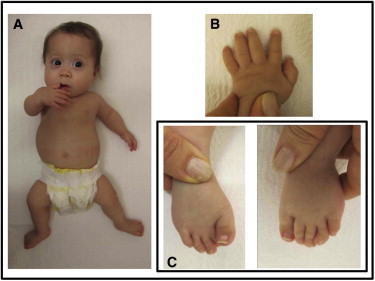
Clinical Features of One DBQD Type 2 Subject with XYLT1 Mutation Individual 7 (family 6) at 12 months. Note the flat face, narrow thorax, short limbs (A) with hip dislocation, hyperlaxity of fingers (B), and deviation of toes (C).
Figure 2
Figure 2
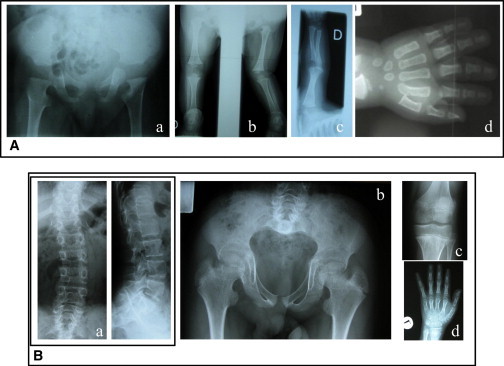
Radiological Features of Two DBQD Type 2 Subjects with XYLT1 Mutations (A) Subject 1 (family 1) at 8 months. Note the monkey wrench appearance of the proximal femora, absence of upper femoral epiphyseal centers (a), knee dislocation (b), short long bones (c), and advanced carpal bone age (d). (B) Subject 4 (family 3) at 12 years of age. Note the scoliosis with irregular vertebral endplates (a), monkey wrench appearance of the proximal femora with short femoral necks, short and broad iliac wings (b), flat knee epiphyses (c), short metacarpals, and advanced carpal bone age and prominent wrist epiphyses (d).
Figure 3
Figure 3
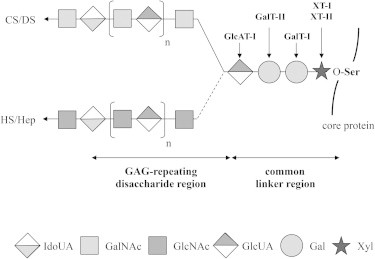
Schematic Representation of the PG Biosynthesis XT-I and XT-II participate in the initiation of the PG biosynthesis by transferring a Xyl to specific Ser residues of the core protein. Two Gal and one GlcUA will be sequentially added via the action of GalT-I, GalT-II, and GlcAT-I to form the common linker region. The addition of a GalNAc will then initiate the assembly of chondroitin-sulfate/dermatan-sulfate (CS/DS) chains while addition of a GlcNAc will initiate the synthesis toward heparan-sulfate/heparin (HS/Hep) chains. Mutations in genes involved in the assembly of the common linker region have been associated with several disorders, namely DBQD type 2 (XYLT1), Ehlers-Danlos progeroid syndrome, type 1 (B4GALT7), Ehlers-Danlos progeroid syndrome, type 2/spondyloepimetaphyseal dysplasia with joint laxity type 1 (SEMD-JL1) (B3GALT6), and Larsen-like syndrome (B3GAT3).
Figure 4
Figure 4
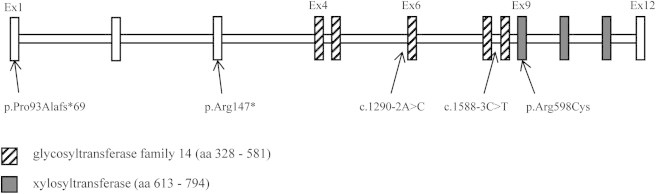
Location of the Five XYLT1 Mutations Organization of XYLT1 gene and protein with the two glycosyltransferase family 14 and xylosyltransferase domains.
Figure 5
Figure 5
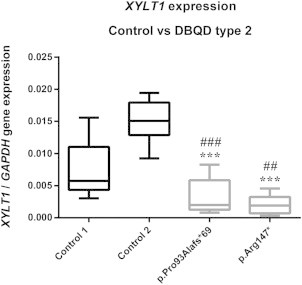
cDNA Level of XYLT1 in Controls and Two Cultured Individual Fibroblasts cDNA levels were normalized to GAPDH. Individuals p.Arg147 and p.Pro93Alafs69 are female aged 14 and male aged 23 years, respectively. Control 1 (female) and 2 (male) are aged 2.5 and 12 years, respectively. Control (black boxes) and individual (gray boxes) data are presented as box plots and are the mean of three independent experiments performed in quadruplate. ##p < 0.01, ###p < 0.001 compared to control 1, ∗∗∗p < 0.001 compared to control 2 by one-way ANOVA with Tukey’s post hoc test. Note that mutations in XYLT1 affect cDNA level of XYLT1.
Figure 6
Figure 6
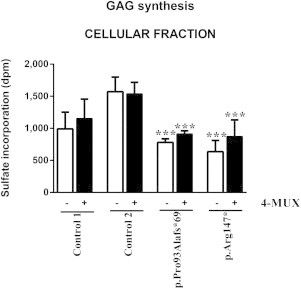
Sulfate Incorporation of Cellular Fractions in Controls and the Two Cultured Individual Fibroblasts in the Presence of 4-MUX or Vehicle The black (+4-MUX, 5 μM) and white (DMSO vehicle) bars represent the mean ± SEM of two independent experiments performed in triplicate. ∗∗∗p < 0.001 when compared to the control 2 by one-way ANOVA with Tukey’s post hoc test. Note that XYLT1 mutations have an impact on the biosynthesis of cellular PGs in the two cultured individual fibroblasts.
Figure 7
Figure 7
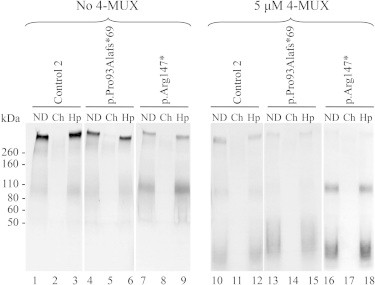
Gel Electrophoresis of Radiolabeled GAG Chains Extracted from Control 2 and the Two Cultured Individual Fibroblasts Media in the Presence 4-MUX or Vehicle For each sample, three lanes corresponding to nondigested (ND), digested by the Chondroitinase ABC (Ch), and digested by the Heparinases II and III (Hp) were loaded onto the gel and the volumes were adjusted to dpm values to visualize GAG profile and distribution. Control 2 (male) is aged 12. Note that mutations in XYLT1 change the distribution and profile of secreted PGs in the two cultured individual fibroblasts.

References

    1. Warman M.L., Cormier-Daire V., Hall C., Krakow D., Lachman R., LeMerrer M., Mortier G., Mundlos S., Nishimura G., Rimoin D.L. Nosology and classification of genetic skeletal disorders: 2010 revision. Am. J. Med. Genet. A. 2011;155A:943–968. - PMC - PubMed
    1. Faivre L., Cormier-Daire V., Eliott A.M., Field F., Munnich A., Maroteaux P., Le Merrer M., Lachman R. Desbuquois dysplasia, a reevaluation with abnormal and “normal” hands: radiographic manifestations. Am. J. Med. Genet. A. 2004;124A:48–53. - PubMed
    1. Faivre L., Le Merrer M., Al-Gazali L.I., Ausems M.G., Bitoun P., Bacq D., Maroteaux P., Munnich A., Cormier-Daire V. Homozygosity mapping of a Desbuquois dysplasia locus to chromosome 17q25.3. J. Med. Genet. 2003;40:282–284. - PMC - PubMed
    1. Huber C., Oulès B., Bertoli M., Chami M., Fradin M., Alanay Y., Al-Gazali L.I., Ausems M.G., Bitoun P., Cavalcanti D.P. Identification of CANT1 mutations in Desbuquois dysplasia. Am. J. Hum. Genet. 2009;85:706–710. - PMC - PubMed
    1. Kim O.H., Nishimura G., Song H.R., Matsui Y., Sakazume S., Yamada M., Narumi Y., Alanay Y., Unger S., Cho T.J. A variant of Desbuquois dysplasia characterized by advanced carpal bone age, short metacarpals, and elongated phalanges: report of seven cases. Am. J. Med. Genet. A. 2010;152A:875–885. - PubMed

Publication types

MeSH terms

Supplementary concepts

LinkOut - more resources