


Prevalence and risk factors for active convulsive epilepsy in rural northeast South Africa
- PMID: 24582322
- PMCID: PMC4000269
- DOI: 10.1016/j.eplepsyres.2014.01.004
Prevalence and risk factors for active convulsive epilepsy in rural northeast South Africa
Abstract
Rationale: Epilepsy is among the most common neurological disorders worldwide. However, there are few large, population-based studies of the prevalence and risk factors for epilepsy in southern Africa.
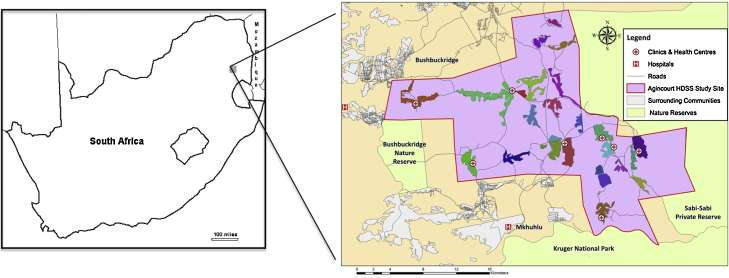
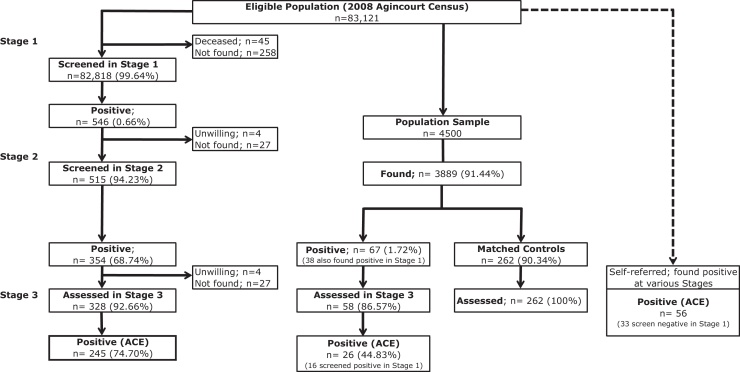
Methods: From August 2008 to February 2009, as part of a multi-site study, we undertook a three-stage, population-based study, embedded within the Agincourt health and socio-demographic surveillance system, to estimate the prevalence and identify risk factors of active convulsive epilepsy (ACE) in a rural South African population.
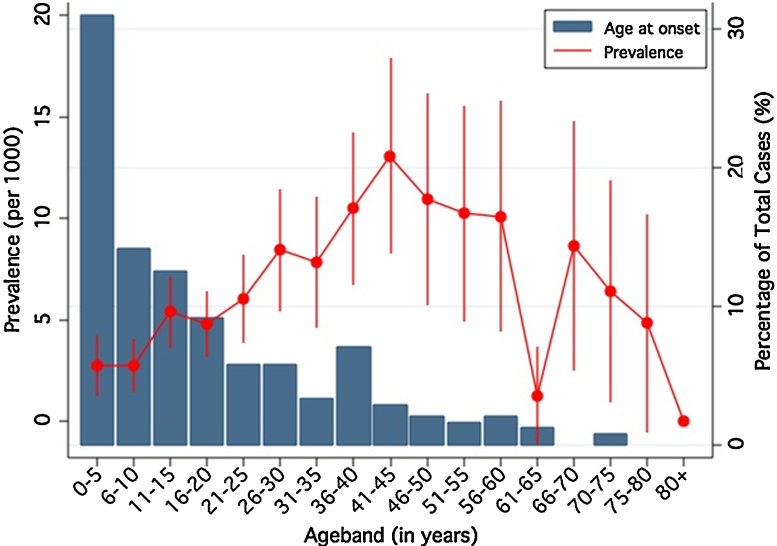
Results: The crude prevalence of ACE, after adjusting for non-response and the sensitivity of the screening method, was 7.0/1,000 individuals (95% CI 6.4-7.6) with significant geographic heterogeneity across the study area. Being male (OR=2.3; 95% CI 1.6-3.2), family history of seizures (OR=4.0; 95% CI 2.0-8.1), a sibling with seizures (OR=7.0; 95% CI 1.6-31.7), problems after delivery (OR=5.9; 95% CI 1.2-24.6), and history of snoring (OR=6.5; 95% CI 4.5-9.5) were significantly associated with ACE. For children, their mother's exposure to some formal schooling was protective (OR=0.30; 95% CI 0.11-0.84) after controlling for age and sex. Human immunodeficiency virus was not found to be associated with ACE.
Conclusions: ACE is less frequent in this part of rural South Africa than other parts of sub-Saharan Africa. Improving obstetric services could prevent epilepsy. The relationship between snoring and ACE requires further investigation, as does the relative contribution of genetic and environmental factors to examine the increased risk in those with a family history of epilepsy.
Keywords: Case-control; Epilepsy; Population-based; Prevalence; Risk factors.
Copyright © 2014 Elsevier B.V. All rights reserved.
Figures
References
-
- American Sleep Disorders Association, editor. American Sleep Disorders Association; Rochester, MN: 2001. (The International Classification of Sleep Disorders, Revised: Diagnostics and Coding Manual).
-
- Beran R.G., Plunkett M.J., Holland G.J. Interface of epilepsy and sleep disorders. Seizure. 1999;8:97–102. - PubMed
-
- Birbeck G.L., Kalichi E.M.N. Epilepsy prevalence in rural Zambia: a door-to-door survey. Trop. Med. Int. Health. 2004;9:92–95. - PubMed
-
- Carabin H., Krecek R., Cowan L., Michael L., Foyaca-Sibat H., Nash T., Willingham A.L. Estimation of the cost of Taenia solium cysticercosis in Eastern Cape province, South Africa. Trop. Med. Int. Health. 2006;11:906–916. - PubMed
-
- Carter J.A., Neville B.G.R., White S., Ross A.J., Otieno G., Mturi N., Musumba C., Newton C.R.J.C. Increased prevalence of epilepsy associated with severe falciparum malaria in children. Epilepsia. 2004;45:978–981. - PubMed
Publication types
MeSH terms
Grants and funding
LinkOut - more resources
Full Text Sources
Other Literature Sources
Medical
Miscellaneous
