


Review
doi: 10.1016/j.dnarep.2014.01.009.
Epub 2014 Feb 26.
Non-homologous end joining: emerging themes and unanswered questions
Affiliations
- PMID: 24582502
- PMCID: PMC4084493
- DOI: 10.1016/j.dnarep.2014.01.009
Item in Clipboard
Review
Non-homologous end joining: emerging themes and unanswered questions
DNA Repair (Amst).
2014 May.
Abstract
Non-homologous end joining (NHEJ) is the major pathway for the repair of ionizing radiation induced DNA double strand breaks in human cells. Here, we discuss current insights into the mechanism of NHEJ and the interplay between NHEJ and other pathways for repair of IR-induced DNA damage.
Keywords: DNA double strand break repair; Ionizing radiation; Non-homologous end joining.
Copyright © 2014 Elsevier B.V. All rights reserved.
Conflict of interest statement
Figures
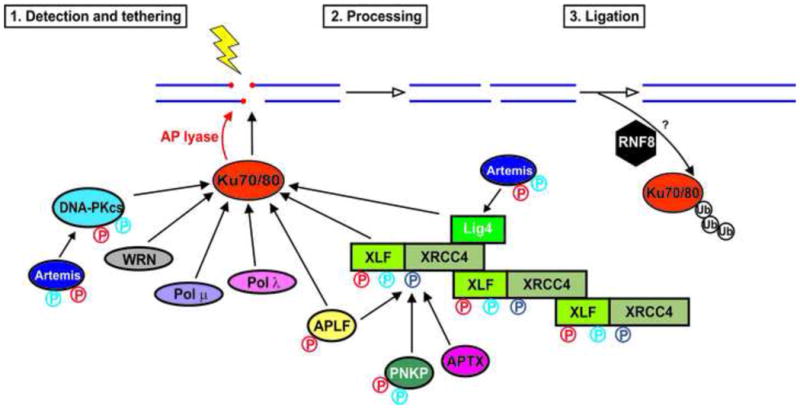
Adapted from [14] with permission. DSBs are detected by the Ku70/80 heterodimer, which interacts with multiple components of the NHEJ machinery, including DNA-PKcs, XLF, WRN and APLF, recruiting them to DSBs. Once the DSB is detected, various enzymes may be involved in processing of the DSB ends, for example, removal of non-ligatable end groups by PNKP, and gap filling by DNA polymerases mu and lambda. The break is resealed by DNA ligase IV, which exists in complex with XRCC4 and XLF. Recent studies suggest that the XRCC4-DNA ligase IV complex is required for DNA-PKcs autophosphorylation [79], suggesting that XRCC4 and DNA ligase IV may be present at the break as a multi-protein complex rather than recruited in the later stages of NHEJ. How Ku is removed from DSBs is unknown, but may involve proteolytic degradation [124-126] or Mre11 nuclease activity [99]. Direct protein-protein interactions are indicated by black lines. The AP lyase activity of Ku [30, 31] is shown by the red arrow. ATM and DNA-PK dependent phosphorylation events are shown in red and blue P symbols respectively. See text and [14] for details.
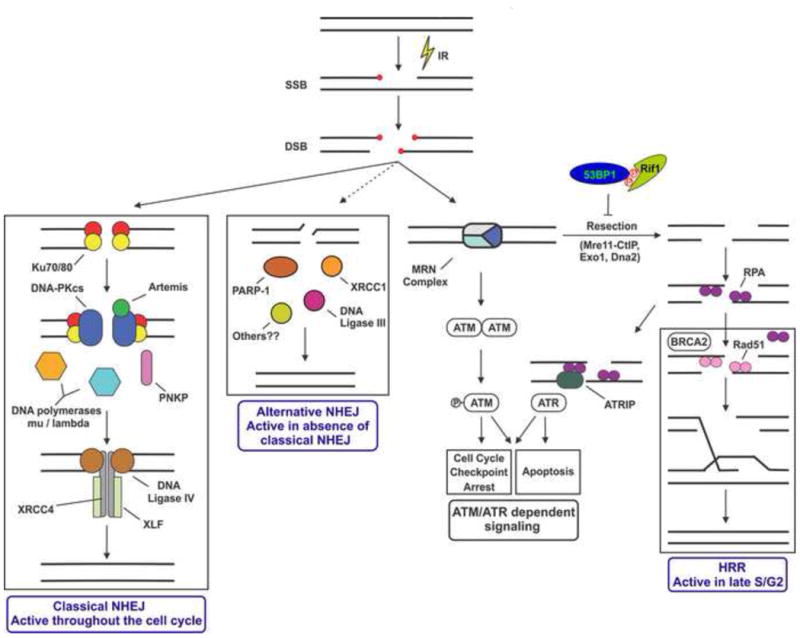
Adapted from [14] with permission. IR induces base damage and SSBs. Two SSBs on opposite strands of the DNA induce a DSB. Damaged, non-ligatable termini are represented by the small red circles. The DSB can be detected by the Ku heterodimer, initiating NHEJ, the major pathway for the repair of IR-induced DSBs, which is active in all stages of the cell cycle. In the absence of classical NHEJ, an alternative or back-up NHEJ pathway, that involves PARP1, XRCC1 and DNA ligases I or III may be initiated [127]. DSBs are detected by the Mre11, Rad50, Nbs1 (MRN) complex which leads to activation of the ATM protein kinase and downstream signaling events that induce cell cycle checkpoint arrest and other cellular responses to DSBs [128]. The MRN complex is required for 5′-3′ resection, likely involving Mre11, CtIP, Exo1, Dna2 and other proteins, which produces long 3′ ends that are recognized by ssDNA-binding protein, RPA. The 53BP1/RIF complex promotes NHEJ by blocking DSB ends from resection [102-106], but the mechanism by which it does so is poorly understood. RPA is displaced by BRCA2, allowing binding of Rad51 and initiation of homologous recombination repair (HRR), which is active only in late S and G2 phases of the cell cycle [96, 129]. Recruitment of RPA also initiates activation of ATR, which like ATM, contributes to activation of cell cycle checkpoints and other cellular responses [130]. Precisely how Ku and MRN compete or cooperate to initiate NHEJ, HRR and activation of ATM is an area of active investigation. See text for details.
References
-
- Hanahan D, Weinberg RA. Hallmarks of cancer: the next generation. Cell. 2011;144:646–674. - PubMed
Publication types
MeSH terms
Substances
Grants and funding
LinkOut - more resources
Full Text Sources
Other Literature Sources
