Review
. 2014 Oct;1839(10):908-918.
doi: 10.1016/j.bbagrm.2014.02.012. Epub 2014 Feb 28.

Themes and variations in riboswitch structure and function

Affiliations
Review

Themes and variations in riboswitch structure and function

Alla Peselis et al. Biochim Biophys Acta. 2014 Oct.

Abstract

The complexity of gene expression control by non-coding RNA has been highlighted by the recent progress in the field of riboswitches. Discovered a decade ago, riboswitches represent a diverse group of non-coding mRNA regions that possess a unique ability to directly sense cellular metabolites and modulate gene expression through formation of alternative metabolite-free and metabolite-bound conformations. Such protein-free metabolite sensing domains utilize sophisticated three-dimensional folding of RNA molecules to discriminate between a cognate ligand from related compounds so that only the right ligand would trigger a genetic response. Given the variety of riboswitch ligands ranging from small cations to large coenzymes, riboswitches adopt a great diversity of structures. Although many riboswitches share structural principles to build metabolite-competent folds, form precise ligand-binding pockets, and communicate a ligand-binding event to downstream regulatory regions, virtually all riboswitch classes possess unique features for ligand recognition, even those tuned to recognize the same metabolites. Here we present an overview of the biochemical and structural research on riboswitches with a major focus on common principles and individual characteristics adopted by these regulatory RNA elements during evolution to specifically target small molecules and exert genetic responses. This article is part of a Special Issue entitled: Riboswitches.

Keywords: Gene expression; Metabolite; Non-coding RNA; RNA structure; Transcription; X-ray crystallography.


Figures

Fig. 1
Fig. 1
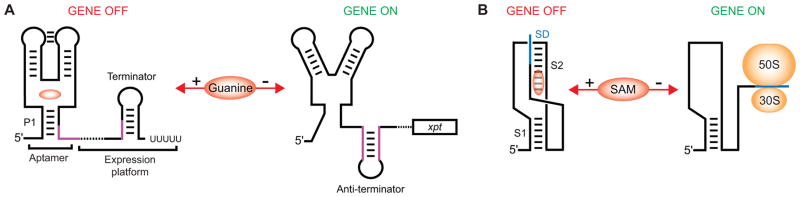
Typical mechanisms of the riboswitch-mediated gene expression control. (A), Transcription termination mechanism of the guanine-specific xpt riboswitch [73]. Guanine binding stabilizes the structure of the junctional metabolite-sensing domain, including regulatory helix P1, and facilitates the formation of a Rho-independent transcriptional terminator that aborts transcription elongation. In the absence of guanine, the metabolite sensor does not adopt the ligand-bound conformation, and the 3′ region of P1 (magenta color) makes alternative base pairing with the region in the expression platform inducing formation of an anti-terminator hairpin. This hairpin prevents formation of the transcription terminator and allows RNA polymerase to transcribe the entire xpt gene. (B), Regulation of translation initiation by the SAM-II riboswitch [52, 53]. SAM binding stabilizes the formation of the pseudoknot-based fold including stem S2 that engages in base pairing with the Shine-Dalgarno sequence (blue color) of the downstream gene. In the absence of SAM, S2 is disrupted and the ribosome can access the Shine-Dalgarno sequence and initiate translation of the gene.
Fig. 2
Fig. 2
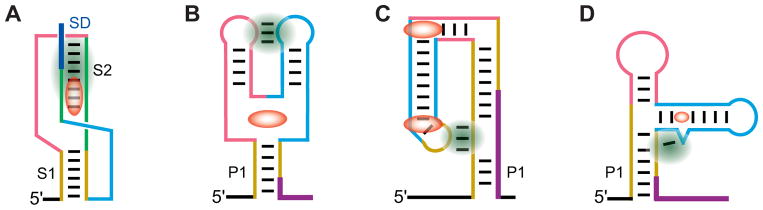
Schematics of architectures observed in riboswitch structures. Ligands are shown in red color. Long-distance tertiary interactions reinforced by ligand binding are highlighted in green color. (A), The pseudoknot type of the metabolite sensing domain, exemplified by the SAM-II riboswitch [52]. (B), The ‘regular’ architecture of junctional riboswitches observed in purine riboswitches. The fold is stabilized by ligand binding in the center of the three-way junction. (C), The ‘inverted’ architecture of junctional riboswitches stabilized in the THF riboswitch by binding to two ligand molecules [89]. (D), Glycine riboswitch is an example of the ‘regular’ architecture stabilized by tertiary interactions that span shorter distance [87].
Fig. 3
Fig. 3
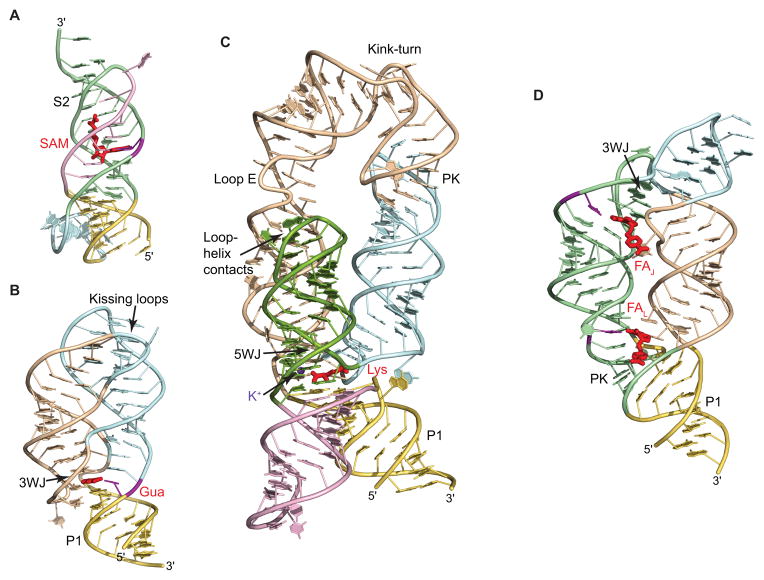
Examples of the riboswitch structures. RNA is shown in ribbon representation and is color-coded according to Fig. 2. Ligands are shown in red color. Nucleotides important for discrimination of the ligand are in violet. 3WJ and 5WJ, three-way and five-way junctions, respectively. PK, pseudoknot. (A) Structure of the SAM-II riboswitch bound to SAM highlights a riboswitch fold based on a pseudoknot conformation [52]. A key feature of the structure is the stabilization of stem S2 by binding to SAM. (B) Structure of the guanine riboswitch bound to guanine (Gua) shows ‘regular’ architecture of junctional riboswitches [73]. The ligand binds in the center of the three-way junction and holds together the junctional fold. Tertiary interactions between apical loops provide correct alignment of stems and reinforce the structure. (C) Structure of the lysine riboswitch bound to lysine [79]. The structure consists of two-helical and three-helical bundles positioned below and above the ligand-bound five-way junction. One of the helices reverses its orientation through a kink-turn and is anchored in place by pseudoknot interactions. Ligand-bound potassium cation is shown by a violet sphere. (D), Structure of the THF riboswitch bound to two molecules of folinic acid (FA) highlights the ‘inverted’ architecture of junctional riboswitches, centered on the three-way junction and stabilized by pseudoknot interactions [89]. Ligand molecules stabilize both the junction and the pseudoknot.
Fig. 4
Fig. 4
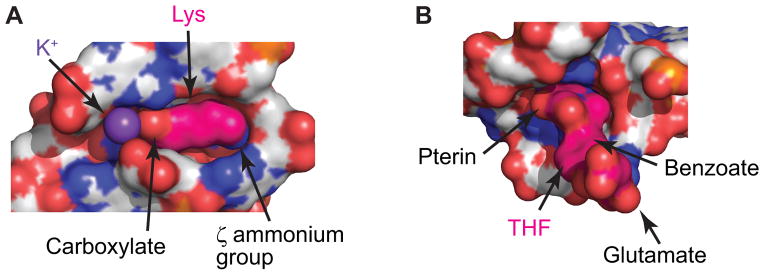
Examples of ligand-binding pockets. RNA (grey) and ligands (hot pink) are shown in surface representation with heteroatoms depicted in the following colors: oxygen, red; nitrogen, blue; phosphorus, orange. All views are from the top in respect to the Fig. 3C,D views. (A), Tight lysine-bound pocket of the lysine riboswitch shows good shape complementarity with bound lysine [79]. A potassium cation (violet sphere) mediates interactions between the carboxylate of lysine and RNA. Nucleotides from the front are removed to visualize the pocket. (B) Semi-open pocket of the THF riboswitch bound to THF [90]. The pocket is located in the junctional region.
Fig. 5
Fig. 5
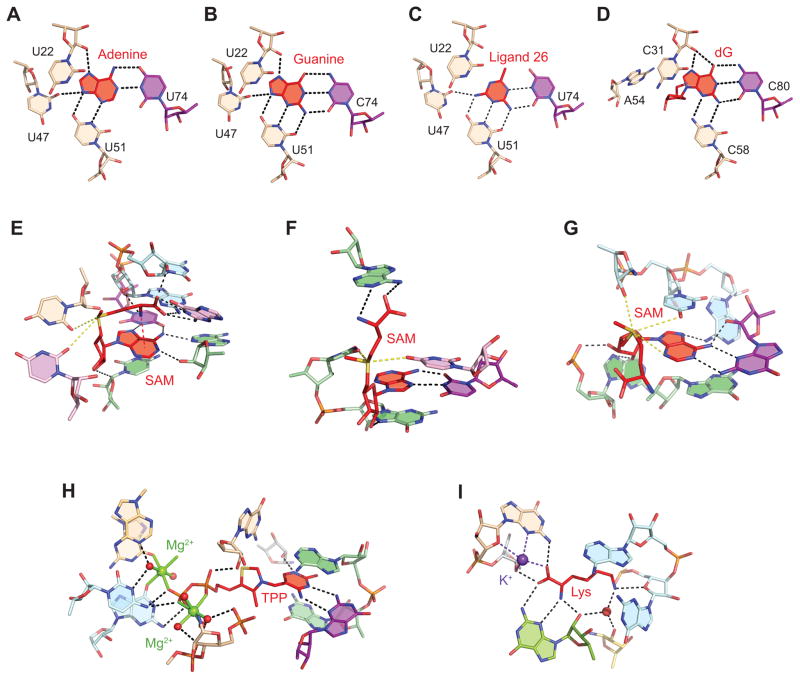
Recognition of different metabolites by riboswitches. The views show only nucleotides involved in ligand binding. Ligands are in red. Hydrogen bonds are depicted by dashed black lines. Carbon atoms of RNA are color-coded as in Figs. 2 and 3 while heteroatoms are shown in atomic colors. (A), Adenine riboswitch bound to adenine [73]. The discriminatory nucleotide is in violet. (B), Guanine riboswitch bound to guanine [73]. (C), Adenine riboswitch bound to a synthetic compound identified by virtual ligand screening [116]. (D), dG riboswitch bound to dG [88]. (E), SAM-I riboswitch bound to SAM [91]. Electrostatic interactions involving the sulfonium group are depicted by yellow dashed lines. Cation-π interaction is shown by red dashed line. (F), SAM-II riboswitch bound to SAM [52]. (G), SAM-III riboswitch bound to SAM [93]. (H), TPP riboswitch bound to TPP and two magnesium cations (green) [75]. The view does not show all intermolecular interactions. Water molecules are shown as pink spheres. Coordination bonds of cations are shown with green sticks. (I), Lysine riboswitch bound to lysine and a potassium cation [79].

References

    1. Kim SH, Suddath FL, Quigley GJ, McPherson A, Sussman JL, Wang AH, Seeman NC, Rich A. Three-dimensional tertiary structure of yeast phenylalanine transfer RNA. Science. 1974;185:435–440. - PubMed
    1. Quigley GJ, Teeter MM, Rich A. Structural analysis of spermine and magnesium ion binding to yeast phenylalanine transfer RNA. Proc Natl Acad Sci U S A. 1978;75:64–68. - PMC - PubMed
    1. Cech TR, Zaug AJ, Grabowski PJ. In vitro splicing of the ribosomal RNA precursor of Tetrahymena: involvement of a guanosine nucleotide in the excision of the intervening sequence. Cell. 1981;27:487–496. - PubMed
    1. Ellington AD, Szostak JW. In vitro selection of RNA molecules that bind specific ligands. Nature. 1990;346:818–822. - PubMed
    1. Tuerk C, Gold L. Systematic evolution of ligands by exponential enrichment: RNA ligands to bacteriophage T4 DNA polymerase. Science. 1990;249:505–510. - PubMed

LinkOut - more resources