


Review
doi: 10.1152/physiol.00040.2013.
Phosphodiesterases maintain signaling fidelity via compartmentalization of cyclic nucleotides
Affiliations
- PMID: 24583770
- PMCID: PMC3949206
- DOI: 10.1152/physiol.00040.2013
Item in Clipboard
Review
Phosphodiesterases maintain signaling fidelity via compartmentalization of cyclic nucleotides
Physiology (Bethesda).
2014 Mar.
Abstract
Novel technological advances have improved our understanding of how cyclic nucleotides are able to convey signals faithfully between cellular compartments. Phosphodiesterases play a crucial role in shaping these signals in health and disease. The concept of compartmentalization is guiding the search for therapies that have the potential to offer greater efficacy and tolerability compared with current treatments.
Conflict of interest statement
No conflicts of interest, financial or otherwise, are declared by the author(s).
Figures
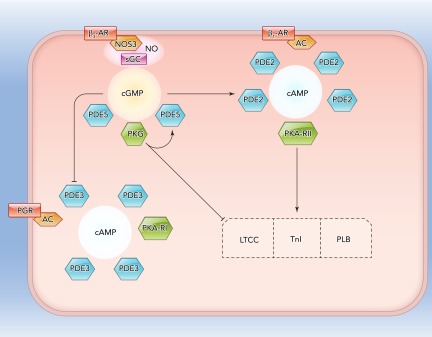
Cartoon depicting compartmentalization and cGMP- and cAMP-dependent signaling cross talk in a cardiomyocyte β-AR, β-adrenoceptor; LTCC, L-type calcium current; TnI, Troponin I; PLB, phospholamban; AC, adenylyl cyclase; sGC, soluble guanylyl cyclase; PGR, prostaglandin receptor. Arrows indicate stimulation. Blunt lines indicate inhibition.
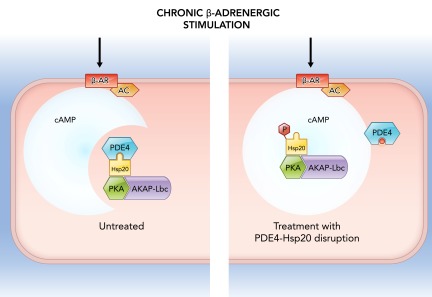
Cartoon depicting how interrupted subcellular PKA-cAMP microdomain signaling may affect cardiac hypertrophic growth Hsp20, heat shock protein 20. Red bar indicates disruptive peptide.
References
-
- Adams SR, Harootunian AT, Buechler YJ, Taylor SS, Tsien RY. Fluorescence ratio imaging of cyclic AMP in single cells. Nature 349: 694–697, 1991 - PubMed
-
- Alonso D, Radomski MW. Nitric oxide, platelet function, myocardial infarction and reperfusion therapies. Heart Fail Rev 8: 47–54, 2003 - PubMed
-
- Alvarez R, Taylor A, Fazzari JJ, Jacobs JR. Regulation of cyclic AMP metabolism in human platelets. Sequential activation of adenylate cyclase and cyclic AMP phosphodiesterase by prostaglandins. Mol Pharmacol 20: 302–309, 1981 - PubMed
-
- Aoki H, Inoue M, Mizobe T, Harada M, Imai H, Kobayashi A. Platelet function is inhibited by nitric oxide liberation during nitroglycerin-induced hypotension anaesthesia. Br J Anaesth 79: 476–481, 1997 - PubMed
Publication types
MeSH terms
Substances
Grants and funding
LinkOut - more resources
Full Text Sources
Other Literature Sources
