. 2014 Jul 1;23(13):3537-51.
doi: 10.1093/hmg/ddu065. Epub 2014 Feb 28.

Inherited mitochondrial DNA variants can affect complement, inflammation and apoptosis pathways: insights into mitochondrial-nuclear interactions

Affiliations

Inherited mitochondrial DNA variants can affect complement, inflammation and apoptosis pathways: insights into mitochondrial-nuclear interactions

M Cristina Kenney et al. Hum Mol Genet. .

Abstract

Age-related macular degeneration (AMD) is the leading cause of vision loss in developed countries. While linked to genetic polymorphisms in the complement pathway, there are many individuals with high risk alleles that do not develop AMD, suggesting that other 'modifiers' may be involved. Mitochondrial (mt) haplogroups, defined by accumulations of specific mtDNA single nucleotide polymorphisms (SNPs) which represent population origins, may be one such modifier. J haplogroup has been associated with high risk for AMD while the H haplogroup is protective. It has been difficult to assign biological consequences for haplogroups so we created human ARPE-19 cybrids (cytoplasmic hybrids), which have identical nuclei but mitochondria of either J or H haplogroups, to investigate their effects upon bioenergetics and molecular pathways. J cybrids have altered bioenergetic profiles compared with H cybrids. Q-PCR analyses show significantly lower expression levels for seven respiratory complex genes encoded by mtDNA. J and H cybrids have significantly altered expression of eight nuclear genes of the alternative complement, inflammation and apoptosis pathways. Sequencing of the entire mtDNA was carried out for all the cybrids to identify haplogroup and non-haplogroup defining SNPs. mtDNA can mediate cellular bioenergetics and expression levels of nuclear genes related to complement, inflammation and apoptosis. Sequencing data suggest that observed effects are not due to rare mtDNA variants but rather the combination of SNPs representing the J versus H haplogroups. These findings represent a paradigm shift in our concepts of mt-nuclear interactions.


Figures

Figure 1.
Figure 1.
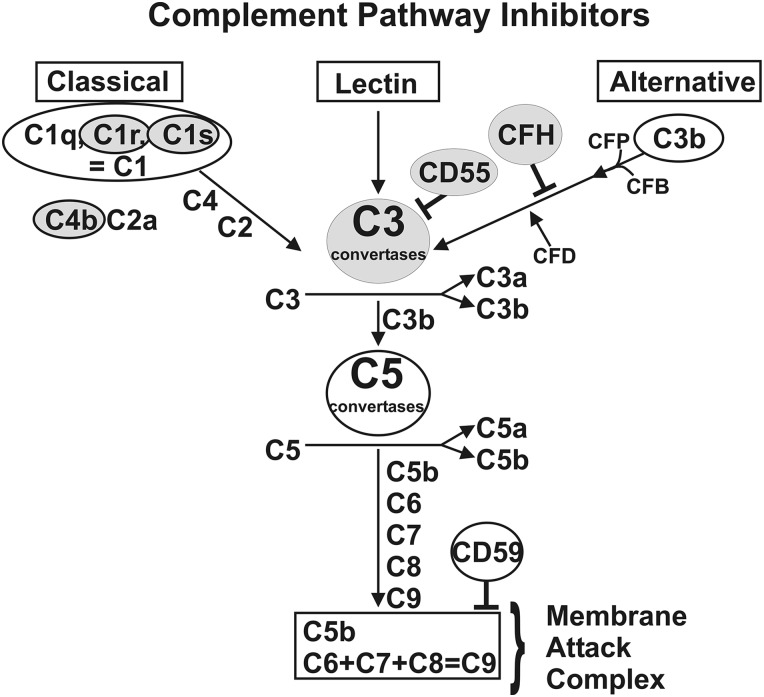
Schematic of the three branches of the complement pathway showing sites where CFH, C3, CD55, C1s, C1r and C4b are located. The CFH is an inhibitor of the alternative complement pathway. CD55 is a critical inhibitor of the C3 convertase step. C1s and C1r are major subunits of C1 component and C4b is a component of C4. The C1s, C1r and C4b are components of the classical complement pathway.
Figure 2.
Figure 2.
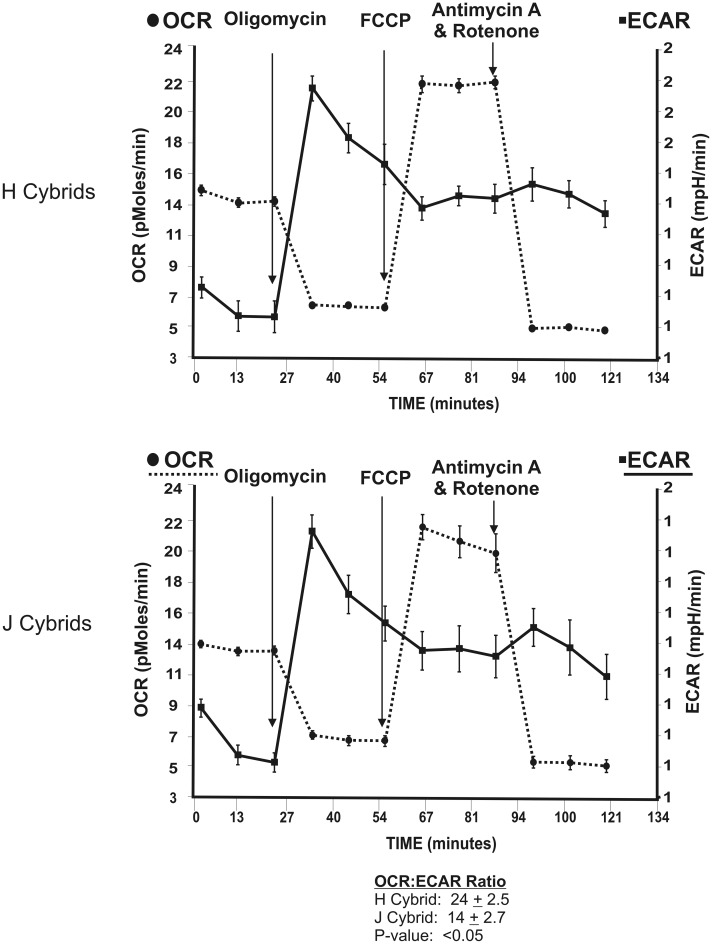
The OCR and ECAR values were measured after sequential treatments with Oligomycin (1 µm), FCCP (1 µm) and Antimycin A plus Rotenone (1 µm) for the H cybrids (n = 3) and J cybrids (n = 3). The values represent the means ± SEM which were obtained by analyzing four wells per cybrid sample and repeating the experiment twice. Note that the H cybrids versus J cybrids showed similar overall patterns in their responses to the inhibitors and uncoupling agents. However, the OCR:ECAR ratios were significantly different from each other (24 ± 2.5 versus 14 ± 2.7, P < 0.05). OCR, oxygen consumption rate; ECAR, extracellular acidification rate; FCCP, carbonyl cyanide 4-trifluoromethoxy-phenylhydrazone.
Figure 3.
Figure 3.
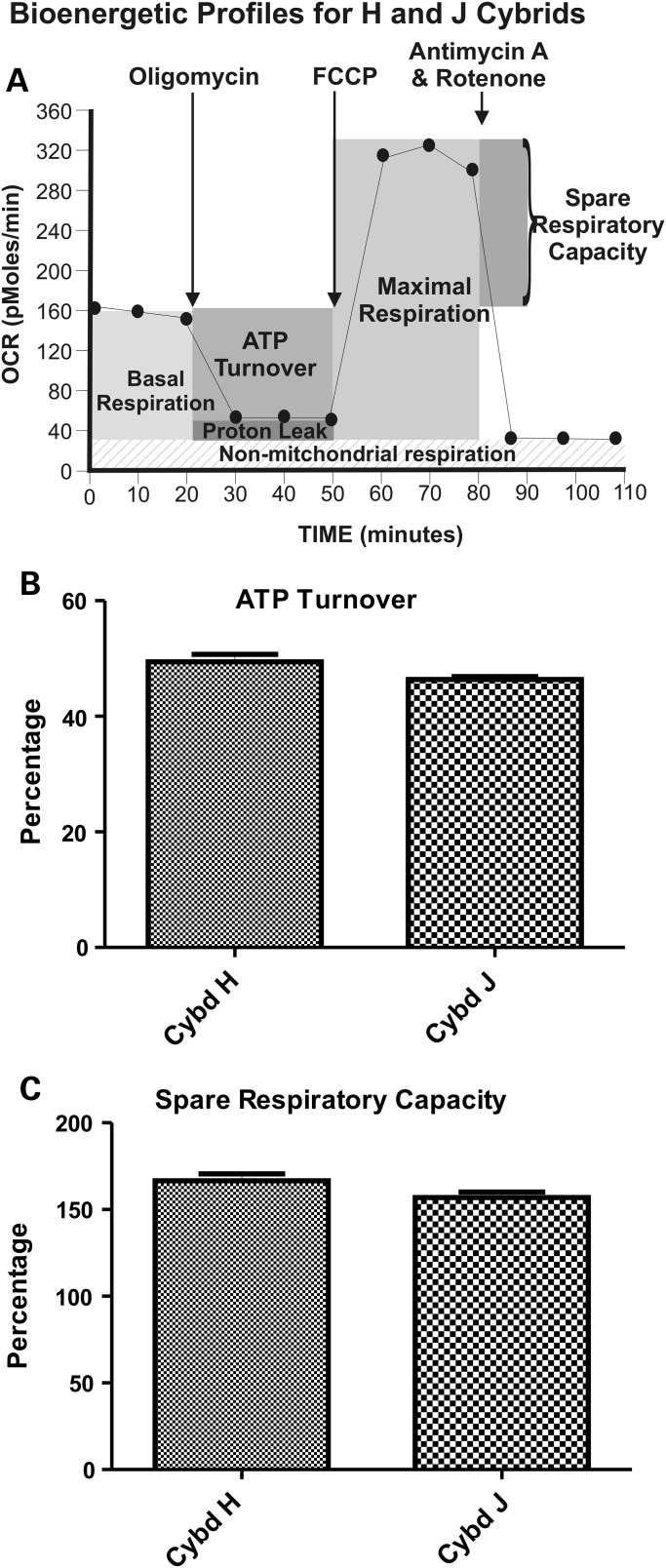
(A) A representative profile measured by the Seahorse XF24 flux analyzer showing OCR and ECAR patterns after sequential treatment with oligomycin (1 µm), FCCP (1 µm) and Antimycin A plus Rotenone (1 µm), showing the regions that define the basal aerobic respiration, ATP turnover and spare respiratory capacity. (B) The H and J cybrids showed similar responses in ATP turnover after Oligomycin treatment. (C) The H and J cybrids showed similar responses in the spare respiratory capacity measured after FCCP treatment. These data are presented as a % response from the basal readings, with non-mt respiration subtracted out and the basal respiratory rate is normalized to 100%. Cybd, cybrid.
Figure 4.
Figure 4.
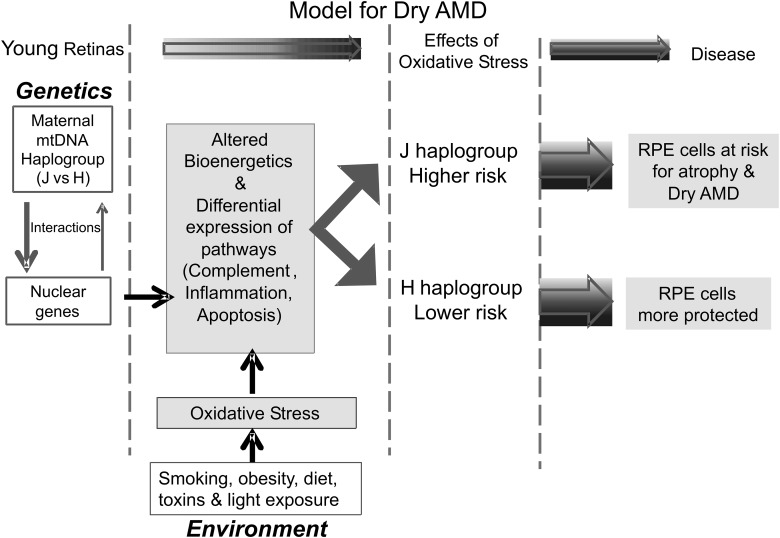
Schematic of new paradigm for mt–nuclear interactions. We propose that individuals have maternally inherited mtDNA haplogroups (e.g. H versus J), which acts as a ‘modifier’ for the nuclear genome via constant interactions. The haplogroup pattern mediates a ‘baseline’ of bioenergetics (e.g. energy production, ATP turnover) and nDNA expression levels for specific cellular pathways (e.g. complement, inflammation and apoptosis). As the cells are exposed to different environmental oxidative-stress factors (e.g. smoking, obesity, light exposures), the H haplogroup cells might respond differently than the J haplogroups cells because of the baseline expression levels of major pathways (e.g. complement, inflammation, apoptosis). This in turn may influence which cells undergo mitochondria dysfunction and cell death and which cells are protected and have longevity.

References

    1. Wallace D.C. Diseases of the mitochondrial DNA. Annu. Rev. Biochem. 1992;61:1175–1212. - PubMed
    1. Wallace D.C. Mitochondrial DNA mutations in diseases of energy metabolism. J. Bioenerg. Biomembr. 1994;26:241–250. - PubMed
    1. McFarland R., Turnbull D.M. Batteries not included: diagnosis and management of mitochondrial disease. J. Intern. Med. 2009;265:210–228. - PubMed
    1. Wallace D.C., Lott M.T., Procaccio V. Mitochondrial Genes in Degenerative Diseases, Cancer and Aging. Philadelphis, PA: Churchill Livingstone Elsevier; 2007.

    1. Czarnecka A.M., Bartnik E. The role of the mitochondrial genome in ageing and carcinogenesis. J. Aging Res. 2011;2011:136435. - PMC - PubMed

Publication types

Substances