


Comparing the Incidence of Catheter-Related Complications with Straight and Coiled Tenckhoff Catheters in Peritoneal Dialysis Patients-A Single-Center Prospective Randomized Trial
- PMID: 24584608
- PMCID: PMC4520727
- DOI: 10.3747/pdi.2013.00016
Comparing the Incidence of Catheter-Related Complications with Straight and Coiled Tenckhoff Catheters in Peritoneal Dialysis Patients-A Single-Center Prospective Randomized Trial
Abstract
♦
Objectives: We aimed to prospectively compare the incidence of catheter-related complications and catheter survival for straight (SCs) and coiled (CCs) Tenckhoff catheters in peritoneal dialysis (PD) patients. ♦
Methods: This open prospective randomized trial recruited 189 PD patients with end-stage renal disease from the department of nephrology, The First Affiliated Hospital of Sun Yat-sen University from 6 November 2007 to 27 August 2008. The patients were randomized to a SC (n = 99) or a CC (n = 90) and were then followed for 2 years. All catheter placements were performed by two designated experienced nephrologists who used a standardized institutional placement protocol. The primary study outcomes were catheter-related complications and catheter survival at 1 and 2 years. ♦
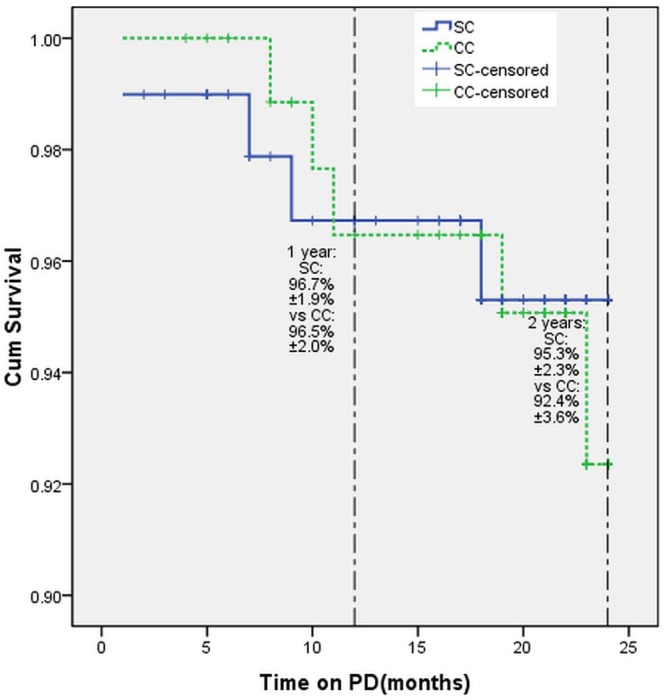
Results: We observed no significant differences in clinical and demographic characteristics between the groups at baseline. The overall incidence of catheter dysfunction was higher in the CC group than in the SC group (17.8% vs 7.1%, p = 0.03), and most of the events occurred 4 weeks or more after the catheters were implanted. Catheter tip migration and omental wrapping were the most common causes of catheter dysfunction. Surgical catheter rescue was more common in patients with CCs than in patients with SCs (9 vs 3 patients respectively, p = 0.05). No significant differences were observed in other catheter-related complications, including dialysate leaks, hernias, and PD-related infections (peritonitis, exit-site, and tunnel infections). Catheter survival rates in the SC and CC groups were similar at 1 year (96.7% ± 1.9% vs 96.5% ± 2.0%, p = 0.98) and at 2 years (95.3% ± 2.3% vs 92.4% ± 3.6%, p = 0.76). ♦
Conclusions: The incidence of PD catheter-related complications is probably higher with CCs than with SCs. The results of our study suggest that a SC is the better option to reduce subsequent catheter complications.
Keywords: Tenckhoff catheter; catheter-related complications; coiled catheters; straight catheters.
Copyright © 2015 International Society for Peritoneal Dialysis.
Figures
References
-
- Dell'Aquila R, Chiaramonte S, Rodighiero MP, Spano' E, Loreto P, Kohn CO, et al. Rational choice of peritoneal dialysis catheter. Perit Dial Int 2007; 27(Suppl 2):S119–25. - PubMed
-
- Akyol AM, Porteous C, Brown MW. A comparison of two types of catheters for continuous ambulatory peritoneal dialysis (CAPD). Perit Dial Int 1990; 10:63–6. - PubMed
-
- Johnson DW, Wong J, Wiggins KJ, Kirwan R, Griffin A, Preston J, et al. A randomized controlled trial of coiled versus straight swan-neck Tenckhoff catheters in peritoneal dialysis patients. Am J Kidney Dis 2006; 48:812–21. - PubMed
-
- Nielsen PK, Hemmingsen C, Friis SU, Ladefoged J, Olgaard K. Comparison of straight and curled Tenckhoff peritoneal dialysis catheter implanted by percutaneous technique: a prospective randomized study. Perit Dial Int 1995; 15:18–21. - PubMed
-
- Lo WK, Lui SL, Li FK, Choy BY, Lam MF, Tse KC, et al. A prospective randomized study on three different peritoneal dialysis catheters. Perit Dial Int 2003; 23(Suppl 2):S127–31. - PubMed
Publication types
MeSH terms
LinkOut - more resources
Full Text Sources
Other Literature Sources
Medical
