


Spontaneous, pro-arrhythmic calcium signals disrupt electrical pacing in mouse pulmonary vein sleeve cells
- PMID: 24586364
- PMCID: PMC3930634
- DOI: 10.1371/journal.pone.0088649
Spontaneous, pro-arrhythmic calcium signals disrupt electrical pacing in mouse pulmonary vein sleeve cells
Abstract
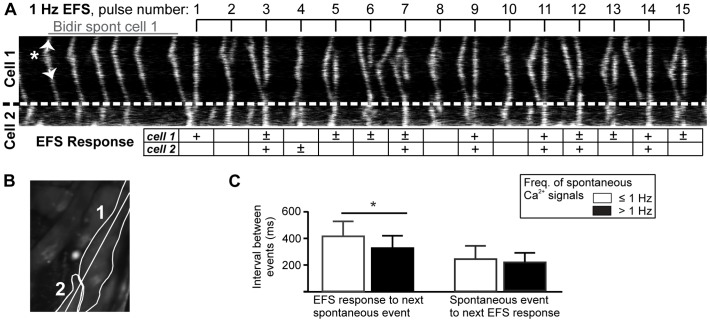
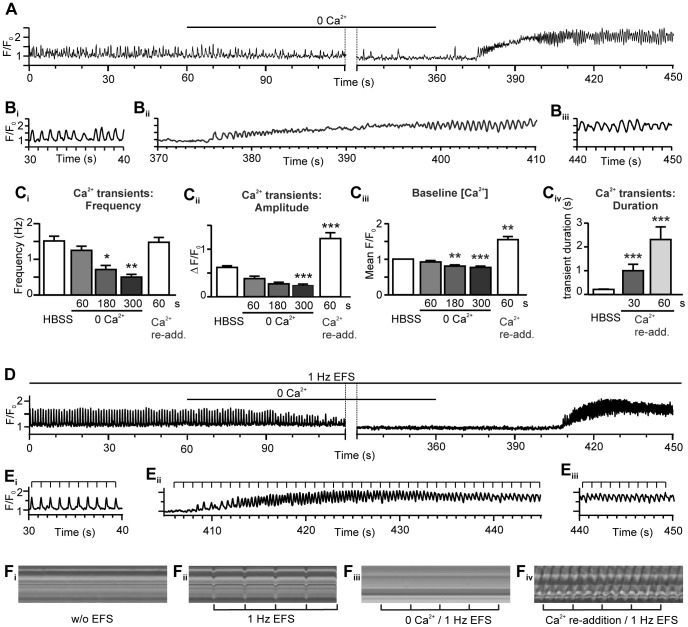
The pulmonary vein, which returns oxygenated blood to the left atrium, is ensheathed by a population of unique, myocyte-like cells called pulmonary vein sleeve cells (PVCs). These cells autonomously generate action potentials that propagate into the left atrial chamber and cause arrhythmias resulting in atrial fibrillation; the most common, often sustained, form of cardiac arrhythmia. In mice, PVCs extend along the pulmonary vein into the lungs, and are accessible in a lung slice preparation. We exploited this model to study how aberrant Ca(2+) signaling alters the ability of PVC networks to follow electrical pacing. Cellular responses were investigated using real-time 2-photon imaging of lung slices loaded with a Ca(2+)-sensitive fluorescent indicator (Ca(2+) measurements) and phase contrast microscopy (contraction measurements). PVCs displayed global Ca(2+) signals and coordinated contraction in response to electrical field stimulation (EFS). The effects of EFS relied on both Ca(2+) influx and Ca(2+) release, and could be inhibited by nifedipine, ryanodine or caffeine. Moreover, PVCs had a high propensity to show spontaneous Ca(2+) signals that arose via stochastic activation of ryanodine receptors (RyRs). The ability of electrical pacing to entrain Ca(2+) signals and contractile responses was dramatically influenced by inherent spontaneous Ca(2+) activity. In PVCs with relatively low spontaneous Ca(2+) activity (<1 Hz), entrainment with electrical pacing was good. However, in PVCs with higher frequencies of spontaneous Ca(2+) activity (>1.5 Hz), electrical pacing was less effective; PVCs became unpaced, only partially-paced or displayed alternans. Because spontaneous Ca(2+) activity varied between cells, neighboring PVCs often had different responses to electrical pacing. Our data indicate that the ability of PVCs to respond to electrical stimulation depends on their intrinsic Ca(2+) cycling properties. Heterogeneous spontaneous Ca(2+) activity arising from stochastic RyR opening can disengage them from sinus rhythm and lead to autonomous, pro-arrhythmic activity.
Conflict of interest statement
Figures





References
-
- Bers DM (2002) Cardiac excitation-contraction coupling. Nature 415: 198–205. - PubMed
-
- Dobrzynski H, Anderson RH, Atkinson A, Borbas Z, D’Souza A, et al. (2013) Structure, function and clinical relevance of the cardiac conduction system, including the atrioventricular ring and outflow tract tissues. Pharmacol Ther 139: 260–288. - PubMed
-
- Berridge MJ (2003) Cardiac calcium signaling. Biochem Soc Trans 31: 930–933. - PubMed
-
- Niggli E (2011) Ryanodine receptors: waking up from refractoriness. Cardiovasc Res 91: 563–564. - PubMed
-
- Nattel S (2003) Atrial electrophysiology and mechanisms of atrial fibrillation. J Cardiovasc Pharmacol Ther 8 Suppl 1: S5–11. - PubMed
Publication types
MeSH terms
Substances
Grants and funding
LinkOut - more resources
Full Text Sources
Other Literature Sources
Medical
Miscellaneous
