


Quality of malaria case management in Malawi: results from a nationally representative health facility survey
- PMID: 24586497
- PMCID: PMC3930691
- DOI: 10.1371/journal.pone.0089050
Quality of malaria case management in Malawi: results from a nationally representative health facility survey
Abstract
Background: Malaria is endemic throughout Malawi, but little is known about quality of malaria case management at publicly-funded health facilities, which are the major source of care for febrile patients.
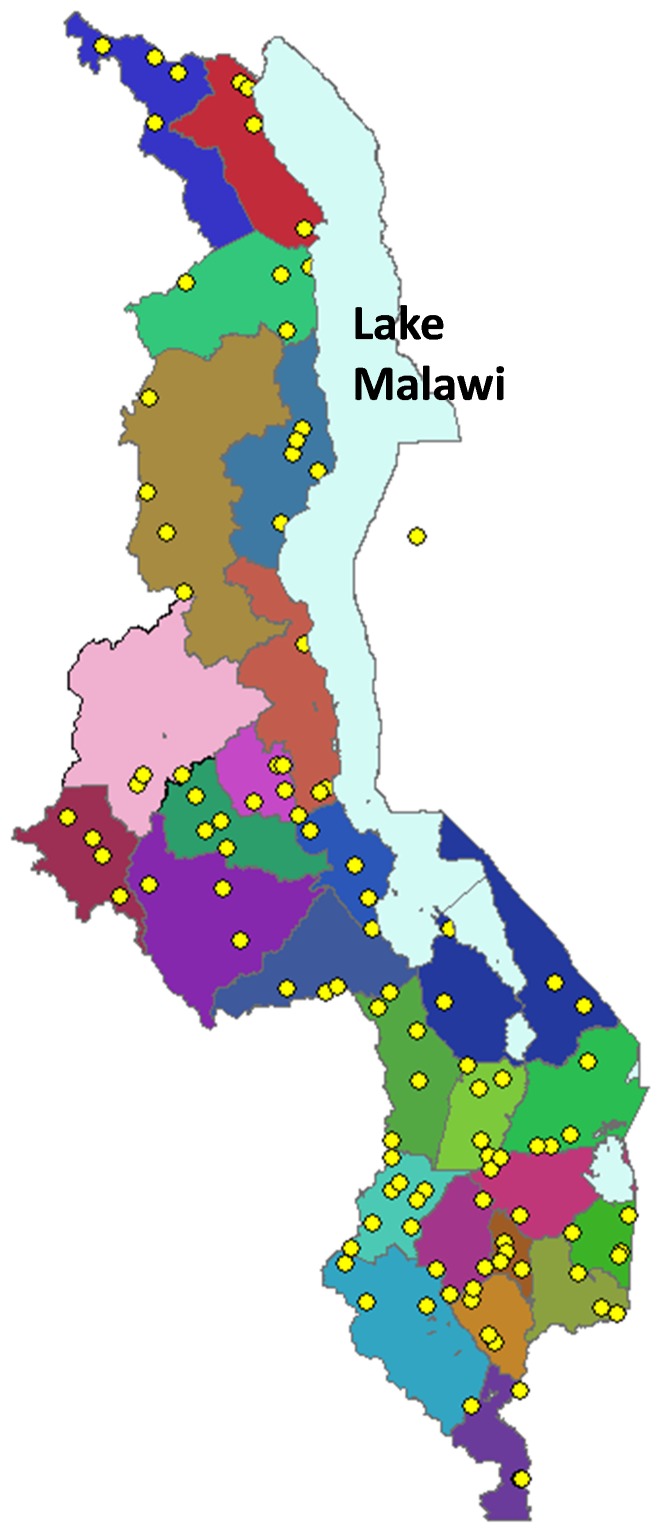
Methods: In April-May 2011, we conducted a nationwide, geographically-stratified health facility survey to assess the quality of outpatient malaria diagnosis and treatment. We enrolled patients presenting for care and conducted exit interviews and re-examinations, including reference blood smears. Moreover, we assessed health worker readiness (e.g., training, supervision) and health facility capacity (e.g. availability of diagnostics and antimalarials) to provide malaria case management. All analyses accounted for clustering and unequal selection probabilities. We also used survey weights to produce estimates of national caseloads.
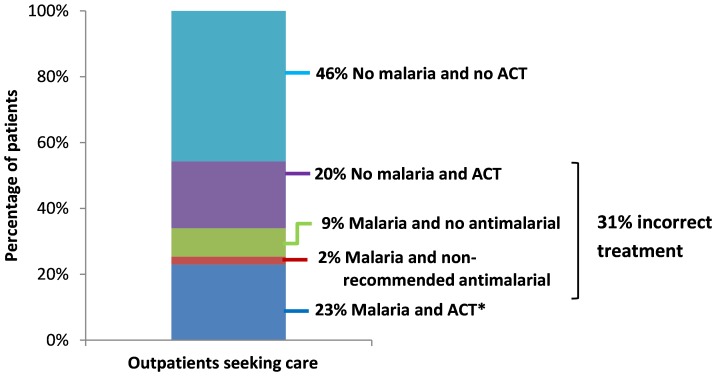
Results: At the 107 facilities surveyed, most of the 136 health workers interviewed (83%) had received training on malaria case management. However, only 24% of facilities had functional microscopy, 15% lacked a thermometer, and 19% did not have the first-line artemisinin-based combination therapy (ACT), artemether-lumefantrine, in stock. Of 2,019 participating patients, 34% had clinical malaria (measured fever or self-reported history of fever plus a positive reference blood smear). Only 67% (95% confidence interval (CI): 59%, 76%) of patients with malaria were correctly prescribed an ACT, primarily due to missed malaria diagnosis. Among patients without clinical malaria, 31% (95% CI: 24%, 39%) were prescribed an ACT. By our estimates, 1.5 million of the 4.4 million malaria patients seen in public facilities annually did not receive correct treatment, and 2.7 million patients without clinical malaria were inappropriately given an ACT.
Conclusions: Malawi has a high burden of uncomplicated malaria but nearly one-third of all patients receive incorrect malaria treatment, including under- and over-treatment. To improve malaria case management, facilities must at minimum have basic case management tools, and health worker performance in diagnosing malaria must be improved.
Conflict of interest statement
Figures
References
-
- World Health Organization (2010) Guidelines for the treatment of malaria, second edition. Geneva: WHO.
-
- Zurovac D, Rowe AK (2006) Quality of treatment for febrile illness among children at outpatient facilities in sub-Saharan Africa. Ann Trop Med Parasitol 100: 283–296. - PubMed
-
- Bloland PB, Lackritz EM, Kazembe PN, Were JB, Steketee R, et al. (1993) Beyond chloroquine: implications of drug resistance for evaluating malaria therapy efficacy and treatment policy in Africa. J Infect Dis 167: 932–937. - PubMed
-
- World Health Organization (2011) World Malaria Report. Geneva: WHO.
Publication types
MeSH terms
Substances
Grants and funding
LinkOut - more resources
Full Text Sources
Other Literature Sources
Medical
Miscellaneous
