


Small-cell lung cancer in England: trends in survival and chemotherapy using the National Lung Cancer Audit
- PMID: 24586771
- PMCID: PMC3931780
- DOI: 10.1371/journal.pone.0089426
Small-cell lung cancer in England: trends in survival and chemotherapy using the National Lung Cancer Audit
Abstract
Background: The purpose of this study was to identify trends in survival and chemotherapy use for individuals with small-cell lung cancer (SCLC) in England using the National Lung Cancer Audit (NLCA).
Methods: We used data from the NLCA database to identify people with histologically proven SCLC from 2004-2011. We calculated the median survival by stage and assessed whether patient characteristics changed over time. We also assessed whether the proportion of patients with records of chemotherapy and/or radiotherapy changed over time.
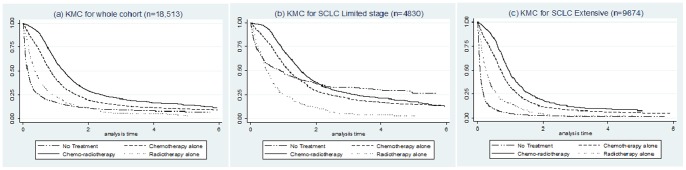
Results: 18,513 patients were diagnosed with SCLC in our cohort. The median survival was 6 months for all patients, 1 year for those with limited stage and 4 months for extensive stage. 69% received chemotherapy and this proportion changed very slightly over time (test for trends p = 0.055). Age and performance status of patients remained stable over the study period, but the proportion of patients staged increased (p-value<0.001), mainly because of improved data completeness. There has been an increase in the proportion of patients that had a record of receiving both chemotherapy and radiotherapy each year (from 19% to 40% in limited and from 9% to 21% in extensive stage from 2004 to 2011). Patients who received chemotherapy with radiotherapy had better survival compared with any other treatment (HR 0.24, 95% CI 0.23-0.25).
Conclusion: Since 2004, when the NLCA was established, the proportion of patients with SCLC having chemotherapy has remained static. We have found an upward trend in the proportion of patients receiving both chemotherapy and radiotherapy which corresponded to a better survival in this group, but as it only applied for a small proportion of patients, it was not enough to change the overall survival.
Conflict of interest statement
Figures
References
-
- National Institute for Health and Care Excellence (Feburary 2005) The Diagnosis and Treatment of Lung Cancer: Methods, evidence & guidance.
-
- Riaz SP, Luchtenborg M, Coupland VH, Spicer J, Peake MD, et al. (2012) Trends in incidence of small cell lung cancer and all lung cancer. Lung Cancer 75: 280–284. - PubMed
-
- National Institute for Health and Clinical Excellence (April 2011) Lung Cancer: The diagnosis and treatment of lung cancer.
-
- Health and Social Care Information Centre (2010) National Lung Cancer Audit 2010.
-
- Health and Social Care Information Centre (2011) National Lung Cancer Audit Report 2011.
Publication types
MeSH terms
LinkOut - more resources
Full Text Sources
Other Literature Sources
Medical
