


Model-observer similarity, error modeling and social learning in rhesus macaques
- PMID: 24587063
- PMCID: PMC3933687
- DOI: 10.1371/journal.pone.0089825
Model-observer similarity, error modeling and social learning in rhesus macaques
Abstract
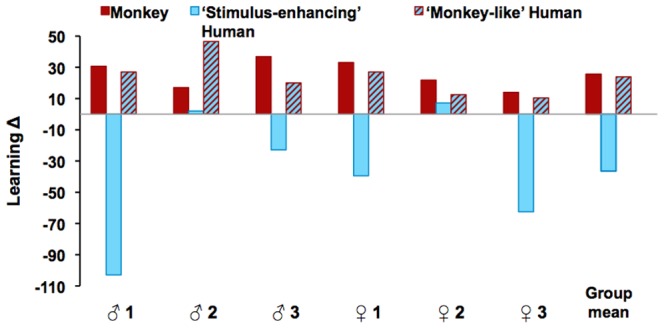
Monkeys readily learn to discriminate between rewarded and unrewarded items or actions by observing their conspecifics. However, they do not systematically learn from humans. Understanding what makes human-to-monkey transmission of knowledge work or fail could help identify mediators and moderators of social learning that operate regardless of language or culture, and transcend inter-species differences. Do monkeys fail to learn when human models show a behavior too dissimilar from the animals' own, or when they show a faultless performance devoid of error? To address this question, six rhesus macaques trained to find which object within a pair concealed a food reward were successively tested with three models: a familiar conspecific, a 'stimulus-enhancing' human actively drawing the animal's attention to one object of the pair without actually performing the task, and a 'monkey-like' human performing the task in the same way as the monkey model did. Reward was manipulated to ensure that all models showed equal proportions of errors and successes. The 'monkey-like' human model improved the animals' subsequent object discrimination learning as much as a conspecific did, whereas the 'stimulus-enhancing' human model tended on the contrary to retard learning. Modeling errors rather than successes optimized learning from the monkey and 'monkey-like' models, while exacerbating the adverse effect of the 'stimulus-enhancing' model. These findings identify error modeling as a moderator of social learning in monkeys that amplifies the models' influence, whether beneficial or detrimental. By contrast, model-observer similarity in behavior emerged as a mediator of social learning, that is, a prerequisite for a model to work in the first place. The latter finding suggests that, as preverbal infants, macaques need to perceive the model as 'like-me' and that, once this condition is fulfilled, any agent can become an effective model.
Conflict of interest statement
Figures


References
-
- Laland KN (2004) Social learning strategies. Learning and Behavior 32: 4–14. - PubMed
-
- Valone TJ (2007) From eavesdropping on performance to copying the behavior of others: a review of public information use. Behavioral Ecology and Sociobiology 62: 1–14.
-
- Whiten A (2012) Social learning, traditions and culture. In: Mitani JC, Call J, Kappeler PM, Palombit RA, Silk JB, editors (2012) The Evolution of Primate Societies. Chicago: Chicago University Press. p. 681–699.
-
- Hadj-Bouziane F, Meunier M, Boussaoud D (2003) Conditional visuo-motor learning in primates: a key role for the basal ganglia. Journal of Physiology Paris 97: 567–79. - PubMed
Publication types
MeSH terms
LinkOut - more resources
Full Text Sources
Other Literature Sources
