


Effectiveness of online self-help for suicidal thoughts: results of a randomised controlled trial
- PMID: 24587233
- PMCID: PMC3937447
- DOI: 10.1371/journal.pone.0090118
Effectiveness of online self-help for suicidal thoughts: results of a randomised controlled trial
Abstract
Background: Many people with suicidal thoughts do not receive treatment. The Internet can be used to reach more people in need of support.
Objective: To test the effectiveness of unguided online self-help to reduce suicidal thoughts.
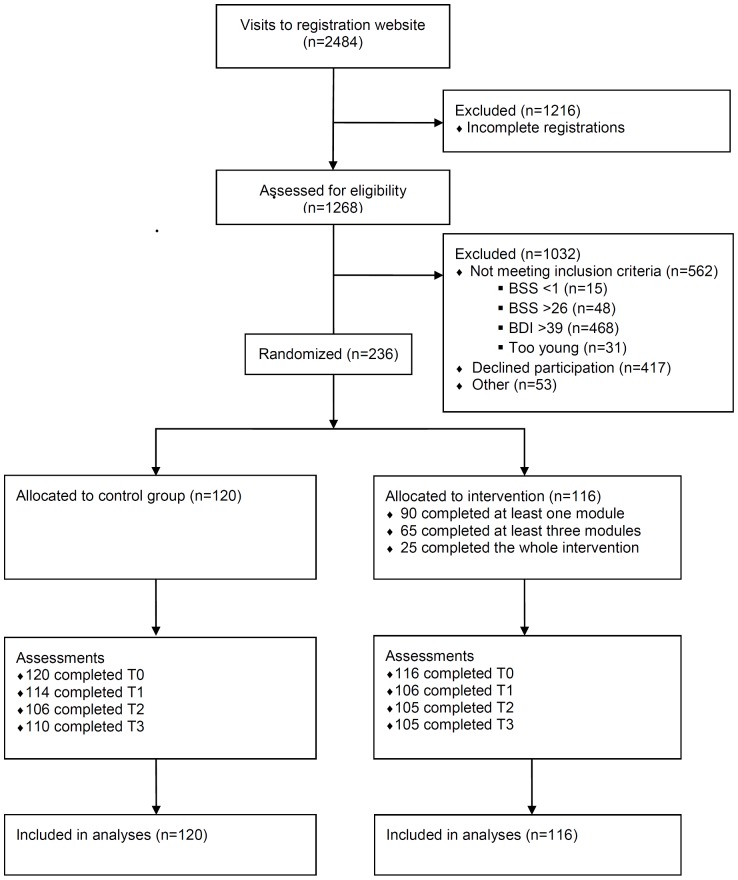
Method: 236 adults with mild to moderate suicidal thoughts were randomised to the intervention (n=116) or a waitlist control group (n=120). Assessments took place at baseline, and 2, 4 and 6 weeks later. Primary outcome was suicidal thoughts. Secondary outcomes were depressive symptoms, anxiety, hopelessness, worry, and health status.
Results: The intervention group showed a small significant effect in reducing suicidal thoughts (d=0.28). Effects were more pronounced for those with a history of repeated suicide attempts. There was also a significant reduction in worry (d=0.33). All other secondary outcomes showed small but non-significant improvements.
Conclusions: Although effect sizes were small, the reach of the internet could enable this intervention to help many people reduce their suicidal thoughts.
Trial registration: Netherlands Trial Register NTR1689.
Conflict of interest statement
References
-
- Linehan MM, Comtois KA, Murray AM, Brown MZ, Gallop RJ, et al. (2006) Two-year randomized controlled trial and follow-up of dialectical behavior therapy vs therapy by experts for suicidal behaviors and borderline personality disorder. Arch Gen Psychiatry 63: 757–66. - PubMed
-
- Brown GK, ten Have T, Henriques GR, Xie SX, Hollander JE, et al. (2005) Cognitive therapy for the prevention of suicide attempts. A randomized controlled trial. JAMA 294: 563–70. - PubMed
-
- Tarrier N, Taylor K, Gooding P (2008) Cognitive-behavioral interventions to reduce suicide behavior. A systematic review and meta-analysis. Behav Modif 32: 77–108. - PubMed
-
- van den Bosch LMC, Koeter MWJ, Stijnen T, Verheul R, van den Brink W (2005) Sustained efficacy of dialectical behaviour therapy for borderline personality disorder. Behav Res Ther 43: 1231–41. - PubMed
-
- Verheul R, van den Bosch LMC, Koeter MWJ, de Ridder MAJ, Stijnen T, et al. (2003) Dialectical behaviour therapy for women with borderline personality disorder. Br J Psychiatry 182: 135–40. - PubMed
Publication types
MeSH terms
Associated data
LinkOut - more resources
Full Text Sources
Other Literature Sources
Medical
