


Natural diet of coral-excavating sponges consists mainly of dissolved organic carbon (DOC)
- PMID: 24587253
- PMCID: PMC3934968
- DOI: 10.1371/journal.pone.0090152
Natural diet of coral-excavating sponges consists mainly of dissolved organic carbon (DOC)
Abstract
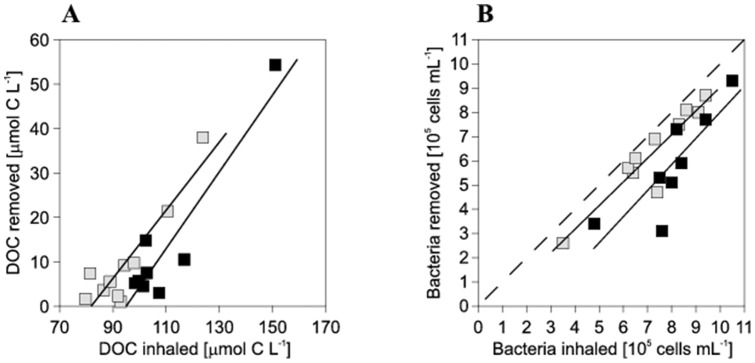
Coral-excavating sponges are the most important bioeroders on Caribbean reefs and increase in abundance throughout the region. This increase is commonly attributed to a concomitant increase in food availability due to eutrophication and pollution. We therefore investigated the uptake of organic matter by the two coral-excavating sponges Siphonodictyon sp. and Cliona delitrix and tested whether they are capable of consuming dissolved organic carbon (DOC) as part of their diet. A device for simultaneous sampling of water inhaled and exhaled by the sponges was used to directly measure the removal of DOC and bacteria in situ. During a single passage through their filtration system 14% and 13% respectively of the total organic carbon (TOC) in the inhaled water was removed by the sponges. 82% (Siphonodictyon sp.; mean ± SD; 13 ± 17 μmol L(-1)) and 76% (C. delitrix; 10 ± 12 μmol L(-1)) of the carbon removed was taken up in form of DOC, whereas the remainder was taken up in the form of particulate organic carbon (POC; bacteria and phytoplankton) despite high bacteria retention efficiency (72 ± 15% and 87 ± 10%). Siphonodictyon sp. and C. delitrix removed DOC at a rate of 461 ± 773 and 354 ± 562 μmol C h(-1) respectively. Bacteria removal was 1.8 ± 0.9 × 10(10) and 1.7 ± 0.6 × 10(10) cells h(-1), which equals a carbon uptake of 46.0 ± 21.2 and 42.5 ± 14.0 μmol C h(-1) respectively. Therefore, DOC represents 83 and 81% of the TOC taken up by Siphonodictyon sp. and C. delitrix per hour. These findings suggest that similar to various reef sponges coral-excavating sponges also mainly rely on DOC to meet their carbon demand. We hypothesize that excavating sponges may also benefit from an increasing production of more labile algal-derived DOC (as compared to coral-derived DOC) on reefs as a result of the ongoing coral-algal phase shift.
Conflict of interest statement
Figures


References
-
- Hein JF, Risk MJ (1975) Bioerosion of coral heads: inner patch reefs, Florida reef tract. Bull Mar Sci 25: 133–138.
-
- Gonzalez-Rivero M, Yakob L, Mumby PJ (2011) The role of sponge competition on coral reef alternative steady states. Ecological Modelling 222: 1847–1853.
-
- Risk MJ, Sammarco PW, Edinger EN (1995) Bioerosion in Acropora across the continental shelf of the Great Barrier Reef. Coral Reefs 14: 79–86.
-
- Mallela J, Perry CT (2007) Calcium carbonate budget for two coral reefs affected by different terrestrial runoff regimes, Rio Bueno, Jamaica. Coral Reefs 26: 129–145.
-
- Calcinai B, Azzini F, Bavestrello G, Gaggero L, Cerrano C (2007) Excavating rates and boring pattern of Cliona albimarginata (Porifera: Clionaidae) in different substrata. In: Custódio MR, Hajdu E, Lôbo-Hajdu G, Muricy G (eds) Porifera research: biodiversity, innovation and sustainability. Proc 7th Int Sponge Symp: 255–263.
Publication types
MeSH terms
Substances
LinkOut - more resources
Full Text Sources
Other Literature Sources
