


Seroprevalence of hepatitis B virus among adults at high risk for HIV transmission two decades after implementation of nationwide hepatitis B virus vaccination program in Taiwan
- PMID: 24587275
- PMCID: PMC3935970
- DOI: 10.1371/journal.pone.0090194
Seroprevalence of hepatitis B virus among adults at high risk for HIV transmission two decades after implementation of nationwide hepatitis B virus vaccination program in Taiwan
Abstract
Background: Seroprevalence of hepatitis B virus (HBV) after implementation of universal neonatal HBV vaccination and catch-up vaccination programs remains rarely investigated among the adults who were born in the vaccination era (in or after 1986) and engaged in high-risk sexual behaviors.
Materials and methods: Between 2006 and 2012, we determined HBV surface antigen ([HBsAg), anti-HBs, and HBV core antibody (anti-HBc), hepatitis C virus antibody (anti-HCV) and rapid plasma reagin titers among HIV-infected men who have sex with men (MSM) born during 1984-1985 (Group I: 244 persons) and those born in or after 1986 (Group II: 523), and HIV-uninfected MSM (Group III: 377) and heterosexuals (Group IV: 217) born in or after 1986. Prevalence and incidence of HBV infection were estimated and multivariate analysis was performed to identify factors associated with HBsAg positivity.
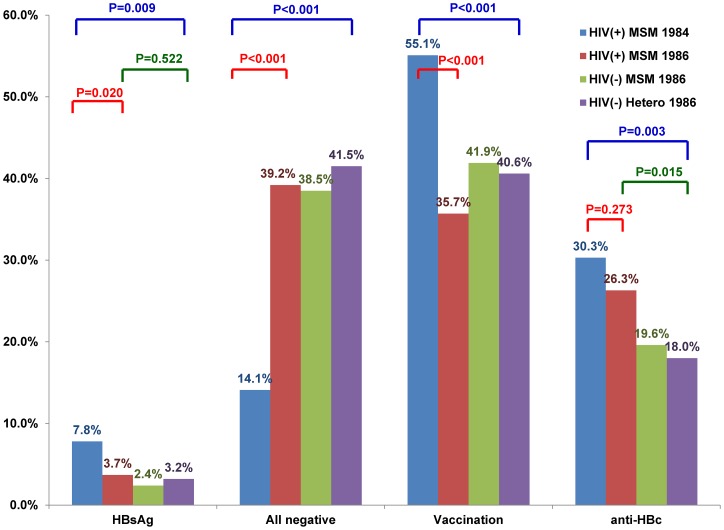
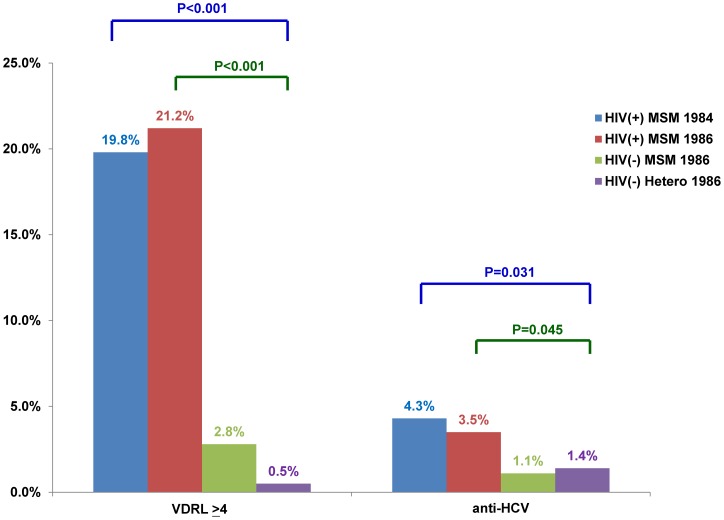
Results: Compared with Group I, Groups II-IV had a significantly lower prevalence of HBsAg positivity (7.8% vs 3.7%, 2.4%, and 3.2%, respectively); and the prevalence of anti-HBc positivity was also lower for Groups III and IV (30.3% vs. 19.6%, and 18.0%, respectively), but no difference was observed between Groups I and II (30.3% vs. 26.3%). In multivariate analysis, HBsAg positivity was significantly associated with syphilis (adjusted odds ratio, 2.990; 95% confidence interval, 1.502-5.953) and anti-HCV positivity (adjusted odds ratio, 3.402; 95% confidence interval, 1.091-10.614). In subjects of Group II with all-negative HBV markers at baseline, the incidence rate of HBsAg seroconversion was 0.486 episodes per 100 person-years; and for those who received combination antiretroviral therapy containing lamivudine and/or tenofovir, none developed HBsAg seroconversion during the follow-up.
Conclusions: Among the adults who were born in or after 1986 and engaged in high-risk sexual behaviors in Taiwan, neonatal HBV vaccination and catch-up vaccination programs conferred long-term protection against HBsAg seroconversion and HBsAg positivity was associated with syphilis and anti-HCV positivity.
Conflict of interest statement
Figures
References
-
- Centers for Disease C, Prevention (2006) Hepatitis B vaccination coverage among adults – United States, 2004. MMWR Morbidity and mortality weekly report 55: 509–511. - PubMed
-
- Su WJ, Liu CC, Liu DP, Chen SF, Huang JJ, et al. (2012) Effect of age on the incidence of acute hepatitis B after 25 years of a universal newborn hepatitis B immunization program in Taiwan. The Journal of infectious diseases 205: 757–762. - PubMed
-
- McMahon BJ, Bulkow LR, Singleton RJ, Williams J, Snowball M, et al. (2011) Elimination of hepatocellular carcinoma and acute hepatitis B in children 25 years after a hepatitis B newborn and catch-up immunization program. Hepatology 54: 801–807. - PubMed
-
- Chen SM, Kung CM, Yang WJ, Wang HL (2011) Efficacy of the nationwide hepatitis B infant vaccination program in Taiwan. Journal of clinical virology: the official publication of the Pan American Society for Clinical Virology 52: 11–16. - PubMed
-
- Chang MH, Chen CJ, Lai MS, Hsu HM, Wu TC, et al. (1997) Universal hepatitis B vaccination in Taiwan and the incidence of hepatocellular carcinoma in children. Taiwan Childhood Hepatoma Study Group. The New England journal of medicine 336: 1855–1859. - PubMed
MeSH terms
Substances
LinkOut - more resources
Full Text Sources
Other Literature Sources
Medical
