


Remating and sperm competition in replicate populations of Drosophila melanogaster adapted to alternative environments
- PMID: 24587283
- PMCID: PMC3934985
- DOI: 10.1371/journal.pone.0090207
Remating and sperm competition in replicate populations of Drosophila melanogaster adapted to alternative environments
Abstract
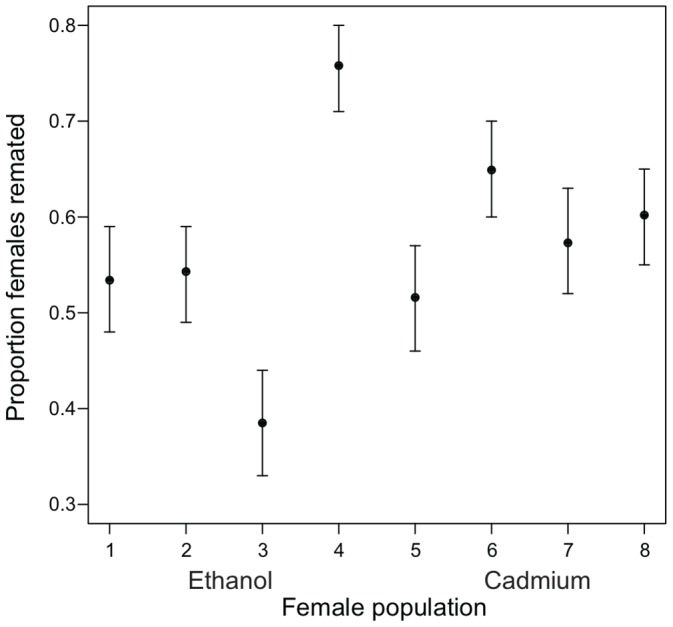
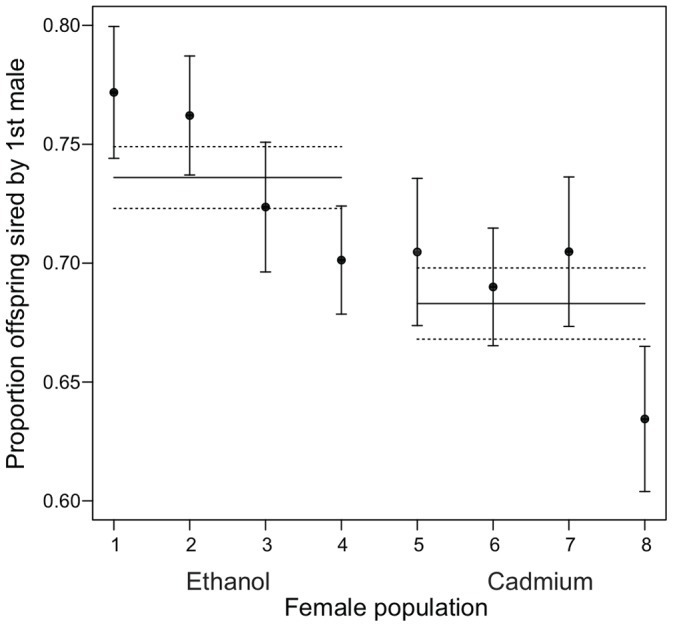
The prevalence of sexual conflict in nature, as well as the supposedly arbitrary direction of the resulting coevolutionary trajectories, suggests that it may be an important driver of phenotypic divergence even in a constant environment. However, natural selection has long been central to the operation of sexual conflict within populations and may therefore constrain or otherwise direct divergence among populations. Ecological context may therefore matter with respect to the diversification of traits involved in sexual conflict, and if natural selection is sufficiently strong, such traits may evolve in correlation with environment, generating a pattern of ecologically-dependent parallel evolution. In this study we assess among-population divergence both within and between environments for several traits involved in sexual conflict. Using eight replicate populations of Drosophila melanogaster from a long-term evolution experiment, we measured remating rates and subsequent offspring production of females when housed with two separate males in sequence. We found no evidence of any variation in male reproductive traits (offense or defense). However, the propensity of females to remate diverged significantly among the eight populations with no evidence of any environmental effect, consistent with sexual conflict promoting diversification even in the absence of ecological differences. On the other hand, females adapted to one environment (ethanol) tended to produce a higher proportion of offspring sired by their first mate as compared to those adapted to the other (cadmium) environment, suggesting ecologically-based divergence of this conflict phenotype. Because we find evidence for both stochastic population divergence operating outside of an ecological context and environment-dependent divergence of traits under sexual conflict, the interaction of these two processes is an important topic for future work.
Conflict of interest statement
Figures
References
-
- Parker G (1979) Sexual selection and sexual conflict. In: Blum MS, Blum NA, editors. Sexual selection and reproductive competition in insects. New York: Academic Press. 123–166.
-
- Arnqvist G, Rowe L (2005) Sexual Conflict. Princeton, NJ: Princeton University Press.
-
- Rice WR (1996) Sexually antagonistic male adaptation triggered by experimental arrest of female evolution. Nature 381: 232–234. - PubMed
-
- Holland B, Rice WR (1998) Chase-away sexual selection: antagonistic seduction versus resistance. Evolution 52: 1–7. - PubMed
-
- Fowler K, Partridge L (1989) A cost of mating in female fruitflies. Nature 338: 760–761.
Publication types
MeSH terms
LinkOut - more resources
Full Text Sources
Other Literature Sources
Molecular Biology Databases
