


An exclusively human milk diet reduces necrotizing enterocolitis
- PMID: 24588561
- PMCID: PMC4025624
- DOI: 10.1089/bfm.2013.0121
An exclusively human milk diet reduces necrotizing enterocolitis
Abstract
Objective: This study tested the hypothesis that feeding an exclusively human milk (EHM) diet to premature infants reduces the incidence of necrotizing enterocolitis (NEC) associated with enteral feeding.
Study design: An observational study for infants born at less than 33 weeks of gestational age was performed in a single neonatal intensive care unit. An EHM diet prospectively eliminated bovine-based artificial milk, including bovine-based fortifier, through 33 weeks postmenstrual age (PMA). The clinical data from a 2.5-year interval of the EHM diet were compared with data from the previous 6.5 years for similar infants who received bovine-based milk products before 33 weeks PMA.
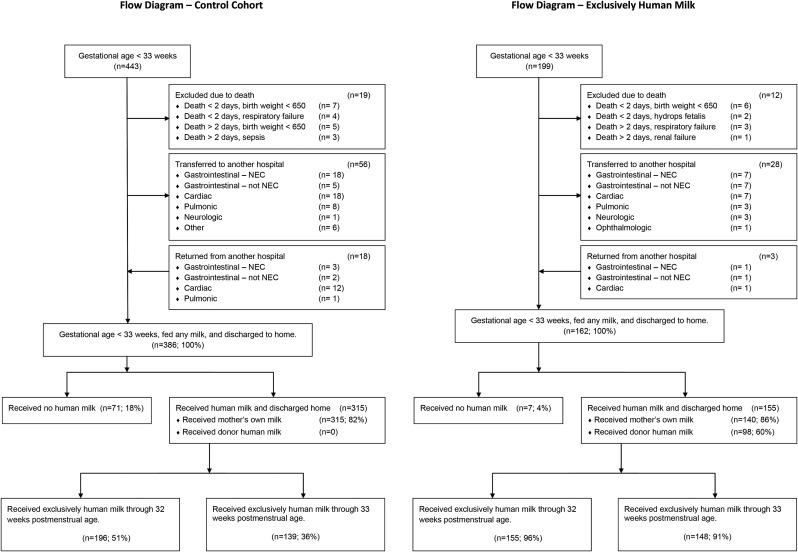
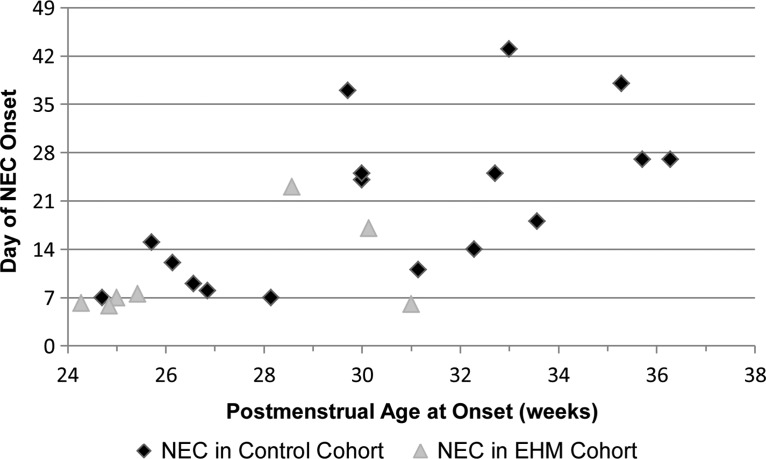
Results: In the EHM diet cohort, 148 of 162 infants (91%) received EHM through 33 weeks PMA. In order to achieve an EHM diet, 140 of 162 infants (86%) received their own mother's milk, and 98 of 162 infants (60%) received donor human milk. The EHM cohort was also fed a human milk-based fortifier to truly eliminate bovine products. The distribution of NEC onset in the EHM cohort was significantly different from that in the control cohort for the day of onset (p=0.042) and the PMA at onset (p=0.011). In the control cohort, NEC onset after Day 7 of life occurred in 15 of 443 infants (3.4%), significantly more than in the EHM cohort where NEC occurred in two of 199 infants (1%) (p=0.009).
Conclusions: Changing to an EHM milk diet through 33 weeks PMA reduced the incidence of NEC associated with enteral feeding.
Figures
References
-
- Section on Breastfeeding. Breastfeeding and the use of human milk. Pediatrics 2012;129:e827–e841 - PubMed
-
- Grave GD, Nelson SA, Walker W, et al. . New therapies and preventive approaches for necrotizing enterocolitis: Report of a research planning workshop. Pediatr Res 2007;62:510–514 - PubMed
-
- Henderson G, Craig S, Brocklehurst P, et al. . Enteral feeding regimens and necrotising enterocolitis in preterm infants: A multicentre case-control study. Arch Dis Child Fetal Neonatal Ed 2009;94:F120–F123 - PubMed
-
- Lucas A, Cole T. Breast milk and neonatal necrotising enterocolitis. Lancet 1990;336:1519–1523 - PubMed
-
- Schanler RJ, Shulman RJ, Lau C. Feeding strategies for premature infants: Beneficial outcomes of feeding fortified human milk versus preterm formula. Pediatrics 1999;103:1150–1157 - PubMed
Publication types
MeSH terms
Associated data
LinkOut - more resources
Full Text Sources
Other Literature Sources
Medical
