


Novel insights into the development and maintenance of the blood-brain barrier
- PMID: 24590145
- PMCID: PMC3972432
- DOI: 10.1007/s00441-014-1811-2
Novel insights into the development and maintenance of the blood-brain barrier
Abstract
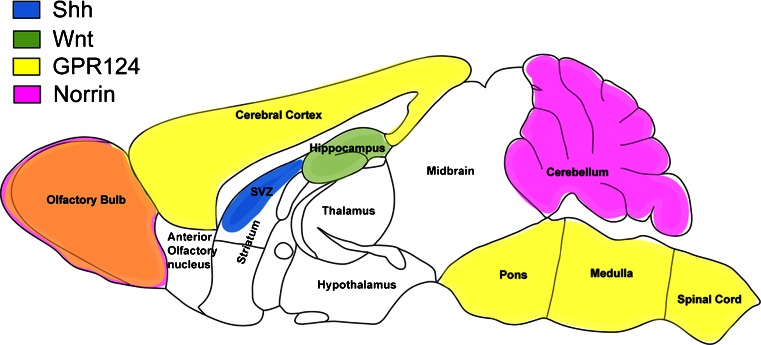
The blood-brain barrier (BBB) is essential for maintaining homeostasis within the central nervous system (CNS) and is a prerequisite for proper neuronal function. The BBB is localized to microvascular endothelial cells that strictly control the passage of metabolites into and out of the CNS. Complex and continuous tight junctions and lack of fenestrae combined with low pinocytotic activity make the BBB endothelium a tight barrier for water soluble moleucles. In combination with its expression of specific enzymes and transport molecules, the BBB endothelium is unique and distinguishable from all other endothelial cells in the body. During embryonic development, the CNS is vascularized by angiogenic sprouting from vascular networks originating outside of the CNS in a precise spatio-temporal manner. The particular barrier characteristics of BBB endothelial cells are induced during CNS angiogenesis by cross-talk with cellular and acellular elements within the developing CNS. In this review, we summarize the currently known cellular and molecular mechanisms mediating brain angiogenesis and introduce more recently discovered CNS-specific pathways (Wnt/β-catenin, Norrin/Frizzled4 and hedgehog) and molecules (GPR124) that are crucial in BBB differentiation and maturation. Finally, based on observations that BBB dysfunction is associated with many human diseases such as multiple sclerosis, stroke and brain tumors, we discuss recent insights into the molecular mechanisms involved in maintaining barrier characteristics in the mature BBB endothelium.
Figures

References
-
- Abbott NJ, Patabendige AA, Dolman DE, Yusof SR, Begley DJ. Structure and function of the blood–brain barrier. Neurobiol Dis. 2010;37:13–25. - PubMed
-
- Adams RH, Alitalo K. Molecular regulation of angiogenesis and lymphangiogenesis. Nat Rev Mol Cell Biol. 2007;8:464–478. - PubMed
-
- Alvarez J, Dodelet-Devillers A, Ifergan I, Bernard M, Van Horssen J, Charron F, Prat A. Astrocyte-secreted sonic hedgehog supports CNS anti-inflammatory activity and promotes optimal human blood brain barrier functioning. Clin Immunol. 2009;131:S34–S34.
-
- Alvarez JI, Dodelet-Devillers A, Kebir H, Ifergan I, Fabre PJ, Terouz S, Sabbagh M, Wosik K, Bourbonnière L, Bernard M, Van Horssen J, Vries HE de, Charron F, Prat A (2011) The hedgehog pathway promotes blood-brain barrier integrity and CNS immune quiescence. Science 334:1727–7731 - PubMed
Publication types
MeSH terms
Substances
LinkOut - more resources
Full Text Sources
Other Literature Sources
