Prevalence and correlates of suicidal behavior among soldiers: results from the Army Study to Assess Risk and Resilience in Servicemembers (Army STARRS)
- PMID: 24590178
- PMCID: PMC4100464
- DOI: 10.1001/jamapsychiatry.2014.30
Prevalence and correlates of suicidal behavior among soldiers: results from the Army Study to Assess Risk and Resilience in Servicemembers (Army STARRS)
Abstract
Importance: The suicide rate among US Army soldiers has increased substantially in recent years.
Objectives: To estimate the lifetime prevalence and sociodemographic, Army career, and psychiatric predictors of suicidal behaviors among nondeployed US Army soldiers.
Design, setting, and participants: A representative cross-sectional survey of 5428 nondeployed soldiers participating in a group self-administered survey.
Main outcomes and measures: Lifetime suicidal ideation, suicide plans, and suicide attempts.
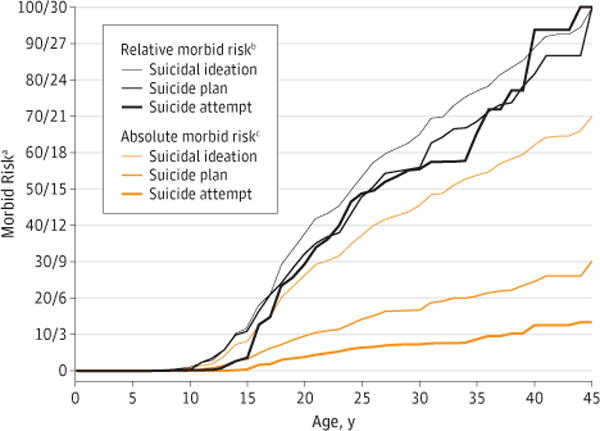
Results: The lifetime prevalence estimates of suicidal ideation, suicide plans, and suicide attempts are 13.9%, 5.3%, and 2.4%. Most reported cases (47.0%-58.2%) had pre-enlistment onsets. Pre-enlistment onset rates were lower than in a prior national civilian survey (with imputed/simulated age at enlistment), whereas post-enlistment onsets of ideation and plans were higher, and post-enlistment first attempts were equivalent to civilian rates. Most reported onsets of plans and attempts among ideators (58.3%-63.3%) occur within the year of onset of ideation. Post-enlistment attempts are positively related to being a woman (with an odds ratio [OR] of 3.3 [95% CI, 1.5-7.5]), lower rank (OR = 5.8 [95% CI, 1.8-18.1]), and previously deployed (OR = 2.4-3.7) and are negatively related to being unmarried (OR = 0.1-0.8) and assigned to Special Operations Command (OR = 0.0 [95% CI, 0.0-0.0]). Five mental disorders predict post-enlistment first suicide attempts in multivariate analysis: pre-enlistment panic disorder (OR = 0.1 [95% CI, 0.0-0.8]), pre-enlistment posttraumatic stress disorder (OR = 0.1 [95% CI, 0.0-0.7]), post-enlistment depression (OR = 3.8 [95% CI, 1.2-11.6]), and both pre- and post-enlistment intermittent explosive disorder (OR = 3.7-3.8). Four of these 5 ORs (posttraumatic stress disorder is the exception) predict ideation, whereas only post-enlistment intermittent explosive disorder predicts attempts among ideators. The population-attributable risk proportions of lifetime mental disorders predicting post-enlistment suicide attempts are 31.3% for pre-enlistment onset disorders, 41.2% for post-enlistment onset disorders, and 59.9% for all disorders.
Conclusions and relevance: The fact that approximately one-third of post-enlistment suicide attempts are associated with pre-enlistment mental disorders suggests that pre-enlistment mental disorders might be targets for early screening and intervention. The possibility of higher fatality rates among Army suicide attempts than among civilian suicide attempts highlights the potential importance of means control (ie, restricting access to lethal means [such as firearms]) as a suicide prevention strategy.
Conflict of interest statement
Figures
Comment in
-
Suicide risk among soldiers: early findings from Army Study to Assess Risk and Resilience in Servicemembers (Army STARRS).JAMA Psychiatry. 2014 May;71(5):487-9. doi: 10.1001/jamapsychiatry.2014.24. JAMA Psychiatry. 2014. PMID: 24590002 No abstract available.
-
Suicide rates double among US soldiers between 2004 and 2009, research shows.BMJ. 2014 Mar 6;348:g1987. doi: 10.1136/bmj.g1987. BMJ. 2014. PMID: 24603960 No abstract available.
-
Mental health and the army.JAMA Psychiatry. 2014 Aug;71(8):965-6. doi: 10.1001/jamapsychiatry.2014.689. JAMA Psychiatry. 2014. PMID: 25102900 No abstract available.
-
Mental health and the army.JAMA Psychiatry. 2014 Aug;71(8):966-7. doi: 10.1001/jamapsychiatry.2014.695. JAMA Psychiatry. 2014. PMID: 25102901 No abstract available.
-
Mental health and the army.JAMA Psychiatry. 2014 Aug;71(8):967. doi: 10.1001/jamapsychiatry.2014.697. JAMA Psychiatry. 2014. PMID: 25102902 No abstract available.
-
Mental health and the army--reply.JAMA Psychiatry. 2014 Aug;71(8):967-8. doi: 10.1001/jamapsychiatry.2014.716. JAMA Psychiatry. 2014. PMID: 25102903 No abstract available.
References
-
- Goldsmith SK, Pellmar TC, Kleinman AM, Bunney WE, editors. Reducing Suicide: A National Imperative. Washington, DC: The National Academies Press; 2002. - PubMed
-
- Bachynski KE, Canham-Chervak M, Black SA, Dada EO, Millikan AM, Jones BH. Mental health risk factors for suicides in the US Army, 2007–8. Inj Prev. 2012;18(6):405–412. - PubMed
-
- Haney EM, O’Neil ME, Carson S, et al. Suicide Risk Factors and Risk Assessment Tools: A Systematic Review. Portland, OR: Department of Veterans Affairs; 2012. - PubMed
Publication types
MeSH terms
Grants and funding
LinkOut - more resources
Full Text Sources
Other Literature Sources
Medical