Review
. 2014 Apr;12(4):289-99.
doi: 10.1038/nrmicro3230. Epub 2014 Mar 3.

In search of a new paradigm for protective immunity to TB

Affiliations
Review

In search of a new paradigm for protective immunity to TB

Cláudio Nunes-Alves et al. Nat Rev Microbiol. 2014 Apr.

Abstract

Clinical trials of vaccines against Mycobacterium tuberculosis are well under way and results are starting to come in. Some of these results are not so encouraging, as exemplified by the latest Aeras-422 and MVA85A trials. Other than empirically determining whether a vaccine reduces the number of cases of active tuberculosis, which is a daunting prospect given the chronic nature of the disease, we have no way of assessing vaccine efficacy. Therefore, investigators seek to identify biomarkers that predict vaccine efficacy. Historically, focus has been on the production of interferon-γ by CD4(+) T cells, but this has not been a useful correlate of vaccine-induced protection. In this Opinion article, we discuss recent advances in our understanding of the immune control of M. tuberculosis and how this knowledge could be used for vaccine design and evaluation.


Figures
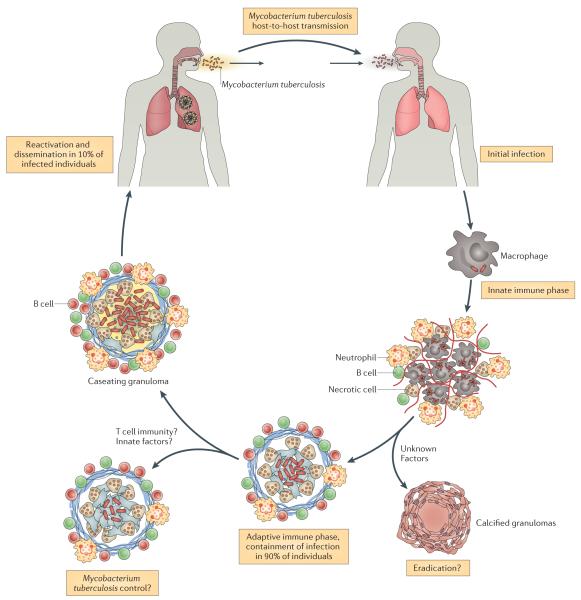
Figure 1
Figure 1
TB pathogenesis. Infection is initiated by inhalation of aerosol droplets containing bacteria. The initial stages of infection are characterized by innate immune responses involving recruitment of inflammatory cells to the lung. Following bacterial dissemination to the draining lymph node, dendritic cell presentation of bacterial antigens leads to T cell priming, and triggers an expansion of antigen-specific T cells, which are recruited to the lung. The recruitment of immune T cells, B cells, activated macrophages and other leukocytes leads to the establishment of granulomas, which can contain M. tuberculosis. The majority of infected individuals will remain in a “latent” state of infection, in which no clinical symptoms are present. A small percentage of these people will eventually progress and develop active disease, which can lead to the release of M. tuberculosis from granulomas eroded into the airways. When individuals with active TB cough, they can generate infectious droplets that propagate the infection.
Figure 2
Figure 2
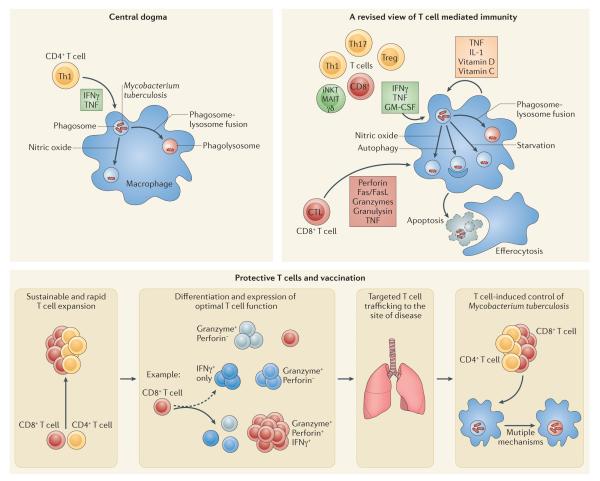
Paradigms of protective immunity to TB. a. The “central dogma” of protective immunity to TB is that CD4+ T cells produce IFNγ, which synergizes with TNF (produced by the T cell or the macrophage), and together these activate macrophage antimicrobial activity capable of restricting M. tuberculosis growth. Two pathways activated by IFNγ that are capable of killing M. tuberculosis are nitric oxide (NO) production and phagolysosome fusion, which acidifies the bacterial phagosome. b. “A revised view of protective T cell immunity” incorporates additional T cell subsets (CD4+, CD8+, and unconventional T cells – γδ T cells, MAIT cells and CD1-restricted T cells), and includes additional mechanisms by which T cells mediate killing of M. tuberculosis. These include additional cytokines (for example, possibly GM-CSF) and cytolysis of infected macrophages. The cytolytic mechanisms vary and can include cytotoxic granules, which can deliver antimicrobial peptides such as granulysin, but can also deliver granzymes, which can trigger apoptotic cell death. CTL activity mediated by FasL/Fas or TNF can also lead to apoptosis. Apoptosis can have a beneficial effect on the outcome of infection as infected apoptotic cells can be engulfed by bystander macrophages, which are capable of destroying the apoptotic cells including any intracellular bacteria. Finally, several components of the innate response, including IL-1 and vitamins, can synergize with cytokines produced by T cells. c. “Protective T cells and vaccination” focuses on the desired features of protective T cell responses. Rationale vaccine design should aim to elicit protective T cells by optimizing their action on infected cells in several ways. Vaccine-elicited memory T cells must rapidly expand and generate secondary effector T cells that undergo sustained proliferation following activation. While the functions of primary effector T cells are expressed heterogeneously (broken arrow), vaccination (solid arrow) can lead to more homogenous expression of effector functions during the recall response. Such T cells, often identified as multifunctional T cells, may have a greater protective potential. Primed effector and memory T cells should efficiently traffic to sites of infection, but the kinetics of the response must be balanced with respect to T cell subsets, and limit the potential for T cell exhaustion, excessive inflammatory pathology, or an ineffective response that hinders T cell - target contact.
Fig 3
Fig 3

References

    1. Russell DG, Barry CE, III, Flynn JL. Tuberculosis: what we don’t know can, and does, hurt us. Science. 2010;328:852–856. - PMC - PubMed
    1. Cooper AM, Mayer-Barber KD, Sher A. Role of innate cytokines in mycobacterial infection. Mucosal Immunology. 2011;4:252–60. - PMC - PubMed
    1. Chackerian AA, Alt JM, Perera TV, Dascher CC, Behar SM. Dissemination of Mycobacterium tuberculosis is influenced by host factors and precedes the initiation of T-cell immunity. Infect Immun. 2002;70:4501–9. - PMC - PubMed
    1. Wolf AJ, et al. Initiation of the adaptive immune response to Mycobacterium tuberculosis depends on antigen production in the local lymph node, not the lungs. J Exp.Med. 2008;205:105–115. - PMC - PubMed
    1. Reiley WW, et al. ESAT-6-specific CD4 T cell responses to aerosol Mycobacterium tuberculosis infection are initiated in the mediastinal lymph nodes. Proc.Natl.Acad.Sci.U.S.A. 2008;105:10961–10966. - PMC - PubMed

Publication types

MeSH terms