


Interventions for improving patients' trust in doctors and groups of doctors
- PMID: 24590693
- PMCID: PMC7386923
- DOI: 10.1002/14651858.CD004134.pub3
Interventions for improving patients' trust in doctors and groups of doctors
Abstract
Background: Trust is a fundamental component of the patient-doctor relationship and is associated with increased satisfaction, adherence to treatment, and continuity of care. Our 2006 review found little evidence that interventions improve patients' trust in their doctor; therefore an updated search was required to find out if there is further evidence of the effects of interventions that may improve trust in doctors or groups of doctors.
Objectives: To update our earlier review assessing the effects of interventions intended to improve patients' trust in doctors or a group of doctors.
Search methods: In 2003 we searched the Cochrane Central Register of Controlled Trials (CENTRAL, The Cochrane Library), MEDLINE, EMBASE, Health Star, PsycINFO, CINAHL, LILACS, African Trials Register, African Health Anthology, Dissertation Abstracts International and the bibliographies of studies selected for inclusion. We also contacted researchers active in the field. We updated and re-ran the searches on available original databases (Cochrane Central Register of Controlled Trials (CENTRAL, The Cochrane Library issue 2, 2013), MEDLINE (OvidSP), EMBASE (OvidSP), PsycINFO (OvidSP), CINAHL (Ebsco)) as well as Proquest Dissertations and Current Contents for the period 2003 to 18 March 2013.
Selection criteria: Randomised controlled trials (RCTs), quasi-randomised controlled trials, controlled before and after studies, and interrupted time series of interventions (informative, educational, behavioural, organisational) directed at doctors or patients (or carers) where trust was assessed as a primary or secondary outcome.
Data collection and analysis: Two review authors independently extracted data and assessed the risk of bias of included studies. Where mentioned, we extracted data on adverse effects. We synthesised data narratively.
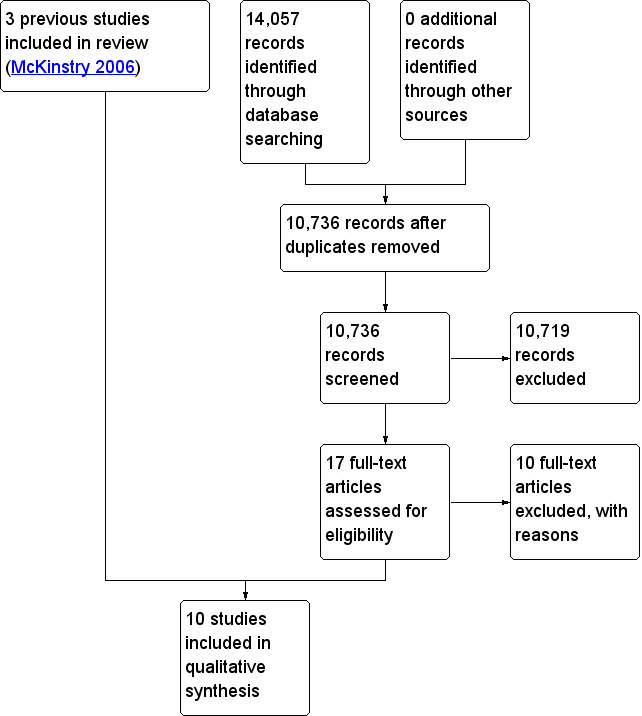
Main results: We included 10 randomised controlled trials (including 7 new trials) involving 11,063 patients. These studies were all undertaken in North America, and all but two involved primary care. As expected, there was considerable heterogeneity between the studies. Interventions were of three main types; three employed additional physician training, four were education for patients and three provided additional information about doctors in terms of financial incentives or consulting style. Additionally, several different measures of trust were employed.The studies gave conflicting results. Trials showing a small but statistically-significant increase in trust included: a trial of physician disclosure of financial incentives; a trial of providing choice of physician based on concordance between patient and physician beliefs about care; a trial of group visits for new inductees into a Health Maintenance Organisation; a trial of training oncologists in communication skills; and a trial of group visits for diabetic patients. However, trust was not affected in a subsequent larger trial of group visits for uninsured people with diabetes, nor with a decision aid for helping choose statins, another trial of disclosure of financial incentives or specifically training doctors to increase trust or cultural competence. There was no evidence of harm from any of the studies.
Authors' conclusions: Overall, there remains insufficient evidence to conclude that any intervention may increase or decrease trust in doctors. This may be due in part to the sensitivity of trust instruments, and a ceiling effect, as trust in doctors is generally high. It may be that current measures of trust are insufficiently sensitive. Further trials are required to explore the impact of doctors' specific training or the use of a patient-centred or decision-sharing approach on patients' trust, especially in the areas of healthcare provider choice, and induction into healthcare organisation. International trials would be of particular benefit. The review was constrained by the lack of consistency between trust measurements, timeframes and populations.
Conflict of interest statement
None known
Figures
Update of
-
Interventions for improving patients' trust in doctors and groups of doctors.Cochrane Database Syst Rev. 2006 Jul 19;(3):CD004134. doi: 10.1002/14651858.CD004134.pub2. Cochrane Database Syst Rev. 2006. Update in: Cochrane Database Syst Rev. 2014 Mar 04;(3):CD004134. doi: 10.1002/14651858.CD004134.pub3. PMID: 16856033 Updated.
References
References to studies included in this review
Clancy 2003 {published data only}
-
- Clancy DE, Cope DW, Magruder KM, Huang P, Salter KH, Fields AW. Evaluating group visits in an uninsured or inadequately insured patient population with uncontrolled type 2 diabetes. The Diabetes Educator 2003;29:292‐302. - PubMed
Clancy 2007 {published data only}
-
- Clancy D, Yeager DE, Huang P, Magruder KM. Further evaluating of the acceptability of group visits in an uninsured or inadequately insured patient population with uncontrolled type 2 diabetes. The Diabetes Educator 2007;33:309‐14. - PubMed
Hall 2002 {published data only}
-
- Hall MA, Dugan E, Balkrishnan R, Bradley D. How disclosing HMO physician incentives affects trust. Health Affairs 2002;21(2):197‐206. - PubMed
Hsu 2003 {published data only}
-
- Krupat E, Hsu J, Irish J, Schmittdie JA, Selby J. Matching patients and practitioners based on beliefs about care: results of a randomised controlled trial. The American Journal of Managed Care 2004;10(11):814‐22. - PubMed
Nannenga 2009 {published data only}
-
- Weymiller AJ, Montori VM, Jones LA, Gafni A, Guyatt GH, Bryant SC, et al. Helping patients with type 2 diabetes mellitus make treatment decisions: statin choice randomised trial. Archives of Internal Medicine 2007;167:1076‐82. - PubMed
Pearson 2006 {published data only}
-
- Pearson SD, Kleinman K, Rusinak D, Levison W. A trial of disclosing physicians financial incentives to patients. Archives of Internal Medicine 2006;166:623‐8. - PubMed
Thom 1999 {published data only}
-
- Thom DH. Training physicians to increase patient trust. Journal of Evaluation in Clinical Practice 2000;6(6):245‐53. - PubMed
-
- Thom DH, Ribisl KM, Stewart AL, Luke DA. Further validation and reliability testing of the Trust in Physician Scale. The Stanford Trust Study Physicians. Medical Care 1999;37(5):510‐17. - PubMed
Thom 2006 {published data only}
Thompson 2001 {published data only (unpublished sought but not used)}
-
- Thompson M, Gee S, Larson P, Kotz K, Northrop L. Health and loyalty promotion visits for new enrollees: results of a randomised controlled trial. Patient Education and Counseling 2001;42(1):53‐65. [DOI: ] - PubMed
Tulsky 2011 {published data only}
References to studies excluded from this review
Barkin 2003 {published data only}
-
- Barkin S, Balkrishnan R, Manuel J, Hall MA. Effect of language immersion on communication with Latino patients. North Carolina Medical Journal 2003;64(6):258‐62. - PubMed
Campbell 2005 {published data only}
-
- Campbell S, Steiner A, Robison J, Webb D, Raven A, Richards S, et al. Do personal medical services contracts improve quality of care? A multi‐method evaluation. Journal of Health Services Research and Policy 2005;10(1):31‐9. - PubMed
Chung 2012 {published data only}
Levison 2005 {published data only}
-
- Levinson W, Kao A, Kuby AM, Thisted RA. The effect of physician disclosure of financial incentives on trust. Archives of Internal Medicine 2005;165:625‐30. - PubMed
Mazor 2004 {published data only}
-
- Mazor KM, Simon SR, Yood RA, Martinson BC, Gunter MJ, Reed GW, et al. Health plan members’ views about disclosure of medical errors. Annals of Internal Medicine 2004;140:409‐18. - PubMed
Mazor 2005 {published data only}
Meloche 2003 {published data only}
-
- Meloche CR. The Partnership Agreement: A Collaborative Communication Strategy for Increasing Prescription Medication Adherence [PhD Thesis]. Detroit, USA: Wayne State University, 2003.
Saha 2011 {published data only}
Van Voorhees 2009 {published data only}
-
- Voorhees BW, Fogel J, Pomper BE, Marko M, Reid N, Watson N, et al. Adolescent dose and ratings of an internet‐based depression prevention program: a randomized trial of primary care physician brief advice versus a motivational interview. Journal of Cognitive and Behavioural Psychotherapy 2009;9(1):1‐19. - PMC - PubMed
Additional references
Anderson 1990
-
- Anderson LA, Dedrick RF. Development of the Trust in Physician scale: a measure to assess interpersonal trust in patient‐physician relationships. Psychological Reports 1990;67(3 Pt 2):1091‐100. - PubMed
Balkrishnan 2003
-
- Balkrishnan R, Dugan E, Camacho FT, Hall MA. Trust and satisfaction with physicians, insurers, and the medical profession. Medical Care 2003;41(9):1058‐64. - PubMed
Baloush‐Kleinman 2011
-
- Baloush‐Kleinman V, Levine SZ, Roe D, Shnitt D, Weizman A, Poyurovsky M. Adherence to antipsychotic drug treatment in early‐episode schizophrenia: a six‐month naturalistic follow‐up study. Schizophrenia Research 2011;130(1‐3):176‐81. - PubMed
Barefoot 1998
-
- Barefoot JC, Maynard KE, Beckham JC, Brummett BH, Hooker K, Siegler IC. Trust, health, and longevity. Journal of Behavioral Medicine 1998;21(6):517‐26. - PubMed
Bayer Institute 1995
-
- Bayer Institute for Health Care Communication. Physician‐Patient Communication Workshop. West Haven CT: Bayer Institute for Health Care Communication, 1995.
Benjamins 2006
-
- Benjamins MR. Religious influences on trust in physicians and the health care system. International Journal of Psychiatric Medicine 2006;36(1):69‐83. - PubMed
Bertakis 1991
-
- Bertakis KD, Roter D, Putnam SM. The relationship of physician medical interview style to patient satisfaction. Journal of Family Practice 1991;32:175‐81. - PubMed
Car 2005
-
- Car J. Exploring Notions of Patient‐Doctor Partnership in South Asian and European People with Asthma: Qualitative Interview Study [PhD Thesis]. London, UK: University of London, 2005.
CCCRG 2013
-
- Cochrane Consumers and Communication Review Group. Standard Protocol Text and Additional Guidance for Review Authors. http://cccrg.cochrane.org (accessed 27 May 2013) 2013.
Crawshaw 1995
-
- Crawshaw R, Rogers DE, Pellegrino ED, Bulger RJ, Lundberg GD, Bristow LR, et al. Patient‐physician covenant. JAMA 1995;273(19):1553. - PubMed
Cusack 2000
-
- Cusack DA. Ireland: breakdown of trust between doctor and patient. Lancet 2000;356(9239):1431‐2. - PubMed
Davis 1991
-
- Davis AR, Ware JE. GHAA's Consumer Satisfaction Survey. Washington, DC: Group Health Association of America, 1991.
Dibben 2000
-
- Dibben MR, Morris SE, Lean ME. Situational trust and co‐operative partnerships between physicians and their patients: a theoretical explanation transferable from business practice. QJM : Monthly Journal of the Association of Physicians 2000;93(1):55‐61. - PubMed
Doescher 2000
-
- Doescher MP, Saver BG, Franks P, Fiscella K. Racial and ethnic disparities in perceptions of physician style and trust. Archives of Family Medicine 2000;9(10):1156‐63. - PubMed
Emanuel 1995
-
- Emanuel EJ, Dubler NN. Preserving the physician‐patient relationship in the era of managed care. JAMA 1995;273(4):323‐9. - PubMed
Epstein 1993
-
- Epstein RM, Campbell TL, Cohen‐Cole SA, McWhinney IR, Smilkstein G. Perspectives on patient‐doctor communication. Journal of Family Practice 1993;37:377‐88. - PubMed
Eveleigh 2012
-
- Eveleigh RM, Muskens E, Ravesteijn H, Dijk I, Rijswijk E, Lucassen P. An overview of 19 instruments assessing the doctor‐patient relationship: different models or concepts are used. Journal of Clinical Epidemiology 2012;65:10‐15. - PubMed
Fiskella 2004
-
- Fiscella K, Meldrum S, Franks P, Shields CG, Duberstein P, McDaniel SH, et al. Patient trust: is it related to patient‐centered behavior of primary care physicians?. Medical Care 2004;42(11):1049‐55. - PubMed
Fugelli 2001
Gray 1997
-
- Gray BH. Trust and trustworthy care in the managed care era. Health Affairs 1997;16(1):34‐49. - PubMed
Grumbach 1999
-
- Grumbach K, Selby JV, Damberg C, Bindman AB, Quesenberry C Jr, Truman A, et al. Resolving the gatekeeper conundrum: what patients value in primary care and referrals to specialists. JAMA 1999;282(3):261‐6. - PubMed
Hall 2001
Hall 2002b
-
- Hall M, Zheng B, Dugan E, Camacho F, Kidd K, Mishra A, et al. Measuring patients' trust in their primary care providers. Medical Care Research 2002;59(3):293‐318. - PubMed
Heer 1997
-
- Heer FW. The place of trust in our changing surgical environment. Archives of Surgery 1997;132(8):809‐14. - PubMed
Higgins 2011
-
- Higgins JPT, Green S (editors). Cochrane Handbook for Systematic Reviews of Interventions Version 5.1.0 [updated March 2011]. The Cochrane Collaboration, 2011. Available from www.cochrane‐handbook.org.
Hillen 2011
-
- Hillen MA, deHaes HCJM, Smets EMA. Cancer patients' trust in their physician ‐ a review. Psycho‐Oncology 2011 March;20:227‐241. - PubMed
Hillman 1998
-
- Hillman AL. Mediators of patient trust. JAMA 1998;280(19):1703‐4. - PubMed
Hupcey 2001
-
- Hupcey JE, Penrod J, Morse JM, Mitcham C. An exploration and advancement of the concept of trust. Journal of Advanced Nursing 2001;36(2):282‐93. - PubMed
Kao 1998a
-
- Kao AC, Green DC, Zaslavsky AM, Koplan JP, Cleary PD. The relationship between method of physician payment and patient trust. JAMA 1998;280(19):1708‐14. - PubMed
Kao 1998b
Keating 2002
Keating 2004
-
- Keating NL, Gandhi TK, Orav EJ, Bates DW, Ayanian JZ. Patient characteristics and experiences associated with trust in specialist physicians. Archives of Internal Medicine 2004;164(9):1015‐20. - PubMed
Kirkpatrick 1983
-
- Kirkpatrick E (ed). Chambers 20th Century Dictionary. Edinburgh: Chambers, 1983.
Kroenke 1989
-
- Kroenke K, Mangelsdorff AD. Common symptoms in ambulatory care: incidence, evaluation, therapy, and outcome. The American Journal of Medicine 1989;86(3):262‐6. - PubMed
Krupat 2000
-
- Krupat E, Rosenkranz SL, Yeager CM, Barnard K, Putman SM, Inui TS. The practice orientations of physicians and patients: the effect of doctor‐patient congruence on satisfaction. Patient Education and Counselling 2000;39:49‐59. - PubMed
Krupat 2004
-
- Krupat E, Hsu J, Irish J, Schmittdiel JA, Selby J. Matching patients and practitioners based on beliefs about care: results of a randomized controlled trial. American Journal of Managed Care 2004 Nov;10(11 (Pt 1)):814‐22. - PubMed
LaVeist 2000
-
- LaVeist TA, Nickerson KJ, Bowie JV. Attitudes about racism, medical mistrust, and satisfaction with care among African American and white cardiac patients. Medical Care Research & Review 2000;57(Suppl 1):146‐61. - PubMed
Lee 2009
-
- Lee YY, Lin JL. The effects of trust in physicians on self‐efficacy, adherence and diabetes outcomes. Social Science and Medicine 2009;68(6):1060‐8. - PubMed
Lupton 1996
-
- Lupton D. Your life in their hands: trust and the medical encounter. In: James V, Gabe J editor(s). Health and the Sociology of Emotions. Oxford: Blackwell, 1996.
Mechanic 1996a
-
- Mechanic D. Changing medical organization and the erosion of trust. The Milbank Quarterly 1996;74(2):171‐89. - PubMed
Mechanic 1996b
-
- Mechanic D, Schlesinger M. The impact of managed care on patients' trust in medical care and their physicians. JAMA 1996;275(21):1693‐7. - PubMed
Mechanic 2000
-
- Mechanic D, Meyer S. Concepts of trust among patients with serious illness. Social Science & Medicine 2000;51(5):657‐68. - PubMed
Montori 2007
Newcomer 1997
-
- Newcomer LN. Measures of trust in health care. Health Affairs 1997;16(1):50‐1. - PubMed
Nguyen 2009
O'Neill 2002
-
- O'Neill O. A Question of Trust. Cambridge: Cambridge University Press, 2002.
Oliver 2004
Ozawa 2013
-
- Ozawa S, Sripad P. How do you measure trust in the health system? A systematic review of the literature. Social Science and Medicine 2013;91:10‐14. - PubMed
Pearson 2000
Quill 1989
-
- Quill TE. Recognising and adjusting to barriers in doctor‐patient communication. Annals of Internal Medicine 1989;111:51‐7. - PubMed
Rosser 2001
-
- Rosser WW, Kasperski J. The benefits of a trusting physician‐patient relationship. Journal of Family Practice 2001;50(4):329‐30. - PubMed
Roter 1995
-
- Roter DL, Hall JA, Kern DE, Barker LR, Cole KA, Roca RP. Improving physicians' interviewing skills and reducing patients' emotional distress: a randomized controlled trial. Archives of Internal Medicine 1995;155:1877‐84. - PubMed
Rubin 1993
-
- Rubin HR, Gandek B, Rogers WH, Kosinski M, McHorney CA, Ware JE. Patients' ratings of outpatients visits in different practice settings. Results from the Medical Outcomes study. JAMA 1993;270:835‐40. - PubMed
Safran 2001
-
- Safran DG, Montgomery JE, Chang H, Murphy J, Rogers WH. Switching doctors: predictors of voluntary disenrollment from a primary physician's practice. Journal of Family Practice 2001;50(2):130‐6. - PubMed
Sheline 1991
-
- Sheline B, Callahan EJ, Kaufman A, Umland BE. Problem based learning. In: Swee D editor(s). Teaching Family Medicine in Medical School. Kansas City, MO: Society for Teachers of Family Medicine, 1991.
Shi 2001
-
- Shi L, Starfield B, Xu J. Validating the Adult Primary Care Assessment Tool. Journal of Family Practice 2001;50:161‐70.
Shortell 1998
-
- Shortell SM, Waters TM, Clarke KW, Budetti PP. Physicians as double agents: maintaining trust in an era of multiple accountabilities. JAMA 1998;280(12):1102‐8. - PubMed
Simpson 1991
Skinner 2009
Tarrant 2008
Thom 1997
-
- Thom DH, Campbell B. Patient‐physician trust: an exploratory study. Journal of Family Practice 1997;44(2):169‐76. - PubMed
Thom 2001
-
- Thom DH, Stanford Trust Study Physicians. Physician behaviours that predict patient trust. Journal of Family Practice 2001;50(4):323‐8. - PubMed
Thom 2006b
-
- Thom DH, Tirado MD. Development and validation of a patient‐reported measure of physician cultural competency. Medical Care Research and Review 2006;63(5):636‐55. - PubMed
Weaver 1993
-
- Weaver MJ, Ow CL, Walker DJ, Degenhardt EF. A questionnaire for patients' evaluations of their physicians' humanistic behaviors. Journal of General Internal Medicine 1999;8(3):135‐9. - PubMed
Weymiller 2007
-
- Weymiller AJ, Montori VM, Jones LA, Gafni A, Guyatt GH, Bryant SJ, et al. Helping patients with type 2 diabetes mellitus make treatment decisions: statin choice randomized trial. Archives of Internal Medicine 2007;167(10):1076‐82. - PubMed
Zheng 2002
-
- Zheng B, Hall M, Dugan E, Kidd K, Levine D. Development of a scale to measure patients' trust in health insurers. Health Services Research 2002;37(1):185‐200. - PubMed
References to other published versions of this review
Car 2003
Publication types
MeSH terms
LinkOut - more resources
Full Text Sources
Other Literature Sources
Medical
Miscellaneous
