


Introgression of two chromosome regions for leaf photosynthesis from an indica rice into the genetic background of a japonica rice
- PMID: 24591053
- PMCID: PMC3991736
- DOI: 10.1093/jxb/eru047
Introgression of two chromosome regions for leaf photosynthesis from an indica rice into the genetic background of a japonica rice
Abstract
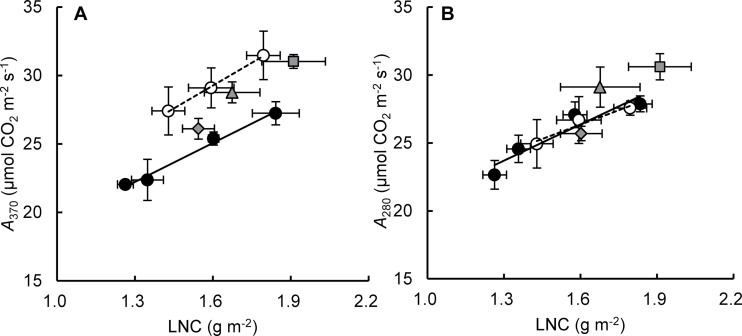
Increases in rates of individual leaf photosynthesis (P n) are critical for future increases of rice yields. A previous study, using introgression lines derived from a cross between indica cultivar Habataki, with one of the highest recorded values of P n, and the Japanese elite cultivar Koshihikari, identified four QTLs (qCAR4, qCAR5, qCAR8, and qCAR11) that affect P n. The present study examined the combined effect of qCAR4 and qCAR8 on P n in the genetic background of Koshihikari. The pyramided near-isogenic line NIL(qCAR4+qCAR8) showed higher P n than both NIL(qCAR4) and NIL(qCAR8), equivalent to that of Habataki despite being due to only two out of the four QTLs. The high P n of NIL(qCAR4+qCAR8) may be attributable to the high leaf nitrogen content, which may have been inherited from NIL(qCAR4), to the large hydraulic conductance due to the large root surface area from NIL(qCAR4), and to the high hydraulic conductivity from NIL(qCAR8). It might be also attributable to high mesophyll conductance, which may have been inherited from NIL(qCAR4). The induction of mesophyll conductance and the high leaf nitrogen content and high hydraulic conductivity could not be explained in isolation from the Koshihikari background. These results suggest that QTL pyramiding is a useful approach in rice breeding aimed at increasing P n.
Keywords: Hydraulic conductance; Oryza sativa; leaf nitrogen content; photosynthesis; quantitative trait locus; stomatal conductance..
Figures


References
-
- Adachi S, Nakae T, Uchida M, et al. 2013. The mesophyll anatomy enhancing CO2 diffusion is a key trait for improving rice photosynthesis. Journal of Experimental Botany 64, 1061–1072 - PubMed
-
- Ando T, Yamamoto T, Shimizu T, Ma XF, Shomura A, Takeuchi Y, Lin SY, Yano M. 2008. Genetic dissection and pyramiding of quantitative traits for panicle architecture by using chromosomal segment substitution lines in rice. Theoretical and Applied Genetics 116, 881–890 - PubMed
-
- Asanuma S, Nito N, Ookawa T, Hirasawa T. 2008. Yield, dry matter production and ecophysiological characteristics of rice cultivar, Habataki compared with cv. Sasanishiki. Japanese Journal of Crop Science 77, 474–480
-
- Ashikari M, Matsuoka M. 2006. Identification, isolation and pyramiding of quantitative trait loci for rice breeding. Trends in Plant Science 11, 344–350 - PubMed
Publication types
MeSH terms
LinkOut - more resources
Full Text Sources
Other Literature Sources
