. 2014 May;139(1):48-58.
doi: 10.1093/toxsci/kfu036. Epub 2014 Mar 3.

Halogenated bisphenol-A analogs act as obesogens in zebrafish larvae (Danio rerio)

Affiliations

Halogenated bisphenol-A analogs act as obesogens in zebrafish larvae (Danio rerio)

Anne Riu et al. Toxicol Sci. 2014 May.

Abstract

Obesity has increased dramatically over the past decades, reaching epidemic proportions. The reasons are likely multifactorial. One of the suggested causes is the accelerated exposure to obesity-inducing chemicals (obesogens). However, out of the tens of thousands of industrial chemicals humans are exposed to, very few have been tested for their obesogenic potential, mostly due to the limited availability of appropriate in vivo screening models. In this study, we investigated whether two commonly used flame retardants, the halogenated bisphenol-A (BPA) analogs tetrabromobisphenol-A (TBBPA) and tetrachlorobisphenol-A (TCBPA), could act as obesogens using zebrafish larvae as an in vivo animal model. The effect of embryonic exposure to these chemicals on lipid accumulation was analyzed by Oil Red-O staining, and correlated to their capacity to activate human and zebrafish peroxisome proliferator-activated receptor gamma (PPARγ) in zebrafish and in reporter cell lines. Then, the metabolic fate of TBBPA and TCBPA in zebrafish larvae was analyzed by high-performance liquid chromatography (HPLC) . TBBPA and TCBPA were readily taken up by the fish embryo and both compounds were biotransformed to sulfate-conjugated metabolites. Both halogenated-BPAs, as well as TBBPA-sulfate induced lipid accumulation in zebrafish larvae. TBBPA and TCBPA also induced late-onset weight gain in juvenile zebrafish. These effects correlated to their capacity to act as zebrafish PPARγ agonists. Screening of chemicals for inherent obesogenic capacities through the zebrafish lipid accumulation model could facilitate prioritizing chemicals for further investigations in rodents, and ultimately, help protect humans from exposure to environmental obesogens.

Keywords: PPARγ; TBBPA; TCBPA; lipid; obesity; zebrafish.


Figures
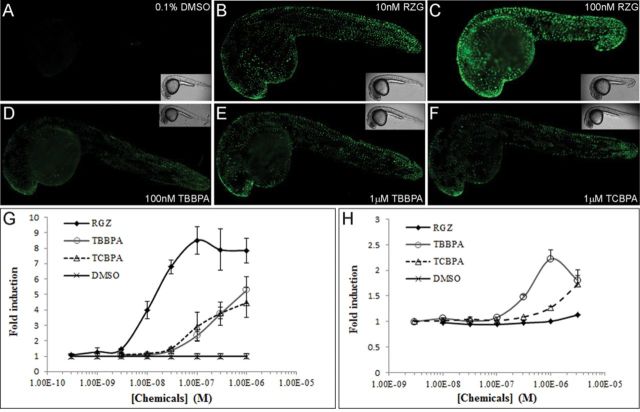
FIG. 1.
FIG. 1.
Human and zebrafish PPARγ activation by halogenated-BPAs in vivo and in vitro. (A–F) GFP fluorescence and bright field (insert) images (lateral view) of 28 hpf Tg(hPPARγ-eGFP) zebrafish embryos treated for 24 h with DMSO (A), RGZ (B, C), TBBPA (D, E) and TCBPA (F). (G) Dose-response curves of quantified GFP expression in 28 hpf Tg(hPPARγ-eGFP) zebrafish embryos exposed to 0.1% DMSO, RGZ, TBBPA, and TCBPA. (H) Results of luciferase assays showing dose-response curves for 0.1% DMSO, RGZ, TBBPA, and TCBPA in HG5LN-GAL4-zfPPARγ reporter cell line. Results are expressed as fold induction above control (mean ± SD from three independent experiments).
FIG. 2.
FIG. 2.
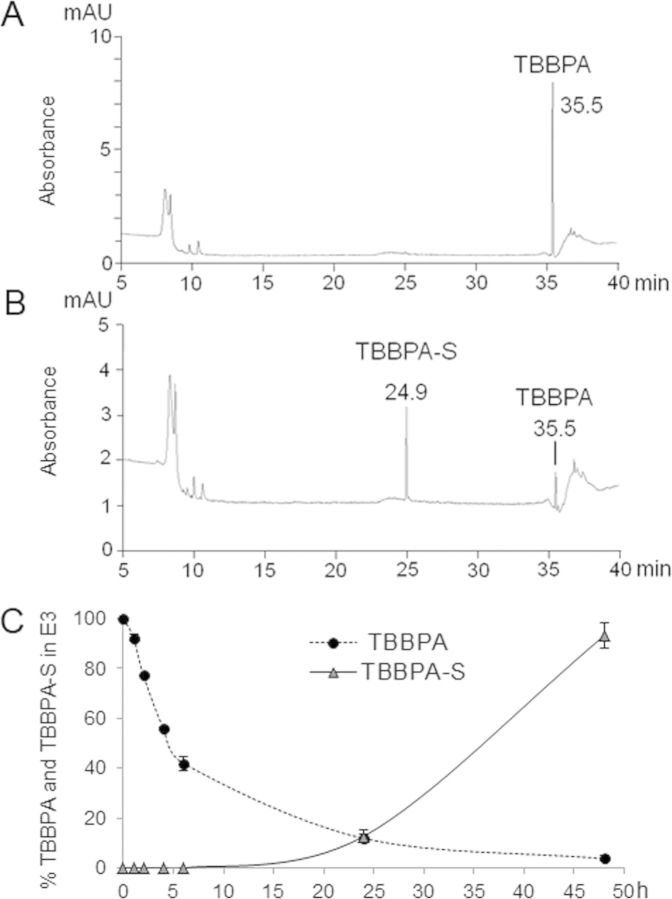
Uptake and metabolism of TBBPA in early zebrafish larvae. (A) A typical HPLC-UV chromatogram of unchanged TBBPA in embryo media (E3) and (B) a typical HPLC-UV chromatogram from an E3 sample from 8 dpf wild-type zebrafish larvae exposed to 1μM TBBPA for 24 h. (C) TBBPA uptake and TBBPA-S formation kinetics recovered in E3 from zebrafish exposed to TBBPA from 3 dpf for 48 h. Results are expressed as mean ± SD from three independent experiments.
FIG. 3.
FIG. 3.
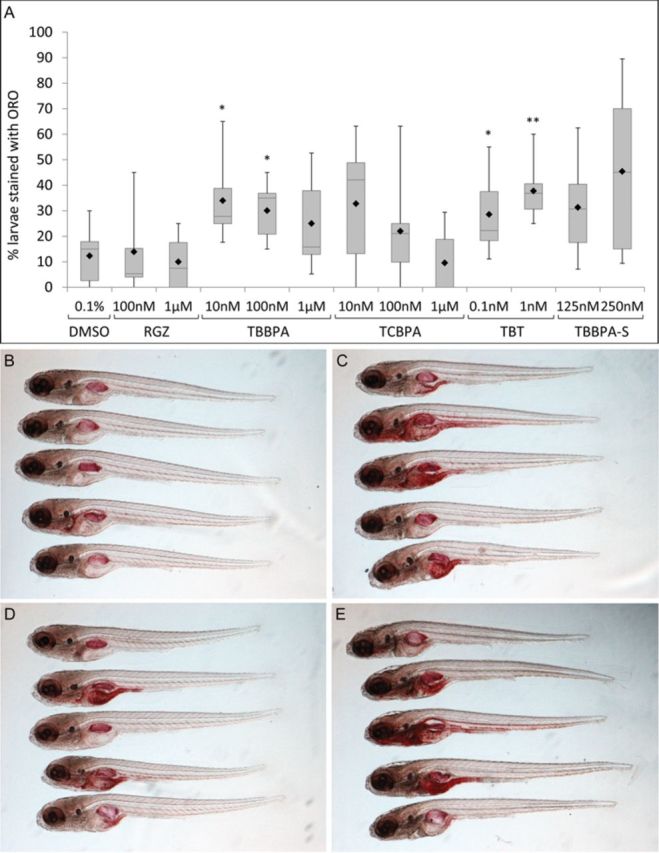
Effects of exposure to TBBPA, TCBPA, TBT, and the TBBPA metabolite, TBBPA-S, on lipid accumulation in 11 dpf zebrafish larvae. (A) Box-plot diagram showing the quantification of the percentage of zebrafish larvae (11 dpf) stained with ORO after 8 days of exposure to RGZ, TBBPA, TCBPA, TBT, and TBBPA-S. The box-plot depicts six values, namely the minimum and maximum values, the upper (Q3) and lower (Q1) quartiles, the median and the mean. The length of the box represents the interquartile range. The median is identified by a line inside the box and the mean is represented by a black diamond. (B–E) Lateral view of a sample of fixed and ORO-stained 11 dpf zebrafish larvae after treatment with 0.1% DMSO (B), 100nM TBBPA (C), 100nM TCBPA (D) and 1nM TBT (E). Statistics were done using a Student's t-test, *p < 0.05, **p < 0.01.
FIG. 4.
FIG. 4.
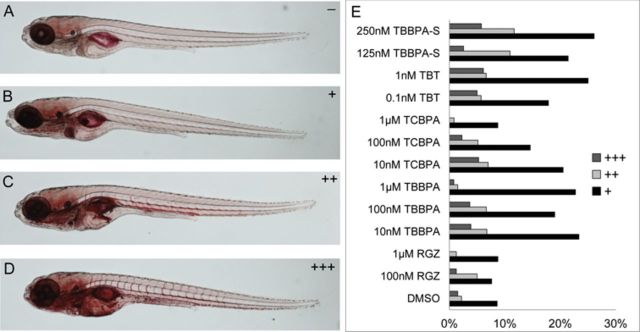
Distribution of ORO staining in 11 dpf treated zebrafish. ORO staining was scored from no staining (A), mild (B), moderate (C), and strong staining (D). Distribution of ORO staining after exposure of zebrafish from 3 dpf to 11 dpf to vehicle (0.1% DMSO), and to different concentrations of RGZ, TBBPA, TCBPA, TBT, and TBBPA-S (E).
FIG. 5.
FIG. 5.
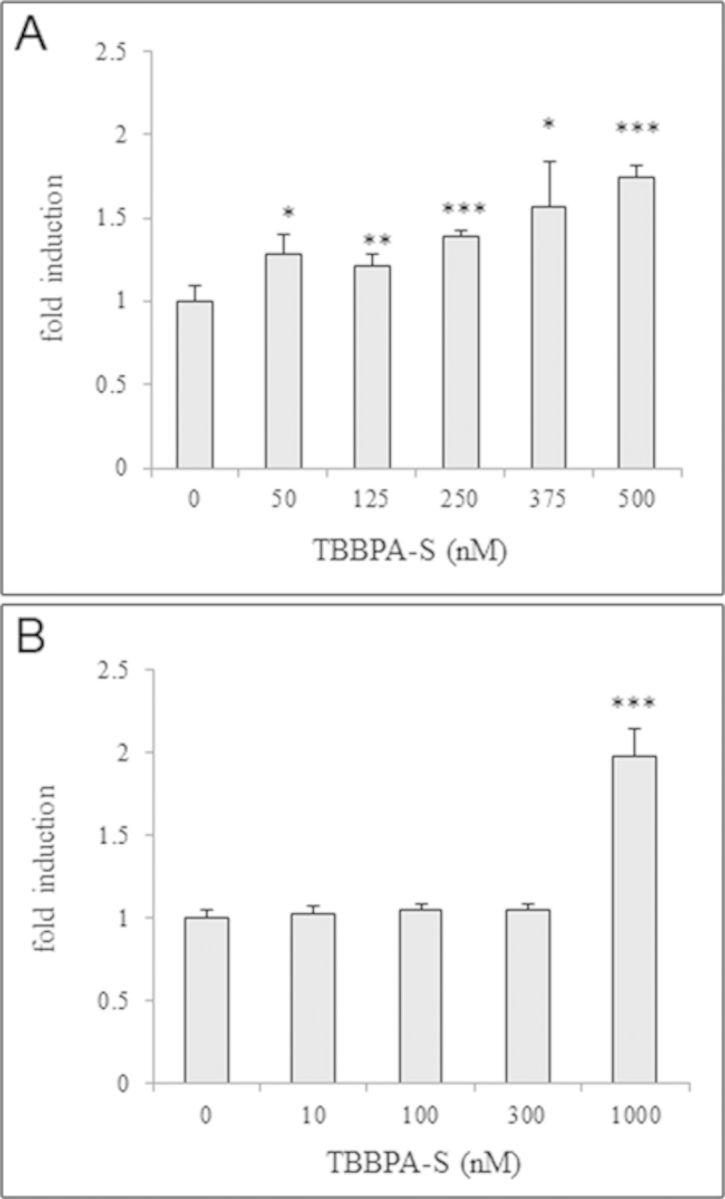
Activation of hPPARγ by TBBPA-S in vitro and in vivo. (A) Dose-response curve of quantified GFP expression of 28 hpf Tg(hPPARγ-eGFP) zebrafish embryos exposed to TBBPA-S (mean ± SD from three independent experiments). (B) Results of luciferase assays showing dose-response curves for TBBPA-S in HG5LN-GAL4-zfPPARγ reporter cell line. Results are expressed as fold induction above control (mean ± SD from three independent experiments). Statistics were done using a Student's t-test, *p < 0.05, **p < 0.01, and ***p < 0.001.
FIG. 6.
FIG. 6.
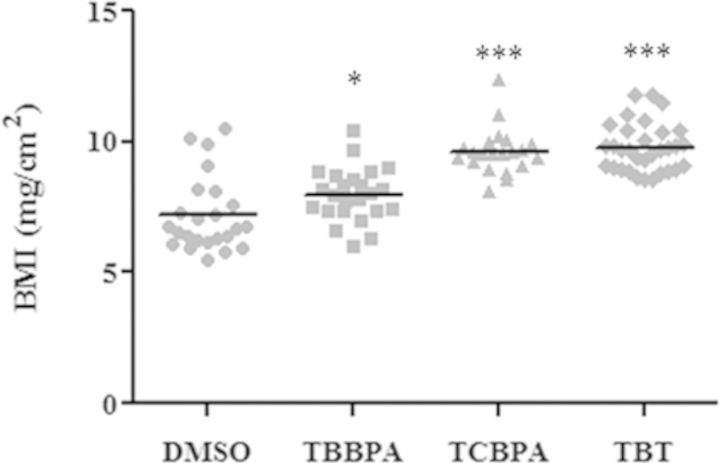
Effect of early chemical exposure on BMI of 30 dpf zebrafish. Changes in BMI (mg/cm2) in 30 dpf juvenile zebrafish exposed to vehicle (0.1% DMSO), 100nM TBBPA, 100nM TCBPA, and 1nM TBT from 3 to 11 dpf and fed an egg yolk diet from 6 to 11 dpf, followed by transfer to the regular housing system and regular feeding regiment until 30 dpf. Control group: n = 24, TBBPA group: n = 24, TCBPA group: n = 21, TBT group: n = 30. Statistics were done using a Student's t-test, *p < 0.05, ***p < 0.001.

References

    1. Aballay L. R., Eynard A. R., Diaz Mdel P., Navarro A., Munoz S. E. Overweight and obesity: A review of their relationship to metabolic syndrome, cardiovascular disease, and cancer in South America. Nutr. Rev. 2013;71:168–179. - PubMed
    1. Baillie-Hamilton P. F. Chemical toxins: A hypothesis to explain the global obesity epidemic. J. Altern. Complement. Med. 2002;8:185–192. - PubMed
    1. Bertrand S., Thisse B., Tavares R., Sachs L., Chaumot A., Bardet P. L., Escriva H., Duffraisse M., Marchand O., Safi R., et al. Unexpected novel relational links uncovered by extensive developmental profiling of nuclear receptor expression. PLoS Genet. 2007;3:e188. - PMC - PubMed
    1. Cariou R., Antignac J. P., Zalko D., Berrebi A., Cravedi J. P., Maume D., Marchand P., Monteau F., Riu A., Andre F., et al. Exposure assessment of French women and their newborns to tetrabromobisphenol-A: Occurrence measurements in maternal adipose tissue, serum, breast milk and cord serum. Chemosphere. 2008;73:1036–1041. - PubMed
    1. EFSA (European Food Safety Authority) Scientific opinion on tetrabromobisphenol A (TBBPA) and its derivatives in food. EFSA J. 2011;9:2477. - PMC - PubMed

Publication types