


A study on knowledge, attitude and practice of contraception among college students in Sikkim, India
- PMID: 24591903
- PMCID: PMC3939094
- DOI: 10.5152/jtgga.2010.03
A study on knowledge, attitude and practice of contraception among college students in Sikkim, India
Abstract
Objective: To assess the knowledge, attitude and practice of contraception among the college students.
Materials and methods: A cross sectional study was conducted in the Government College, Gangtok, Sikkim, during the month of April 2009 to evaluate the knowledge, attitude and practice of contraception among 156 students enrolled in the first year bachelor course. Descriptive statistics was used for data analysis.
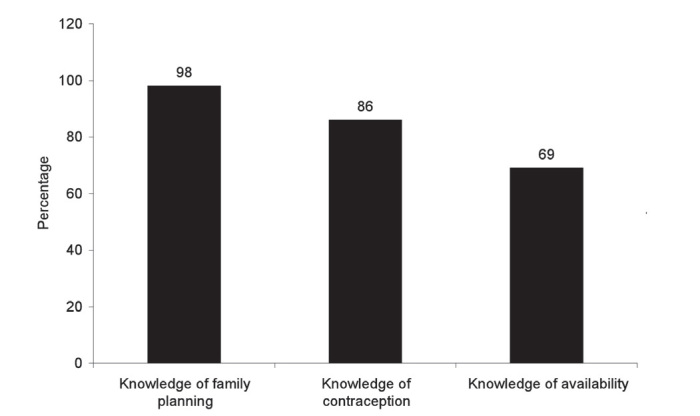
Results: 98% (153/156) of the students had knowledge about family planning and 86% (134/156) of them had heard about contraceptives. Most of them knew about condoms (85%) and contraceptive pills (40%) but knowledge about permanent methods and Cu-T was poor (average 12%). Most students thought contraceptives were to be used to prevent unwanted pregnancy (35%) and for birth spacing (30%). 11% of students had used some form of contraceptive in the past and 7% were currently users. The most commonly used contraceptives were condoms, followed by combined use of OCP and condom.
Conclusion: The study highlights the need to motivate the youth for effective and appropriate use of contraceptives when required and arrest the trend towards unwanted pregnancy.
Amaç: Kolej öğrencilerinin kontrasepsiyon haklkındaki bilgi, tecrübe ve tavırlarını değerlendirmek.
Gereç ve yöntemler: Sikkim, Gangtok’taki devlet kolejinde okuyan 156 ilk yıl öğrencisinin kontrasepsiyon hakkındaki bilgi, tecrübe ve davranışlarını belirlemek için Nisan 2009’da kesitsel bir çalışma yürütüldü. Betimleyici istatistik analizleri kullanıldı.
Bulgular: Öğrencilerinin %98’i (153/159) aile planlamısını biliyordu ve %86’sı (134/156) kontrasepsiyonu duymuştu. Çoğu kondommu biliyor (%85) ve doğum kontrol hapları hakkında fikir sahibi (%40) iken, kalıcı yöntemler ve bakırlı rahim içi araçlar hakkında bilgisi olan azdı (ortalama %12). Çoğu kontraseptiflerin istenmeyen gebeliği önlemek için (%35) veya doğum sayısını azaltmak için (%30) kullanıldığ ını biliyor ve öğrencilerin %11’i geçmişte bazı yöntemleri uygularken,%7 kadar şu an herhangi bir yöntemi kullanıyordu. En sık uygulanan yöntem Kondom ve onu doğum kontrol hapları takip ediyordu.
Sonuç: Çalışmamız, gençleri etkin ve uygun kontraseptif kullanımı hakkında bilgilendirmeye, motive etmek ve istenmeyen gebelik oranını düşürmeye dikkat çekmiştir.
Keywords: Family planning; contraception; knowledge; practice.
Figures
References
-
- Update. Billions and Billions of People. International Family Planing Perspectives. 1998;24:154.
-
- Jones EF, Forrest JD, Goldman N, Henshaw SK, Lincoln R, Rosoff JI, et al. Teenage pregnancy in developed countries: determinants and policy implications. Family Planning Perspectives. 1985;17:53–63. - PubMed
-
- Doppenberg HJAT. Contraceptive choices for teenagers. Fertility Control Reviews. 1993;2:10–3.
-
- Rubinson L, De Rubertis MS. Trends in sexual attitudes and behaviours of a college population over a 15 year period. Journal of Sex Education & Therapy. 1991;17:32–41.
-
- Zelnik M, Shah F. First intercourse among young Americans. Family Planning Perspectives. 1983;15:64–70. - PubMed
LinkOut - more resources
Full Text Sources
Miscellaneous
