


doi: 10.1021/ja411006a.
Epub 2014 Mar 14.
Ferrostatins inhibit oxidative lipid damage and cell death in diverse disease models
Affiliations
- PMID: 24592866
- PMCID: PMC3985476
- DOI: 10.1021/ja411006a
Item in Clipboard
Ferrostatins inhibit oxidative lipid damage and cell death in diverse disease models
J Am Chem Soc.
.
Abstract
Ferrostatin-1 (Fer-1) inhibits ferroptosis, a form of regulated, oxidative, nonapoptotic cell death. We found that Fer-1 inhibited cell death in cellular models of Huntington's disease (HD), periventricular leukomalacia (PVL), and kidney dysfunction; Fer-1 inhibited lipid peroxidation, but not mitochondrial reactive oxygen species formation or lysosomal membrane permeability. We developed a mechanistic model to explain the activity of Fer-1, which guided the development of ferrostatins with improved properties. These studies suggest numerous therapeutic uses for ferrostatins, and that lipid peroxidation mediates diverse disease phenotypes.
Figures
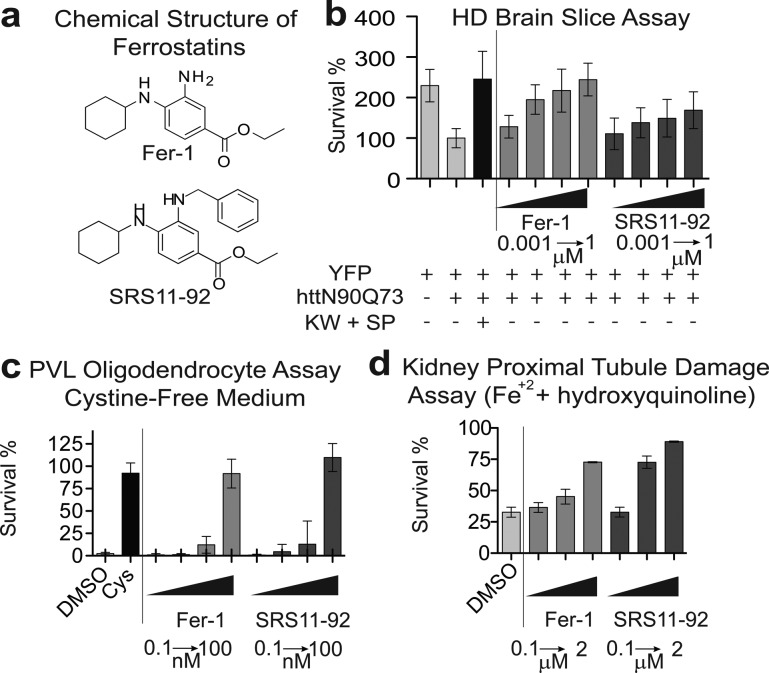
The effects of ferrostatins
in Huntington’s disease (HD),
periventricular leukomalacia (PVL), and kidney proximal tubules cell
death models. (a) Chemical structure of ferrostatins. (b) Effect of
ferrostatins on cell survival in an HD brain-slice model. YFP = yellow
fluorescent protein transfection control. httN90Q73 is mutant huntingtin
(N-terminal 90aa with a Q73 repeat). KW + SP is a combination used
as a positive control for protection. (c) Dose–response test
of the effect of ferrostatins in a model of PVL. Cys = Cystine supplementation,
a positive control for cell death rescue. (d) Effect of ferrostatins,
at various concentrations, in a primary kidney renal tubule damage
model.
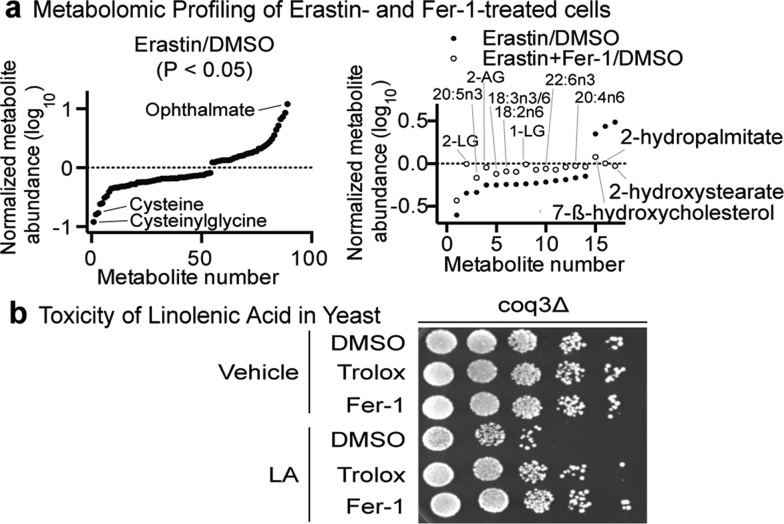
Fer-1 inhibits the oxidative
destruction of unsaturated fatty acids.
(a) Significant (P < 0.05) changes in metabolite
levels in HT-1080 cells treated with erastin (10 μM, 6 h) versus
DMSO (left) or with erastin + Fer-1 (1 μM) versus erastin alone
(right). 2-LG, 2-linoleoylglycerol; 1-LG, 1-linoleoylglycerol; 2-AG,
2-arachidonoyl glycerol. (b) Spot dilutions of Saccharomyces
cerevisiaecoq3Δ cells treated
with linolenic acid (LA, 500 μM) ± trolox (50 μM,
a positive control antioxidant) or ferrostatin-1 (Fer-1, 10 μM).
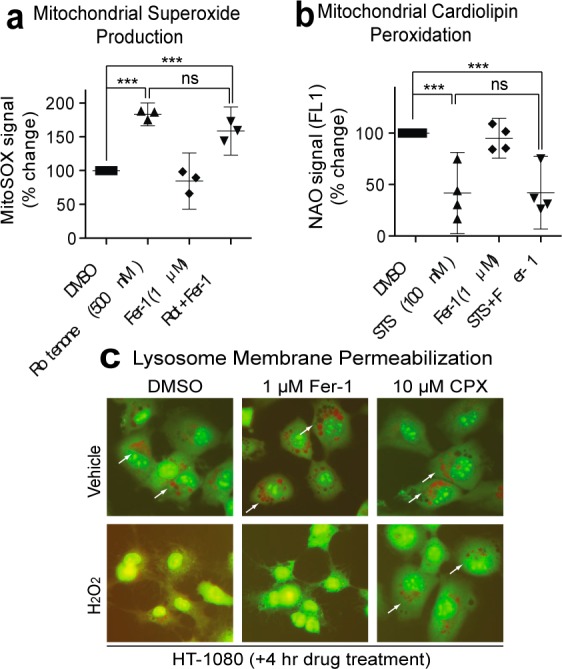
Fer-1 does not inhibit
all forms of ROS production or ROS-induced
death. (a) Mitochondrial ROS production in response to rotenone (Rot,
250 nM, 3 h) ± Fer-1 (1 μM) was detected using MitoSOX.
(b) Cardiolipin peroxidation in response to staurosporine (STS,100
nM, 3 h) detected using 10-nonyl acridine orange (NAO). Data in (a)
and (b) were analyzed by one-way ANOVA ***P <
0.001, ns = not significant; (c) Lysosomal membrane permeabilization
detected in response to H2O2 using acridine
orange (AO) relocalization. An iron chelator, ciclopirox olamine (CPX),
protects from lysosomal rupture.
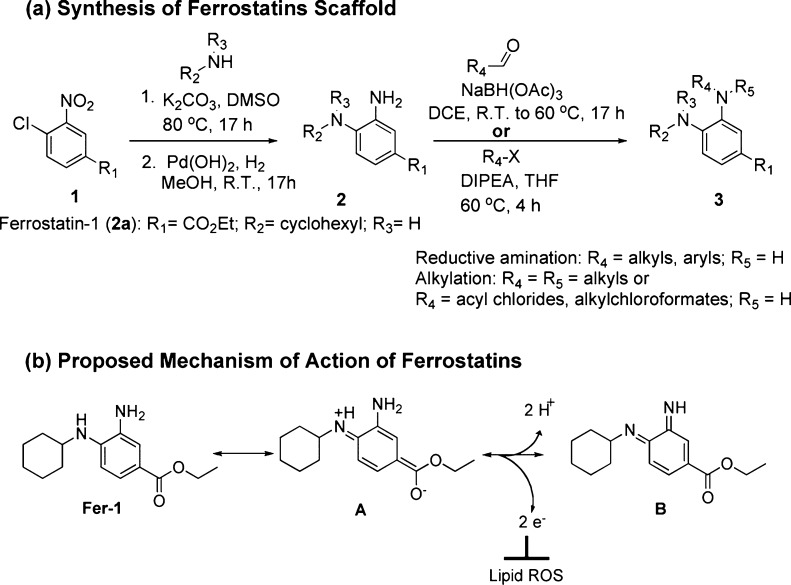
SAR study of Fer-1. (a) General scheme for the synthesis of ferrostatins.
(b) Fer-1 as a reducing agent: release of 2 protons and 2 electrons
results in a formation of ethyl 4-(cyclohexylimino)-3-iminocyclohexa-1,5-dienecarboxylate
intermediate B.
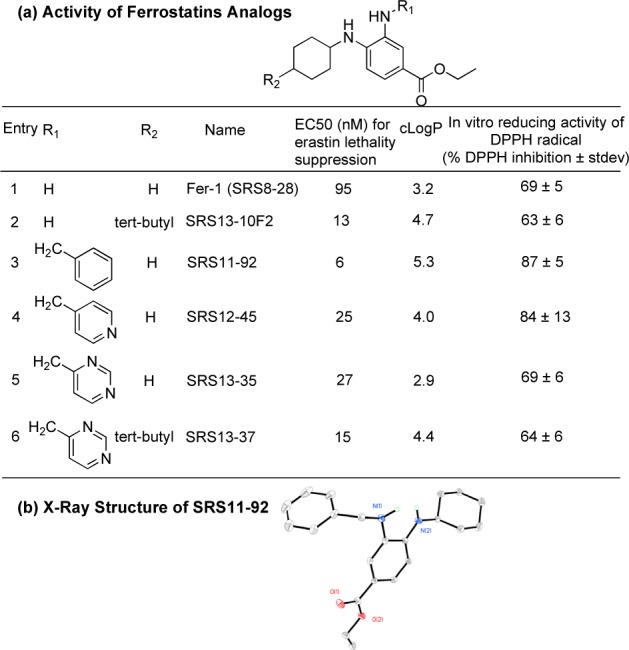
SAR study of Fer-1. (a) EC50, cLogP, and % DPPH
inhibition of selected
potent ferrostatins. DPPH: 2,2-diphenyl-1-picrylhydrazyl radical.
(b) Xray structure of the most potent Fer-1 analogue (SRS11-92).
References
Publication types
MeSH terms
Substances
Grants and funding
- R01 NS066019/NS/NINDS NIH HHS/United States
- 1S10RR025431-01A1/RR/NCRR NIH HHS/United States
- DK34275/DK/NIDDK NIH HHS/United States
- R00 CA166517/CA/NCI NIH HHS/United States
- R01CA097061/CA/NCI NIH HHS/United States
- HD18655/HD/NICHD NIH HHS/United States
- 1K99CA166517-01/CA/NCI NIH HHS/United States
- K99 CA166517/CA/NCI NIH HHS/United States
- R01 DK034275/DK/NIDDK NIH HHS/United States
- R01 CA161061/CA/NCI NIH HHS/United States
- R56 DK034275/DK/NIDDK NIH HHS/United States
- NS066019/NS/NINDS NIH HHS/United States
- P30 HD018655/HD/NICHD NIH HHS/United States
- R01 GM085081/GM/NIGMS NIH HHS/United States
- R01 CA097061/CA/NCI NIH HHS/United States
- R01GM085081/GM/NIGMS NIH HHS/United States
LinkOut - more resources
Full Text Sources
Other Literature Sources
Medical
