


Cancer trends in Lebanon: a review of incidence rates for the period of 2003-2008 and projections until 2018
- PMID: 24593777
- PMCID: PMC3996020
- DOI: 10.1186/1478-7954-12-4
Cancer trends in Lebanon: a review of incidence rates for the period of 2003-2008 and projections until 2018
Abstract
Background: The analysis of cancer incidence trends is essential to health care planning. The aim of this study is to examine variations in cancer incidence rates in Lebanon between 2003 and 2008 and use the observed trends to project cancer incidence until 2018.
Methods: Using secondary data with a cumulative caseload of 45,753 patients from the National Cancer Registry database of the Ministry of Public Health in Lebanon, we estimated sex- and site- specific incidence of cancer for each year of the six-year period between 2003 and 2008. Logarithmic regressions were fitted to estimate the cancer incidence for the forecast years until 2018.
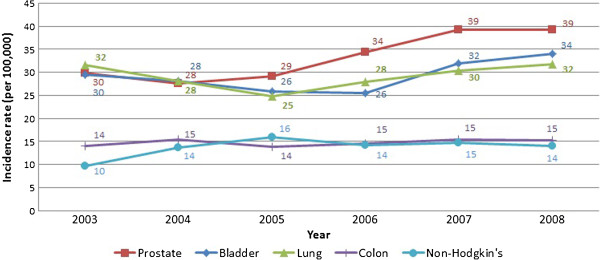
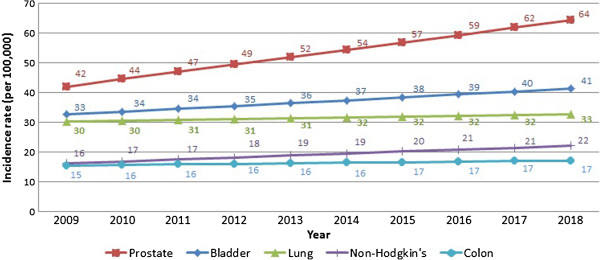
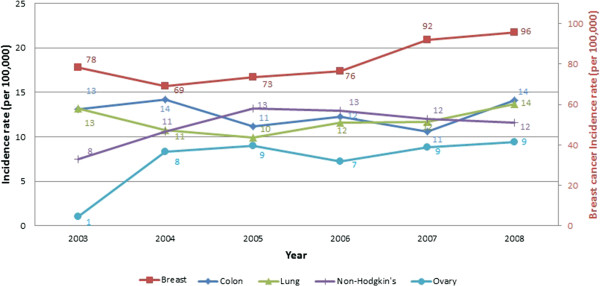
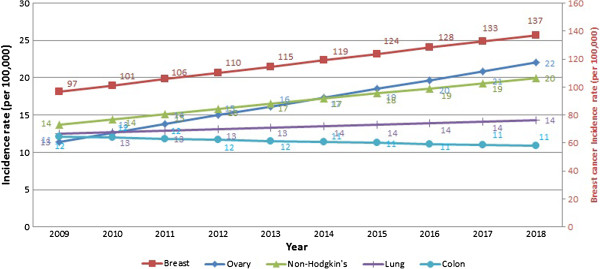
Results: Between 2003 and 2008, males and females presented with an overall 4.5% and 5.4% annual increase, respectively. Significant increases were observed for cancers of the liver and prostate among males, and for cancers of the liver, thyroid, and corpus uteri among females. By 2018, incidence rates were projected to approach 296.0 and 339.5 cases per 100,000 for males and females, respectively. The most common five types of cancer are expected to be prostate, bladder, lung, non-Hodgkin, and colon among males; and breast, ovarian, non-Hodgkin, lung, and colon among females.
Conclusion: The increased availability of screening programs and a growing smoking epidemic, most notably in women, are the most likely explanations behind the increased cancer incidence in the past decade. An aging population and higher proportion of older people suggest further increases in the cancer caseload in the future. The health care system in Lebanon will be required to adapt to the growing burden of cancer in our population.
Figures
References
-
- American Cancer Society. The global economic cost of cancer. http://www.cancer.org/acs/groups/content/@internationalaffairs/documents... Accessed on January 30, 2014.
-
- United Nations - Department of Economic and Social Affairs - Population Division. World population prospects: the 2008 revisions, highlights and advances. s.l.: United Nations; 2011. (Working Paper No.ESA/P/WP.210).
-
- Lebanese Ministry of Public Health. National cancer registry - cancer surveillance. 2012. http://www.moph.gov.lb/Prevention/Surveillance/Pages/Cancer.aspx. Accessed August 1.
LinkOut - more resources
Full Text Sources
Other Literature Sources
Miscellaneous
