


Changes in lumbar disk morphology associated with prolonged sitting assessed by magnetic resonance imaging
- PMID: 24594305
- PMCID: PMC4152382
- DOI: 10.1016/j.pmrj.2014.02.014
Changes in lumbar disk morphology associated with prolonged sitting assessed by magnetic resonance imaging
Abstract
Objective: To determine what if any changes occur to the lumbar disks in the spine after prolonged sitting with and without intermittent breaks during a 4-hour period.
Design: A prospective observational study.
Setting: An academic outpatient clinic.
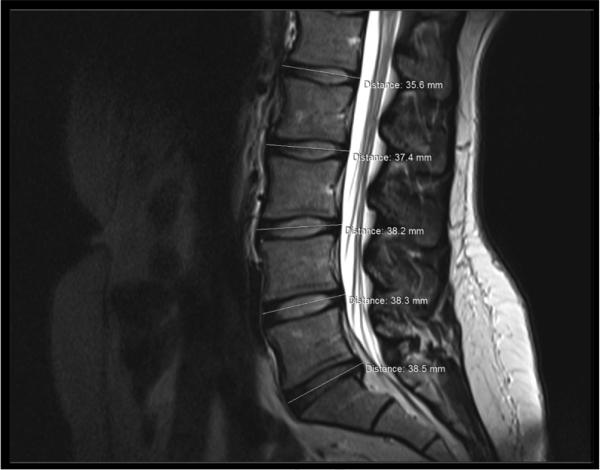
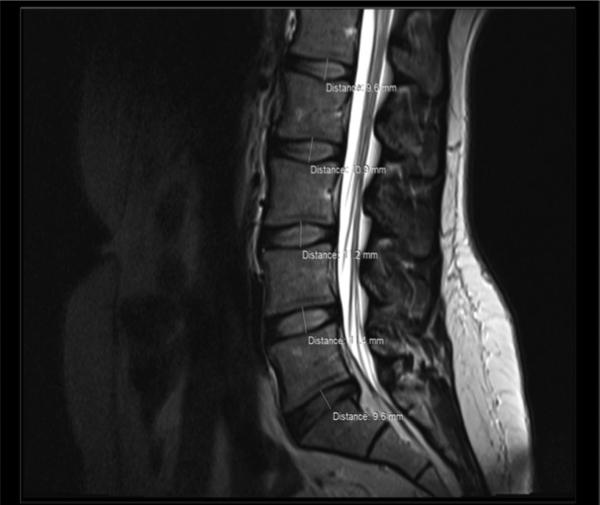
Methods: The measurement of lumbar disk changes was performed with 12 subjects after an analysis of a mid sagittal lumbar magnetic resonance image, which measured lumbar disk height and disk diameter. Scanning and analysis were done over a 2-day period: day 1 at the start of the work day and 4 hours later after continuous sitting; at the start of work day 2 and after four hours after a change in position and stretching protocol every 15 minutes.
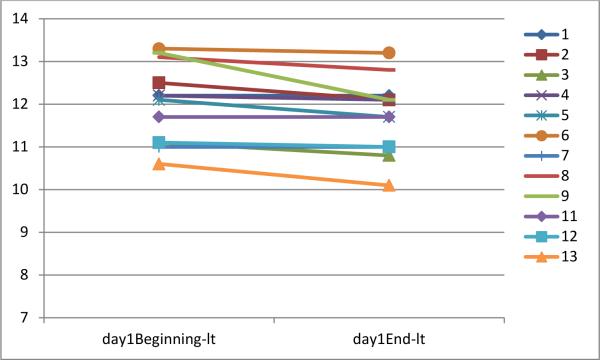
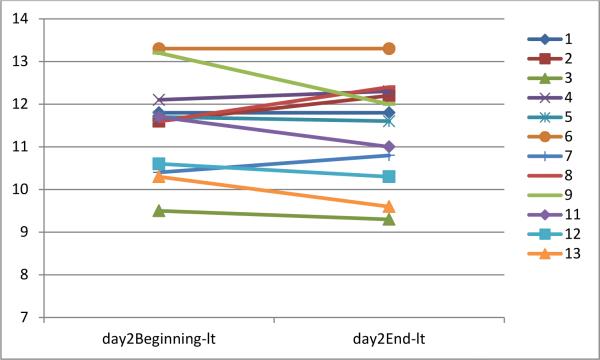
Results: For this study, we first evaluated each level of the lumbar spine for any changes after prolonged sitting for 4 hours over the 2 days. Multiple comparisons bias was eliminated by a Bonferroni correction to limit the overall experiment-wise error rate to .05. The comparison was conducted by using a paired t-test when the normality condition was satisfied and by using a Wilcoxon signed rank test when normality was not satisfied. To test for normality, a Shapiro-Wilk test was used. We found that, for disk height, L4-5 was significantly decreased at the end of the sitting for day 1 but not for day 2. There were no significant height changes for the other lumbar disks. In addition, for disk diameter, there were no significant differences present for any of the disks.
Conclusions: Analysis of the data shows that the greatest change in disk height is at the L4-5 level after prolonged sitting without intermittent breaks. The other levels did not show a significant change in their height. The findings also showed that the L4-5 height changes were not significant with brief positional changes every 15 minutes. Fewer changes in disk height may correlate with an improvement in low back pain and disability.
Copyright © 2014 American Academy of Physical Medicine and Rehabilitation. Published by Elsevier Inc. All rights reserved.
Figures
References
-
- Andersson GBJ. The epidemiology of spinal disorders. In: Frymoyer JW, editor. The adult spine: principles and practice. 2nd ed. Lippincott-Raven; Philadelphia: 1997. pp. 93–141.
-
- Walker BF. The prevalence of low back pain: A systematic review of the literature from 1966 to 1998. J Spinal Disord. 2000;13(3):205–17. - PubMed
-
- Dagenais S, Caro J, Haldeman S. A systematic review of low back pain cost of illness studies in the United States and internationally. Spine J. 2008;8(1):8–20. - PubMed
-
- Nguyen TH, Randolph DC. Nonspecific low back pain and return to work. Am Fam Physician. 2007;76(10):1497–1502. - PubMed
-
- Pai S, Sundaram LJ. Low back pain: An economic assessment in the United States. Orthop Clin North Am. 2004;35:1–5. - PubMed
Publication types
MeSH terms
Grants and funding
LinkOut - more resources
Full Text Sources
Other Literature Sources
